Huang Feihong Memorial Hall
⭐ 3.80
No. 18, Zhongshan Road, Qingcheng District, Qingyuan City, Guangdong Province, China
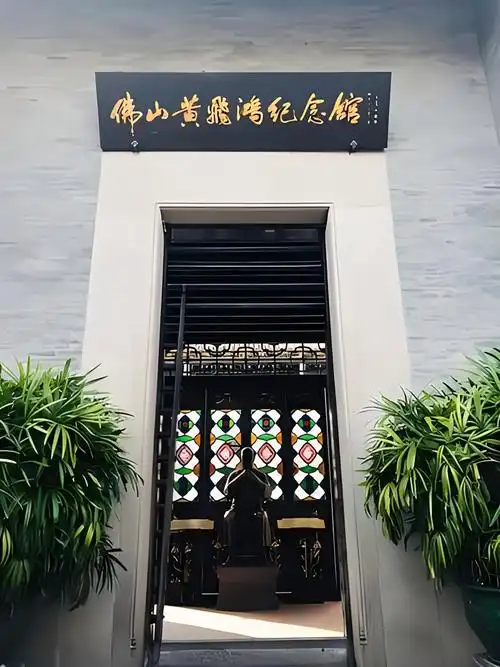 Huang Feihong (1856–1925) emerged during the final decades of the Qing dynasty, an era that, like Victorian Britain or Meiji Japan, witnessed rapid modernization alongside fierce preservation of traditional culture. A master of Hung Ga kung fu and renowned bonesetter, he treated patients ranging from dockworkers to officials in Foshan—a manufacturing hub sometimes called the "Manchester of southern China." His legend, amplified by more than 100 films, made him a global icon of martial virtue. The memorial hall, opened in January 2001, stands as a permanent tribute to this cultural giant.
The memorial occupies a striking Qing-era style building spanning roughly 5,000 square meters, arranged in a traditional two-courtyard layout. Its signature "wok-ear" gables—so named for their resemblance to the curved handles of traditional cooking pans—rise rhythmically along the roofline, a hallmark of Lingnan architecture as distinctive as the stepped gables lining Amsterdam's canal houses. Artisans lavished the structure with the celebrated "four crafts" of the region: intricate wood carvings, brick reliefs, stone sculpture, and molded plasterwork decorate eaves, walls, and doorways, offering visitors a living gallery of Cantonese craftsmanship.
Inside, the museum safeguards over a thousand artifacts: handwritten medical prescriptions, antique weapons, personal effects, period photographs, and what is believed to be the only surviving film footage of the master himself. Adjacent galleries trace nearly seventy years of cinematic adaptations, from 1940s black-and-white classics to contemporary blockbusters, demonstrating how one man's legacy has shaped global perceptions of Chinese martial arts. Together, these collections transform the hall into both a scholarly archive and a popular celebration of Lingnan's fighting heritage.
The true highlight unfolds in the open-air courtyard, where daily performances bring southern martial traditions vividly to life. Costumed troupes present southern lion dancing on towering bamboo poles, demonstrate the explosive power of Hung Ga forms, and wield broadswords and spears to the rhythm of crashing cymbals and booming drums. These scheduled shows—typically at 10:00 AM, 2:15 PM, and 3:30 PM—elevate a quiet museum visit into an immersive cultural spectacle, complementing UNESCO's recognition of Cantonese lion dancing as intangible heritage.
Admission to the memorial is bundled with the Zumiao Temple ticket (around 20 RMB for adults, half price for students), with no separate booking required. Doors open daily from 8:30 AM to 6:00 PM, with last entry at 5:30 PM. The most convenient approach is via the Guangzhou-Foshan Metro Line to Zumiao Station, Exit A—a mere two-minute walk to the entrance. Visitors are strongly advised to confirm performance times upon arrival, as these dynamic shows form the core experience and should not be missed.
For travelers seeking depth beyond the usual sightseeing circuit, pairing the Huang Feihong Memorial with the neighboring Zumiao complex—including its historic Wanfu Stage and the adjacent Ye Wen (Ip Man) Hall—reveals the twin pillars of Foshan's martial legacy within a single half-day visit. Afterward, an evening stroll through the lantern-lit Lingnan Tiandi dining district rewards visitors with regional specialties like double-skin milk pudding and Chen Village rice noodles, completing a journey that unites martial history, architectural beauty, and culinary tradition in one unforgettable day.
Huang Feihong (1856–1925) emerged during the final decades of the Qing dynasty, an era that, like Victorian Britain or Meiji Japan, witnessed rapid modernization alongside fierce preservation of traditional culture. A master of Hung Ga kung fu and renowned bonesetter, he treated patients ranging from dockworkers to officials in Foshan—a manufacturing hub sometimes called the "Manchester of southern China." His legend, amplified by more than 100 films, made him a global icon of martial virtue. The memorial hall, opened in January 2001, stands as a permanent tribute to this cultural giant.
The memorial occupies a striking Qing-era style building spanning roughly 5,000 square meters, arranged in a traditional two-courtyard layout. Its signature "wok-ear" gables—so named for their resemblance to the curved handles of traditional cooking pans—rise rhythmically along the roofline, a hallmark of Lingnan architecture as distinctive as the stepped gables lining Amsterdam's canal houses. Artisans lavished the structure with the celebrated "four crafts" of the region: intricate wood carvings, brick reliefs, stone sculpture, and molded plasterwork decorate eaves, walls, and doorways, offering visitors a living gallery of Cantonese craftsmanship.
Inside, the museum safeguards over a thousand artifacts: handwritten medical prescriptions, antique weapons, personal effects, period photographs, and what is believed to be the only surviving film footage of the master himself. Adjacent galleries trace nearly seventy years of cinematic adaptations, from 1940s black-and-white classics to contemporary blockbusters, demonstrating how one man's legacy has shaped global perceptions of Chinese martial arts. Together, these collections transform the hall into both a scholarly archive and a popular celebration of Lingnan's fighting heritage.
The true highlight unfolds in the open-air courtyard, where daily performances bring southern martial traditions vividly to life. Costumed troupes present southern lion dancing on towering bamboo poles, demonstrate the explosive power of Hung Ga forms, and wield broadswords and spears to the rhythm of crashing cymbals and booming drums. These scheduled shows—typically at 10:00 AM, 2:15 PM, and 3:30 PM—elevate a quiet museum visit into an immersive cultural spectacle, complementing UNESCO's recognition of Cantonese lion dancing as intangible heritage.
Admission to the memorial is bundled with the Zumiao Temple ticket (around 20 RMB for adults, half price for students), with no separate booking required. Doors open daily from 8:30 AM to 6:00 PM, with last entry at 5:30 PM. The most convenient approach is via the Guangzhou-Foshan Metro Line to Zumiao Station, Exit A—a mere two-minute walk to the entrance. Visitors are strongly advised to confirm performance times upon arrival, as these dynamic shows form the core experience and should not be missed.
For travelers seeking depth beyond the usual sightseeing circuit, pairing the Huang Feihong Memorial with the neighboring Zumiao complex—including its historic Wanfu Stage and the adjacent Ye Wen (Ip Man) Hall—reveals the twin pillars of Foshan's martial legacy within a single half-day visit. Afterward, an evening stroll through the lantern-lit Lingnan Tiandi dining district rewards visitors with regional specialties like double-skin milk pudding and Chen Village rice noodles, completing a journey that unites martial history, architectural beauty, and culinary tradition in one unforgettable day.