Qi Culture Museum
⭐ 4.60
Qi Culture Museum, Zhangdian District, Zibo City, Shandong Province, China
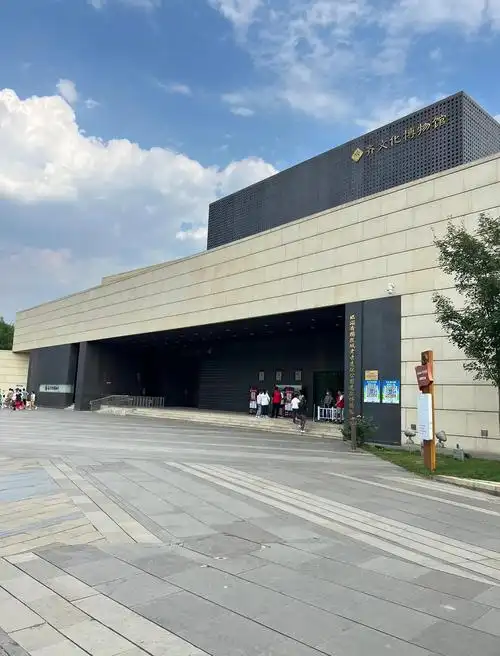 To stand before the Qi Culture Museum is to enter the political stage of an era that produced Sun Tzu's "Art of War," China's oldest military treatise written around the same time Greek city-states were debating democracy in Athens. The Qi State ruled the eastern plains for roughly 800 years, and Linzi was once one of the world's largest cities, likely exceeding contemporary Rome in population during the Warring States period. This museum, designated a national first-class institution, serves as the definitive archive of that remarkable legacy, displaying over 30,000 artifacts across its 35,000 square meters of exhibition space.
The building itself makes a powerful statement, designed in the form of an ancient bronze "ding" tripod, a vessel historically reserved for the most sacred rituals of Chinese statehood. Inaugurated on its present site in 2023 after groundbreaking in 2013, it crowns the very ground where philosophers of the famed Jixia Academy once debated, a place sometimes compared to Plato's Academy in Athens for its role in shaping early philosophical thought. The architecture thus creates a striking dialogue across three thousand years between the container and its cultural contents.
Inside, the narrative unfolds chronologically across eight themed sections tracing Qi from prehistoric origins through its Spring and Autumn heyday to its absorption by the Qin Dynasty in 221 BC. Among the must-see treasures, the Warring States inlaid gold-and-silver bronze animal vessel represents the pinnacle of ancient Chinese metalwork, while a Western Han silver goblet bears witness to surprisingly early cultural exchanges along the Silk Road, predating the Han envoy Zhang Qian's famous westward missions.
What distinguishes this museum from older Chinese institutions is its bold embrace of immersive technology. Naked-eye 3D projections bring artifacts to life without special glasses, holographic installations recreate the famous intellectual debates of the Jixia Academy where Confucianism, Daoism, and Legalism once clashed, and a dedicated music hall performs daily reconstructions of ancient Qi court music. Visitors can also don VR headsets to relive the legendary horse-racing stratagem of Tian Ji, the very parable cited in modern business schools worldwide.
Planning a visit requires minimal effort but some forethought: admission is free, though reservations must be made through the official WeChat account, and the museum closes on Mondays. Foreign visitors presenting a passport skip the booking requirement and may purchase English-language guided tours on-site. Allow between two-and-a-half and three-and-a-half hours to follow the recommended route, which prioritizes the treasure gallery and the Jixia Academy exhibition hall.
Beyond the museum walls, visitors can extend their exploration with a walking tour of the ancient Qi city ruins, a stop at the nearby Football Origin Museum celebrating Linzi as the documented birthplace of organized soccer in the second millennium BC, and views of the historic city walls. Wheelchair loans, family rooms, and charging stations are available, ensuring a comfortable visit for international travelers seeking to understand one of Asia's most enduring cultural heartlands.
To stand before the Qi Culture Museum is to enter the political stage of an era that produced Sun Tzu's "Art of War," China's oldest military treatise written around the same time Greek city-states were debating democracy in Athens. The Qi State ruled the eastern plains for roughly 800 years, and Linzi was once one of the world's largest cities, likely exceeding contemporary Rome in population during the Warring States period. This museum, designated a national first-class institution, serves as the definitive archive of that remarkable legacy, displaying over 30,000 artifacts across its 35,000 square meters of exhibition space.
The building itself makes a powerful statement, designed in the form of an ancient bronze "ding" tripod, a vessel historically reserved for the most sacred rituals of Chinese statehood. Inaugurated on its present site in 2023 after groundbreaking in 2013, it crowns the very ground where philosophers of the famed Jixia Academy once debated, a place sometimes compared to Plato's Academy in Athens for its role in shaping early philosophical thought. The architecture thus creates a striking dialogue across three thousand years between the container and its cultural contents.
Inside, the narrative unfolds chronologically across eight themed sections tracing Qi from prehistoric origins through its Spring and Autumn heyday to its absorption by the Qin Dynasty in 221 BC. Among the must-see treasures, the Warring States inlaid gold-and-silver bronze animal vessel represents the pinnacle of ancient Chinese metalwork, while a Western Han silver goblet bears witness to surprisingly early cultural exchanges along the Silk Road, predating the Han envoy Zhang Qian's famous westward missions.
What distinguishes this museum from older Chinese institutions is its bold embrace of immersive technology. Naked-eye 3D projections bring artifacts to life without special glasses, holographic installations recreate the famous intellectual debates of the Jixia Academy where Confucianism, Daoism, and Legalism once clashed, and a dedicated music hall performs daily reconstructions of ancient Qi court music. Visitors can also don VR headsets to relive the legendary horse-racing stratagem of Tian Ji, the very parable cited in modern business schools worldwide.
Planning a visit requires minimal effort but some forethought: admission is free, though reservations must be made through the official WeChat account, and the museum closes on Mondays. Foreign visitors presenting a passport skip the booking requirement and may purchase English-language guided tours on-site. Allow between two-and-a-half and three-and-a-half hours to follow the recommended route, which prioritizes the treasure gallery and the Jixia Academy exhibition hall.
Beyond the museum walls, visitors can extend their exploration with a walking tour of the ancient Qi city ruins, a stop at the nearby Football Origin Museum celebrating Linzi as the documented birthplace of organized soccer in the second millennium BC, and views of the historic city walls. Wheelchair loans, family rooms, and charging stations are available, ensuring a comfortable visit for international travelers seeking to understand one of Asia's most enduring cultural heartlands.