Zibo Ceramics Museum
⭐ 4.60
No. 13, Renmin Road, Zhangdian District, Zibo City, Shandong Province, China
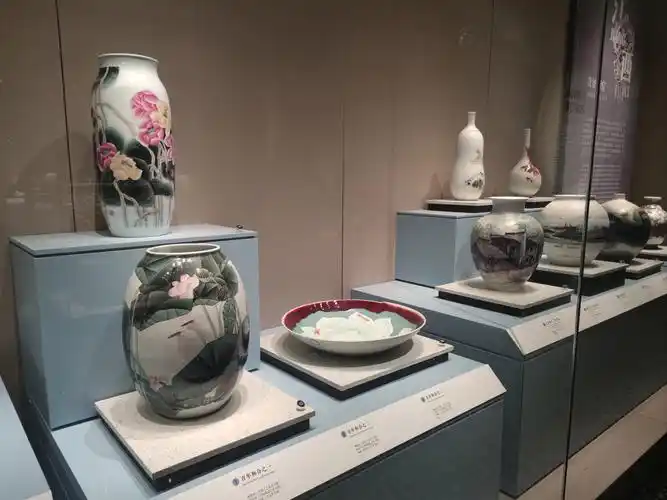 Zibo sits in the heartland of ancient Qi culture and ranks among northern China's most important cradles of ceramic production. While Jingdezhen often claims the title of China's porcelain capital, Zibo quietly boasts more than 10,000 years of pottery traditions, with historic folk kilns such as Zhaili and Cicun once supplying wares across the empire. The museum's 16,000-piece collection traces the full arc from Neolithic pottery to contemporary ceramics, positioning the city as an indispensable research hub for Chinese ceramic civilization—much as Florence tells the story of the Italian Renaissance or Stoke-on-Trent anchors Britain's pottery heritage.
The building itself rewards attention. Designed to evoke the rounded profile of a traditional mantou kiln—the classic Chinese climbing kiln—its stacked, curving volumes echo the silhouettes of ceramic vessels. Spanning 50,000 square meters across five above-ground floors and a basement level, the complex houses 25 galleries and 20,000 square meters of exhibition space. A rooftop observation deck offers panoramic views of Zhangdian district, while the structure's fusion of Qi cultural motifs with contemporary architectural language makes it a public landmark worthy of study in its own right.
Among the prized holdings, the Northern Dynasties celadon lotus vase stands as the only piece of its type in China with a definitively identified kiln source. Alongside it, Western Zhou faience beads, a Yuan-dynasty underglaze-red jar, and ancient Roman glass vessels form a treasure sequence that illuminates East–West exchange through material culture. The exhibition unfolds progressively through ancient Qi civilization, classical ceramics, the celebrated "five-colored glass" tradition, and international dialogue, showcasing both the depth of Chinese craft and the cross-civilizational conversations embedded in every artifact.
Admission is free with valid identification. Visitors may register on-site, though booking ahead through the Alipay mini-program is recommended on weekends and holidays. Opening hours run 9:00 to 17:00 Tuesday through Friday, extending to 21:00 on Saturdays and Sundays from June 2026, with last entry at 16:30. The museum closes on Mondays. Multilingual audio guides and complimentary public tours are offered, and groups of 30 or more can arrange English-language guides with advance notice.
Begin on the first floor's Ancient Qi gallery and ascend through four levels to the International Hall, then descend to the basement VR theater and interactive zones. Glass-blowing demonstrations and intangible-heritage workshops are family favorites, while DIY pottery and porcelain-carving projects let visitors craft personalized souvenirs. Weekday afternoons offer the most relaxed viewing; evening hours suit after-work visits. Pair the experience with the nearby Qi Culture Museum for a deeper immersion into the historic roots of this often-overlooked Shandong city.
Zibo sits in the heartland of ancient Qi culture and ranks among northern China's most important cradles of ceramic production. While Jingdezhen often claims the title of China's porcelain capital, Zibo quietly boasts more than 10,000 years of pottery traditions, with historic folk kilns such as Zhaili and Cicun once supplying wares across the empire. The museum's 16,000-piece collection traces the full arc from Neolithic pottery to contemporary ceramics, positioning the city as an indispensable research hub for Chinese ceramic civilization—much as Florence tells the story of the Italian Renaissance or Stoke-on-Trent anchors Britain's pottery heritage.
The building itself rewards attention. Designed to evoke the rounded profile of a traditional mantou kiln—the classic Chinese climbing kiln—its stacked, curving volumes echo the silhouettes of ceramic vessels. Spanning 50,000 square meters across five above-ground floors and a basement level, the complex houses 25 galleries and 20,000 square meters of exhibition space. A rooftop observation deck offers panoramic views of Zhangdian district, while the structure's fusion of Qi cultural motifs with contemporary architectural language makes it a public landmark worthy of study in its own right.
Among the prized holdings, the Northern Dynasties celadon lotus vase stands as the only piece of its type in China with a definitively identified kiln source. Alongside it, Western Zhou faience beads, a Yuan-dynasty underglaze-red jar, and ancient Roman glass vessels form a treasure sequence that illuminates East–West exchange through material culture. The exhibition unfolds progressively through ancient Qi civilization, classical ceramics, the celebrated "five-colored glass" tradition, and international dialogue, showcasing both the depth of Chinese craft and the cross-civilizational conversations embedded in every artifact.
Admission is free with valid identification. Visitors may register on-site, though booking ahead through the Alipay mini-program is recommended on weekends and holidays. Opening hours run 9:00 to 17:00 Tuesday through Friday, extending to 21:00 on Saturdays and Sundays from June 2026, with last entry at 16:30. The museum closes on Mondays. Multilingual audio guides and complimentary public tours are offered, and groups of 30 or more can arrange English-language guides with advance notice.
Begin on the first floor's Ancient Qi gallery and ascend through four levels to the International Hall, then descend to the basement VR theater and interactive zones. Glass-blowing demonstrations and intangible-heritage workshops are family favorites, while DIY pottery and porcelain-carving projects let visitors craft personalized souvenirs. Weekday afternoons offer the most relaxed viewing; evening hours suit after-work visits. Pair the experience with the nearby Qi Culture Museum for a deeper immersion into the historic roots of this often-overlooked Shandong city.