Jiujiang Yangtze River Bridge
⭐ 3.50
Jiujiang Yangtze River Bridge, Xunyang District, Jiujiang City, Jiangxi Province, China
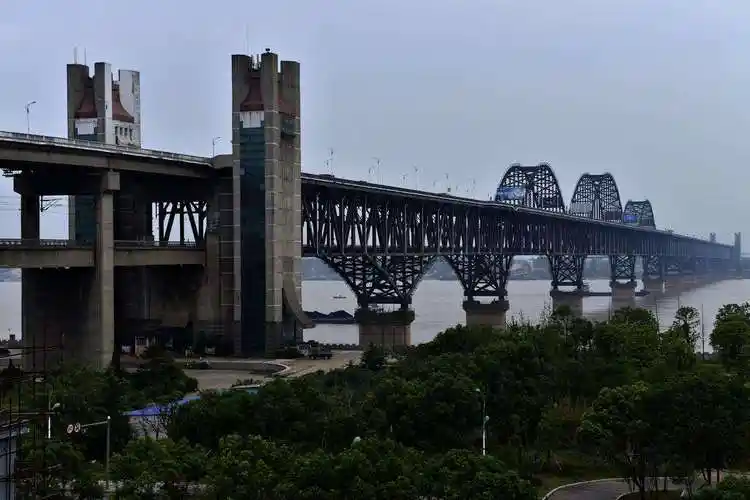 Construction began in 1973 and took roughly 22 years to complete, with the road deck opening in 1993 and the rail deck following in 1995. At the time of its completion, it was the longest and most ambitious combined road-and-rail bridge in China, and its construction required tens of thousands of workers to overcome formidable engineering challenges in deep-water foundations and long-span steel erection. The bridge finally closed the great Yangtze gap that had severed the Beijing-Kowloon Railway, transforming it into a vital artery linking North, East, and South China. In the sweep of bridge-building history, it sits comfortably alongside Europe's great nineteenth-century iron spans, such as Scotland's Forth Bridge.
The bridge employs a striking double-deck, double-track design: the upper level carries a four-lane highway plus pedestrian walkways, while the lower level accommodates twin railway tracks. Its steel-truss superstructure, finished in deep industrial grey, creates bold geometric lines reminiscent of the Eiffel Tower's structural poetry, pure engineering rendered as visual art. Massive piers rise from the riverbed to support the long steel spans, giving the bridge its distinctive dragon-like silhouette as it snakes across the water. Whether bathed in golden sunrise light or silhouetted against stormy skies, the structure never fails to impress.
As a defining landmark in modern Chinese bridge-building, the Jiujiang Yangtze River Bridge embodies the nation's remarkable journey from engineering follower to global leader in infrastructure. Beyond its transport function, it stands as a monument to perseverance, technical ambition, and collective will, a steel-and-concrete tribute to the spirit that has reshaped China's landscape over the past half-century. Watching a freight train thunder across while cars stream overhead offers an almost cinematic experience of contemporary China in motion, a scene echoing the transformative railway age that once reshaped Europe and America.
The bridge is not a ticketed attraction and cannot be walked on, but it is freely visible from surrounding public spaces. The best viewing point on the south, Jiujiang, side is the Jiujiang Yangtze River Bridge Park and adjacent riverside promenade, where photographers can capture the steel truss against the sky and wait for the dramatic moment when a train crosses. The north side, in Huangmei, also features a quieter, more spacious viewing platform ideal for wide-angle compositions. Late afternoon light, between 4:30 and 6:30 PM, is particularly magical, especially when sunset, vehicles, and trains can all be framed together.
For travelers with limited time, the bridge pairs beautifully with nearby cultural sites including Xunyang Tower, Suojiang Tower, and the Pavilion of the Pipa, allowing a satisfying half-day itinerary tracing the literary and military heritage of the Yangtze at Jiujiang. A short river cruise from Xunyang Wharf, lasting 30 to 60 minutes, offers a rare perspective from mid-stream, where the full scale of the bridge reveals itself and you can capture the extraordinary sight of cargo ships, automobiles, and trains sharing the same frame. Visitors should stay behind safety railings, watch for slippery surfaces near the water, and prepare for strong summer heat and biting winter winds along the open riverbank.
Construction began in 1973 and took roughly 22 years to complete, with the road deck opening in 1993 and the rail deck following in 1995. At the time of its completion, it was the longest and most ambitious combined road-and-rail bridge in China, and its construction required tens of thousands of workers to overcome formidable engineering challenges in deep-water foundations and long-span steel erection. The bridge finally closed the great Yangtze gap that had severed the Beijing-Kowloon Railway, transforming it into a vital artery linking North, East, and South China. In the sweep of bridge-building history, it sits comfortably alongside Europe's great nineteenth-century iron spans, such as Scotland's Forth Bridge.
The bridge employs a striking double-deck, double-track design: the upper level carries a four-lane highway plus pedestrian walkways, while the lower level accommodates twin railway tracks. Its steel-truss superstructure, finished in deep industrial grey, creates bold geometric lines reminiscent of the Eiffel Tower's structural poetry, pure engineering rendered as visual art. Massive piers rise from the riverbed to support the long steel spans, giving the bridge its distinctive dragon-like silhouette as it snakes across the water. Whether bathed in golden sunrise light or silhouetted against stormy skies, the structure never fails to impress.
As a defining landmark in modern Chinese bridge-building, the Jiujiang Yangtze River Bridge embodies the nation's remarkable journey from engineering follower to global leader in infrastructure. Beyond its transport function, it stands as a monument to perseverance, technical ambition, and collective will, a steel-and-concrete tribute to the spirit that has reshaped China's landscape over the past half-century. Watching a freight train thunder across while cars stream overhead offers an almost cinematic experience of contemporary China in motion, a scene echoing the transformative railway age that once reshaped Europe and America.
The bridge is not a ticketed attraction and cannot be walked on, but it is freely visible from surrounding public spaces. The best viewing point on the south, Jiujiang, side is the Jiujiang Yangtze River Bridge Park and adjacent riverside promenade, where photographers can capture the steel truss against the sky and wait for the dramatic moment when a train crosses. The north side, in Huangmei, also features a quieter, more spacious viewing platform ideal for wide-angle compositions. Late afternoon light, between 4:30 and 6:30 PM, is particularly magical, especially when sunset, vehicles, and trains can all be framed together.
For travelers with limited time, the bridge pairs beautifully with nearby cultural sites including Xunyang Tower, Suojiang Tower, and the Pavilion of the Pipa, allowing a satisfying half-day itinerary tracing the literary and military heritage of the Yangtze at Jiujiang. A short river cruise from Xunyang Wharf, lasting 30 to 60 minutes, offers a rare perspective from mid-stream, where the full scale of the bridge reveals itself and you can capture the extraordinary sight of cargo ships, automobiles, and trains sharing the same frame. Visitors should stay behind safety railings, watch for slippery surfaces near the water, and prepare for strong summer heat and biting winter winds along the open riverbank.