Dongjiao Coconut Forest
⭐ 4.20
Dongjiao Town, Meilan District, Haikou City, Hainan Province, China
 **Historical Roots of the "Coconut County"**
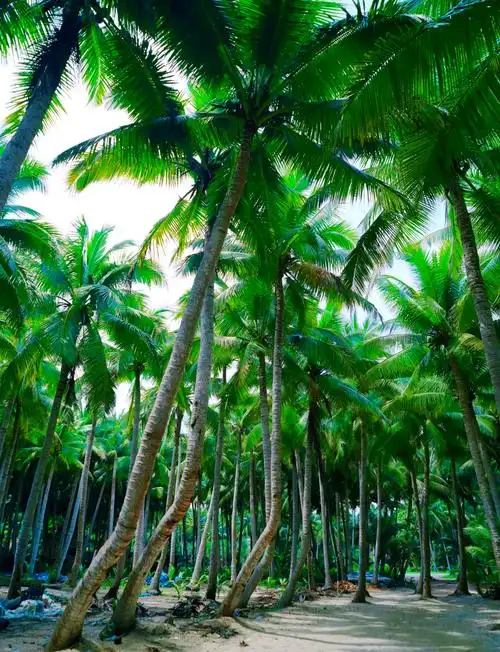
Wenchang has been known as China's "Coconut County" since at least the Ming dynasty, when coastal villagers began planting palms as both a windbreak and a livelihood. The groves you see today are not a modern plantation but a multi-generational living landscape—roughly five hundred thousand trees cultivated by fishing families over several centuries. Much like the olive terraces of Tuscany or the cork forests of Portugal's Alentejo, the palms are simultaneously an ecosystem and an inherited cultural economy, supplying coconuts for food, oil, and trade. Standing beneath the canopy, one looks up at an agricultural heritage that predates almost every beach resort in Southeast Asia.
**A Landscape of Layered Greens and Blues**
The visual drama of Dongjiao lies in its vertical layering: silvery beach in the foreground, dense coconut shade in the middle, and the South China Sea shimmering beyond. Morning and late-afternoon light turn the fringed leaves into lacework against a turquoise horizon, conditions that draw photographers much as Tuscany's cypress avenues attract artists. Scattered through the grove are modest fishing hamlets of stone-and-coral houses, slung hammocks, and wooden pavilions—everything deliberately unpolished, in deliberate contrast to the glass-and-steel resort strips further south on the island.
**Culture and Daily Life**
The local economy still revolves around coconuts and the sea. Visitors can climb (or watch villagers climb) the towering palms, sample young green coconuts picked that morning, and tuck into coconut chicken soup or coconut rice in a family courtyard. The neighbouring Qinglan Harbour remains a working fishing port where fresh crab, grouper, and shellfish are sold straight off the boats—comparable in spirit to a Provençal morning market, but with tropical produce. There are no rides, no shows, no scripted experiences; the entire "show" is ordinary village life unfolding under a palm-frond ceiling.
**Practicalities for the Visitor**
The grove is open daily, roughly 8 a.m. to 6 p.m., entirely free of charge, and there are several free or low-cost parking areas along the coastal road. From Haikou, take an intercity coach to Wenchang's Qinglan Harbour (about 90 minutes), then a short motorcycle taxi or ride-hail to the coast; self-drivers can reach it in roughly an hour via the Hainan Island Coastal Tourism Road. Bring sunscreen, insect repellent, sturdy sandals, and a light rain jacket—facilities are minimal and shade is abundant. Ignore any tout claiming to sell entry tickets; legitimate access is simply walk-in.
**Why It Belongs on Your Itinerary**
For travellers weary of fenced resort compounds, Dongjiao offers something rarer than luxury: freedom. You can spend an entire afternoon swinging in a hammock with a coconut in hand, wade out at low tide to collect shells, or photograph locals harvesting the morning's crop. It pairs effortlessly with nearby Qinglan Harbour, the heritage streets of old Wencheng town, and the panoramic heights of Tonggu Ridge for a relaxed half- or full-day circuit. In a region where tourism is rapidly homogenising, this unassuming stretch of palm and sand remains Hainan at its most authentic.
**Historical Roots of the "Coconut County"**
Wenchang has been known as China's "Coconut County" since at least the Ming dynasty, when coastal villagers began planting palms as both a windbreak and a livelihood. The groves you see today are not a modern plantation but a multi-generational living landscape—roughly five hundred thousand trees cultivated by fishing families over several centuries. Much like the olive terraces of Tuscany or the cork forests of Portugal's Alentejo, the palms are simultaneously an ecosystem and an inherited cultural economy, supplying coconuts for food, oil, and trade. Standing beneath the canopy, one looks up at an agricultural heritage that predates almost every beach resort in Southeast Asia.
**A Landscape of Layered Greens and Blues**
The visual drama of Dongjiao lies in its vertical layering: silvery beach in the foreground, dense coconut shade in the middle, and the South China Sea shimmering beyond. Morning and late-afternoon light turn the fringed leaves into lacework against a turquoise horizon, conditions that draw photographers much as Tuscany's cypress avenues attract artists. Scattered through the grove are modest fishing hamlets of stone-and-coral houses, slung hammocks, and wooden pavilions—everything deliberately unpolished, in deliberate contrast to the glass-and-steel resort strips further south on the island.
**Culture and Daily Life**
The local economy still revolves around coconuts and the sea. Visitors can climb (or watch villagers climb) the towering palms, sample young green coconuts picked that morning, and tuck into coconut chicken soup or coconut rice in a family courtyard. The neighbouring Qinglan Harbour remains a working fishing port where fresh crab, grouper, and shellfish are sold straight off the boats—comparable in spirit to a Provençal morning market, but with tropical produce. There are no rides, no shows, no scripted experiences; the entire "show" is ordinary village life unfolding under a palm-frond ceiling.
**Practicalities for the Visitor**
The grove is open daily, roughly 8 a.m. to 6 p.m., entirely free of charge, and there are several free or low-cost parking areas along the coastal road. From Haikou, take an intercity coach to Wenchang's Qinglan Harbour (about 90 minutes), then a short motorcycle taxi or ride-hail to the coast; self-drivers can reach it in roughly an hour via the Hainan Island Coastal Tourism Road. Bring sunscreen, insect repellent, sturdy sandals, and a light rain jacket—facilities are minimal and shade is abundant. Ignore any tout claiming to sell entry tickets; legitimate access is simply walk-in.
**Why It Belongs on Your Itinerary**
For travellers weary of fenced resort compounds, Dongjiao offers something rarer than luxury: freedom. You can spend an entire afternoon swinging in a hammock with a coconut in hand, wade out at low tide to collect shells, or photograph locals harvesting the morning's crop. It pairs effortlessly with nearby Qinglan Harbour, the heritage streets of old Wencheng town, and the panoramic heights of Tonggu Ridge for a relaxed half- or full-day circuit. In a region where tourism is rapidly homogenising, this unassuming stretch of palm and sand remains Hainan at its most authentic.