Pipa Pavilion
⭐ 3.80
Pipa Pavilion, Xunyang District, Jiujiang City, Jiangxi Province, China
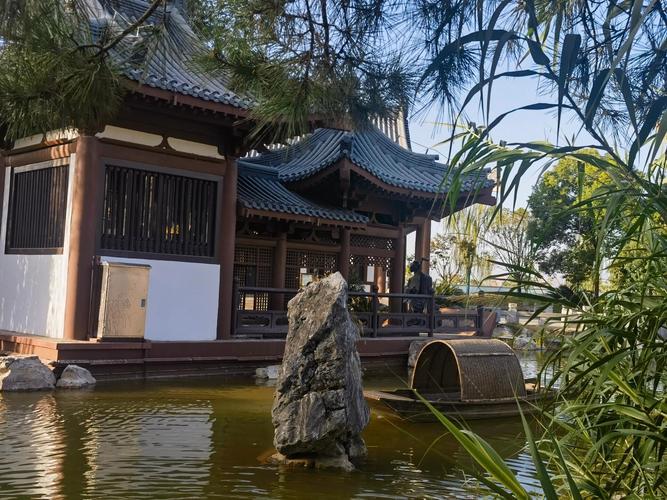 Stand where Bai Juyi stood in 816 AD, when this stretch of the Yangtze—then called Xunyang—inspired what many scholars consider the supreme masterpiece of Chinese narrative poetry. While Europe was still in its early medieval era under Charlemagne's successors, Tang China was experiencing a golden age of cosmopolitan culture. Bai Juyi, demoted to a minor provincial post after clashing with powerful ministers, encountered a woman whose music embodied the sorrows of her fallen fortunes. The resulting poem, "Pipa Xing," was carved so deeply into China's literary consciousness that a shrine was raised here by the Song Dynasty and rebuilt repeatedly thereafter.
The 1988 reconstruction captures Tang architectural grandeur across a 3,300-square-meter garden compound, its sweeping eaves and intricate dougong bracket system—the same ingenious cantilever technique found in Japanese pagodas—creating dramatic shadowplay. The main pavilion rises three tiers to nearly 20 meters, with viewing platforms offering panoramic Yangtze vistas. A sinuous covered corridor displays 56 stone steles inscribed with verses composed about this very spot over twelve centuries, alongside Mao Zedong's bold cursive rendering of the original work in his unmistakable handwriting.
The contemporary star attraction is the "Stringless Pipa" sculpture—a hollow minimalist form that plays with the Chinese aesthetic of negative space. When sunlight passes through its openings, light itself becomes the strings; when rain falls, droplets create the resonance described in the poem's famous opening: "Like great strings, crashing like sudden rain." Interactive costumed "Bai Juyi" characters test visitors' recitation skills, while the nightly "Xunmeng" light show projects animated ink-wash visuals across the pavilion's walls, transforming ancient verses into immersive modern theater.
Located at 1 Binjiang East Road, just east of the Jiujiang Yangtze River Bridge, the pavilion is easily reached by taxi or local bus. Adult admission is 30 yuan, with half-price student tickets and free entry for Jiujiang residents, seniors over 65, military personnel, and disabled visitors. Remarkably, anyone who can recite the entire poem from memory is admitted free—a charming incentive that draws competitive literature students. Mobile payment is accepted throughout. The surrounding riverside gardens and Yangtze promenade are open to the public at no charge.
Plan to arrive between 5:00 and 7:30 PM to witness the Yangtze's golden-hour transformation, then stay for the evening illumination when the pavilion seems to float against the dark river. Allow 60-90 minutes for the complete experience. Pair your visit with neighboring Suojiang Tower and Xunyang Tower—both referenced in classical literature—for a half-day "Yangtze Literary Heritage" walking route. Hanfu rental shops nearby cater to photographers seeking Tang Dynasty aesthetic portraits, while rainy days offer unexpectedly poetic rewards, as the Stringless Pipa sculpture becomes nature's own instrument echoing the poem's opening lines.
Stand where Bai Juyi stood in 816 AD, when this stretch of the Yangtze—then called Xunyang—inspired what many scholars consider the supreme masterpiece of Chinese narrative poetry. While Europe was still in its early medieval era under Charlemagne's successors, Tang China was experiencing a golden age of cosmopolitan culture. Bai Juyi, demoted to a minor provincial post after clashing with powerful ministers, encountered a woman whose music embodied the sorrows of her fallen fortunes. The resulting poem, "Pipa Xing," was carved so deeply into China's literary consciousness that a shrine was raised here by the Song Dynasty and rebuilt repeatedly thereafter.
The 1988 reconstruction captures Tang architectural grandeur across a 3,300-square-meter garden compound, its sweeping eaves and intricate dougong bracket system—the same ingenious cantilever technique found in Japanese pagodas—creating dramatic shadowplay. The main pavilion rises three tiers to nearly 20 meters, with viewing platforms offering panoramic Yangtze vistas. A sinuous covered corridor displays 56 stone steles inscribed with verses composed about this very spot over twelve centuries, alongside Mao Zedong's bold cursive rendering of the original work in his unmistakable handwriting.
The contemporary star attraction is the "Stringless Pipa" sculpture—a hollow minimalist form that plays with the Chinese aesthetic of negative space. When sunlight passes through its openings, light itself becomes the strings; when rain falls, droplets create the resonance described in the poem's famous opening: "Like great strings, crashing like sudden rain." Interactive costumed "Bai Juyi" characters test visitors' recitation skills, while the nightly "Xunmeng" light show projects animated ink-wash visuals across the pavilion's walls, transforming ancient verses into immersive modern theater.
Located at 1 Binjiang East Road, just east of the Jiujiang Yangtze River Bridge, the pavilion is easily reached by taxi or local bus. Adult admission is 30 yuan, with half-price student tickets and free entry for Jiujiang residents, seniors over 65, military personnel, and disabled visitors. Remarkably, anyone who can recite the entire poem from memory is admitted free—a charming incentive that draws competitive literature students. Mobile payment is accepted throughout. The surrounding riverside gardens and Yangtze promenade are open to the public at no charge.
Plan to arrive between 5:00 and 7:30 PM to witness the Yangtze's golden-hour transformation, then stay for the evening illumination when the pavilion seems to float against the dark river. Allow 60-90 minutes for the complete experience. Pair your visit with neighboring Suojiang Tower and Xunyang Tower—both referenced in classical literature—for a half-day "Yangtze Literary Heritage" walking route. Hanfu rental shops nearby cater to photographers seeking Tang Dynasty aesthetic portraits, while rainy days offer unexpectedly poetic rewards, as the Stringless Pipa sculpture becomes nature's own instrument echoing the poem's opening lines.