Qilou Old Street
⭐ 4.50
Qilou Old Street, Meilan District, Haikou City, Hainan Province, China
 **A Legacy of the South Seas Diaspora**
Qilou Old Street traces its roots to 1849, when returning "Southeast Asian" (下南洋) migrants brought back colonial-era building techniques from Singapore, Penang, and Java. The architecture echoes the shophouse traditions of those port cities—familiar to anyone who has strolled through Malacca or Singapore's Emerald Hill—while remaining uniquely Hainanese in character. At its heart lies the ancient Sipailou crossroads, a site of urban significance since the Southern Song dynasty over 800 years ago, making this one of China's most layered urban landscapes.
**Architecture: Where Baroque Meets the Tropics**
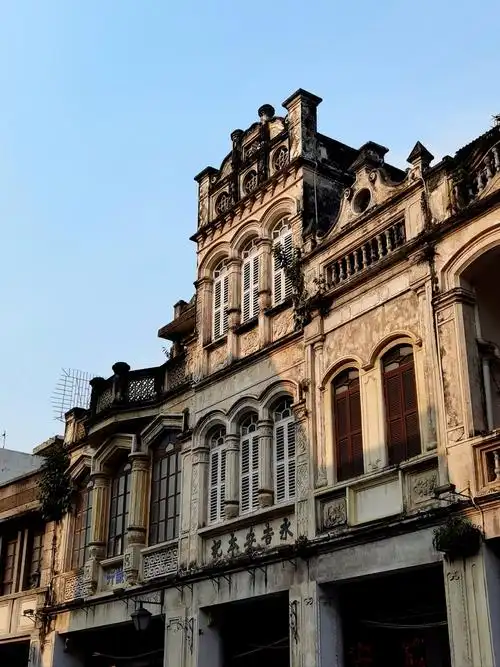
The signature "qilou" form features a continuous covered walkway at street level, supported by columns and sheltered by upper-floor overhangs—essentially a tropical cousin of the arcaded shopping streets of Bologna, Turin, or central Lisbon. Exuberant Baroque-style carved pediments and Greco-Roman colonnades sit alongside Chinese grey-plaster reliefs of phoenixes, peonies, and auspicious beasts, reflecting the hybrid aesthetic of overseas Chinese who yearned for homeland motifs. The Zhongshan Road section is especially photogenic, where raking afternoon light turns the colonnades into corridors of golden arches.
**A Stage for Living Hainanese Culture**
More than a static heritage zone, the district remains a working neighborhood where elderly residents sip "lǎbà chá" (Hainanese dad-tea) in tiled teahouses, just as they have for generations. The Haikou Intangible Cultural Heritage Museum showcases coconut-shell carving and Li brocade weaving, while occasional Qiong opera performances animate the street corners. Locals still shop, cook, and gather beneath the colonnades—earning the area its reputation as a "living street museum."
**Planning Your Visit**
The pedestrian area is open around the clock with no entry fee; most indoor venues (including the heritage museum) operate roughly 9:00–17:30. The main entrance faces the iconic Haikou Clock Tower in Longhua District. Plan to arrive after 16:30 to escape the tropical heat and afternoon rains while catching the golden hour and illuminated facades, or come before 8:00 for a quiet glimpse of authentic local life.
**Where to Eat and What to Do**
Set up camp at Shuixiangkou, the foodie heart of the district, for spicy pork-soup rice, Hainan rice noodles, the refreshing coconut-and-herbal dessert qingbuliang, and garlicky spare ribs. Teahouses serving the classic "one pot, two pieces" ritual (zhègū tea, pineapple buns, and qingbuliang) offer the most genuine social experience. Wear flat shoes—the uneven stone paving punishes high heels—but take advantage of the arcaded walkways during rainy weather. Multilingual visitor assistance, mobile payment, and most international cards are accepted throughout.
**Why It's Worth the Detour**
Few Chinese cities offer such an immersive fusion of Southeast Asian diaspora history, Mediterranean-inspired arcade architecture, and untouristed local street life. Qilou Old Street rewards slow wandering: sip, photograph, snack, and let Haikou's tropical port-city past unfold around you.
**A Legacy of the South Seas Diaspora**
Qilou Old Street traces its roots to 1849, when returning "Southeast Asian" (下南洋) migrants brought back colonial-era building techniques from Singapore, Penang, and Java. The architecture echoes the shophouse traditions of those port cities—familiar to anyone who has strolled through Malacca or Singapore's Emerald Hill—while remaining uniquely Hainanese in character. At its heart lies the ancient Sipailou crossroads, a site of urban significance since the Southern Song dynasty over 800 years ago, making this one of China's most layered urban landscapes.
**Architecture: Where Baroque Meets the Tropics**
The signature "qilou" form features a continuous covered walkway at street level, supported by columns and sheltered by upper-floor overhangs—essentially a tropical cousin of the arcaded shopping streets of Bologna, Turin, or central Lisbon. Exuberant Baroque-style carved pediments and Greco-Roman colonnades sit alongside Chinese grey-plaster reliefs of phoenixes, peonies, and auspicious beasts, reflecting the hybrid aesthetic of overseas Chinese who yearned for homeland motifs. The Zhongshan Road section is especially photogenic, where raking afternoon light turns the colonnades into corridors of golden arches.
**A Stage for Living Hainanese Culture**
More than a static heritage zone, the district remains a working neighborhood where elderly residents sip "lǎbà chá" (Hainanese dad-tea) in tiled teahouses, just as they have for generations. The Haikou Intangible Cultural Heritage Museum showcases coconut-shell carving and Li brocade weaving, while occasional Qiong opera performances animate the street corners. Locals still shop, cook, and gather beneath the colonnades—earning the area its reputation as a "living street museum."
**Planning Your Visit**
The pedestrian area is open around the clock with no entry fee; most indoor venues (including the heritage museum) operate roughly 9:00–17:30. The main entrance faces the iconic Haikou Clock Tower in Longhua District. Plan to arrive after 16:30 to escape the tropical heat and afternoon rains while catching the golden hour and illuminated facades, or come before 8:00 for a quiet glimpse of authentic local life.
**Where to Eat and What to Do**
Set up camp at Shuixiangkou, the foodie heart of the district, for spicy pork-soup rice, Hainan rice noodles, the refreshing coconut-and-herbal dessert qingbuliang, and garlicky spare ribs. Teahouses serving the classic "one pot, two pieces" ritual (zhègū tea, pineapple buns, and qingbuliang) offer the most genuine social experience. Wear flat shoes—the uneven stone paving punishes high heels—but take advantage of the arcaded walkways during rainy weather. Multilingual visitor assistance, mobile payment, and most international cards are accepted throughout.
**Why It's Worth the Detour**
Few Chinese cities offer such an immersive fusion of Southeast Asian diaspora history, Mediterranean-inspired arcade architecture, and untouristed local street life. Qilou Old Street rewards slow wandering: sip, photograph, snack, and let Haikou's tropical port-city past unfold around you.