Taibai Tower
⭐ 3.20
Taibai Tower, Taibai Tower Street, Rencheng District, Jining, Shandong Province, China
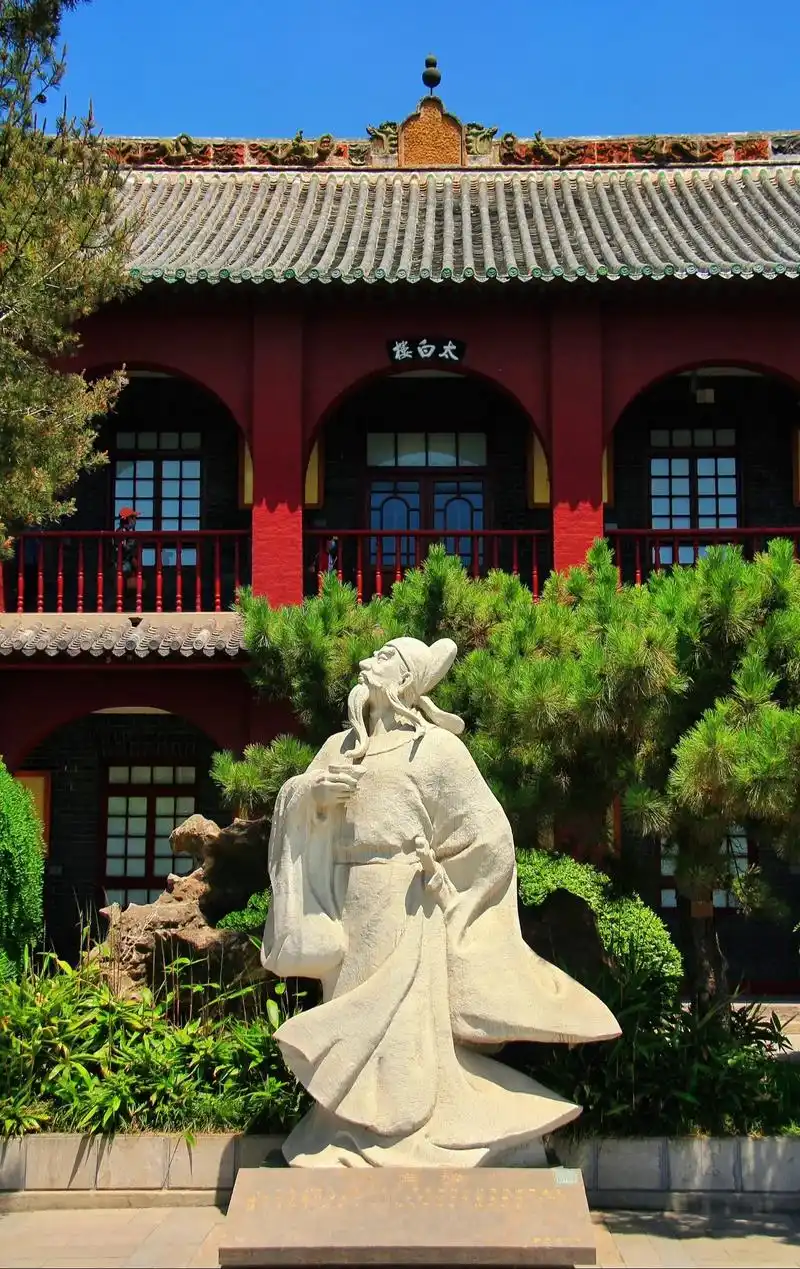 Taibai Tower traces its origins to 736 AD, when it began life as the Entertainer's Wine House, a humble tavern in what was then Rencheng Prefecture—coinciding roughly with the reign of England's King Offa and the early Carolingian Renaissance in Europe. Its fame derives from the long sojourns of Li Bai (701–762), whose romantic, wine-soaked poetry earned him a reputation in Asia comparable to that of Byron or Pushkin in the West. By 1107 it had been officially renamed "Taibai Wine Tower," and in 1391 the Ming-dynasty authorities rebuilt it atop the old city wall, bestowing the name it still bears today.
Architecturally, the 15-to-20-meter structure is a textbook example of the *xieshan* hip-and-gable style favored in imperial China—a silhouette perhaps less foreign to European eyes than first appears, recalling the timber-framed guild halls of medieval Lübeck or the half-timbered civic towers of Germany's Romantic Road. Sitting on a broad brick plinth that was once defensive rampart, the building spreads across more than 4,000 square meters of gray-brick walls, vermilion balustrades, and sweeping tiled eaves. Climbing the wooden staircase to the upper gallery revives the classical vista known as "Taibai's Evening Gaze," with the Grand Canal snaking southward toward the horizon.
The inner courtyard functions as an open-air museum, studded with more than sixty inscribed stone tablets. The undisputed masterpiece is a boldly carved "Magnificent View" (*zhuang guan*) plaque—possibly brushed by Li Bai himself in his famously unrestrained cursive style, much as Michelangelo's late sonnets hint at his sculptor's hand. Equally treasured are the "Three Worthies" portrait stones depicting Li Bai alongside fellow Tang poets Du Fu and He Zhizhang, the Qianlong Emperor's 18th-century imperial colophon, and a Ming-dynasty stone panel of *Qing Ping Melody* rendered in wild cursive script, a setting that will resonate with anyone who has lingered over illuminated manuscripts in a European cathedral library.
Admission is free with passport registration, though the museum closes on Mondays (except national holidays). Opening hours run 9:00 to 18:00 from May through September and until 17:30 in the quieter months. City buses 1, 2, 8, 16, and 19 stop directly at "Taibai Tower." As the entire complex is a protected heritage site, visitors should refrain from touching the stones and switch off flash photography, while modest dress and quiet voices are appreciated.
Plan on 45 minutes to an hour and a half. The most flattering light falls after 4 p.m., when the western sun gilds the flying eaves and the canal below turns molten—an ideal moment for photographers, and for travelers in traditional hanfu attire seeking a quintessentially classical backdrop. Afterward, stroll the canal-side promenade across the bridge to Xiushui City, where local specialties such as braised pork over rice and crispy stuffed flatbreads reward an appetite sharpened by poetry and history.
Taibai Tower traces its origins to 736 AD, when it began life as the Entertainer's Wine House, a humble tavern in what was then Rencheng Prefecture—coinciding roughly with the reign of England's King Offa and the early Carolingian Renaissance in Europe. Its fame derives from the long sojourns of Li Bai (701–762), whose romantic, wine-soaked poetry earned him a reputation in Asia comparable to that of Byron or Pushkin in the West. By 1107 it had been officially renamed "Taibai Wine Tower," and in 1391 the Ming-dynasty authorities rebuilt it atop the old city wall, bestowing the name it still bears today.
Architecturally, the 15-to-20-meter structure is a textbook example of the *xieshan* hip-and-gable style favored in imperial China—a silhouette perhaps less foreign to European eyes than first appears, recalling the timber-framed guild halls of medieval Lübeck or the half-timbered civic towers of Germany's Romantic Road. Sitting on a broad brick plinth that was once defensive rampart, the building spreads across more than 4,000 square meters of gray-brick walls, vermilion balustrades, and sweeping tiled eaves. Climbing the wooden staircase to the upper gallery revives the classical vista known as "Taibai's Evening Gaze," with the Grand Canal snaking southward toward the horizon.
The inner courtyard functions as an open-air museum, studded with more than sixty inscribed stone tablets. The undisputed masterpiece is a boldly carved "Magnificent View" (*zhuang guan*) plaque—possibly brushed by Li Bai himself in his famously unrestrained cursive style, much as Michelangelo's late sonnets hint at his sculptor's hand. Equally treasured are the "Three Worthies" portrait stones depicting Li Bai alongside fellow Tang poets Du Fu and He Zhizhang, the Qianlong Emperor's 18th-century imperial colophon, and a Ming-dynasty stone panel of *Qing Ping Melody* rendered in wild cursive script, a setting that will resonate with anyone who has lingered over illuminated manuscripts in a European cathedral library.
Admission is free with passport registration, though the museum closes on Mondays (except national holidays). Opening hours run 9:00 to 18:00 from May through September and until 17:30 in the quieter months. City buses 1, 2, 8, 16, and 19 stop directly at "Taibai Tower." As the entire complex is a protected heritage site, visitors should refrain from touching the stones and switch off flash photography, while modest dress and quiet voices are appreciated.
Plan on 45 minutes to an hour and a half. The most flattering light falls after 4 p.m., when the western sun gilds the flying eaves and the canal below turns molten—an ideal moment for photographers, and for travelers in traditional hanfu attire seeking a quintessentially classical backdrop. Afterward, stroll the canal-side promenade across the bridge to Xiushui City, where local specialties such as braised pork over rice and crispy stuffed flatbreads reward an appetite sharpened by poetry and history.