Cemetery of Confucius
⭐ 4.60
Konglin, Qufu City, Jining, Shandong Province, China
 **A Living Necropolis Spanning Two and a Half Millennia**
The Cemetery of Confucius has been receiving burials since 479 BCE, the year the Master passed away in nearby Lu. While Rome's Catacombs were abandoned after a few centuries and even Père Lachaise only began in 1804, this single clan graveyard has welcomed descendants without interruption for twenty-five centuries. Confucian disciples first camped here, planting trees in mourning, and from the Han dynasty onward every notable branch of the Kong family was laid to rest. Designated a national treasure in 1961 and a World Heritage Site in 1994 as part of the "Three Confucian Sites," it remains a working cemetery today—one of the most remarkable cultural survival stories anywhere on earth.
**A Carefully Ordered Landscape**
A 7-kilometre wall encloses the grounds, and visitors enter through the Second Forest Gate, passing beneath the "Eternal Spring" memorial arch and crossing a stone bridge over the Zhu River. The axis leads straight to Confucius' tomb, a low "axe-head" mound fronted by a Ming-dynasty Spirit Hall and a yellow-jade stele bearing the title "Great Accomplished, Most Sage, Wenxuan King." Flanking it lie the tombs of his son Kong Li and grandson Kong Ji, arranged in the poignant "carrying the son, embracing the grandson" pattern that mirrors ancient patriarchal ideals—a layout as deliberate as any Renaissance family chapel.
**A Forest of Stone Inscriptions**
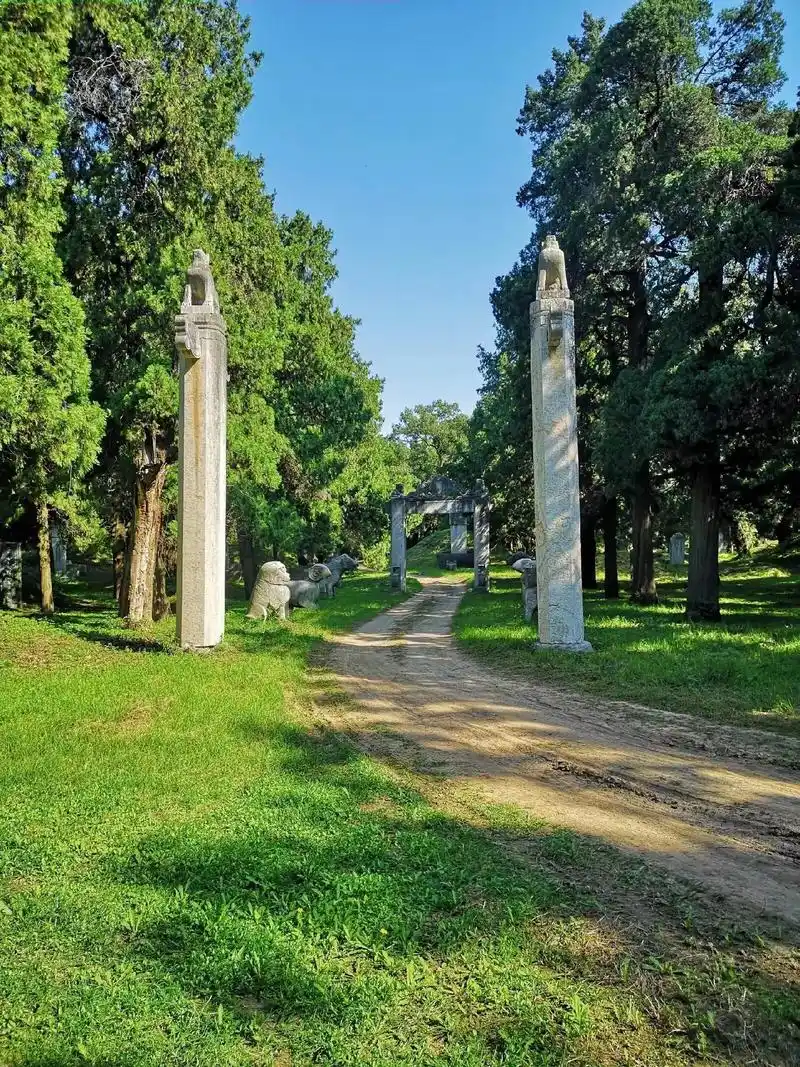
The cemetery is also an open-air museum of Chinese calligraphy. More than 4,000 stone steles from the Song, Jin, Yuan, Ming, Qing and Republican eras line the paths, including works by famous calligraphers such as Yan Song and Weng Fanggang. Along the spirit road, nearly a thousand stone attendants, horses and sheep stand in solemn rows, recalling the funerary sculpture of Etruscan tombs in Italy. Towering cypresses and scholar-trees, some said to have been carried from every corner of the empire by grieving disciples, earned the grove the nickname "Natural Botanical Garden."
**Planning Your Visit**
The cemetery sits at 18 Gulou North Street, about 1.5 km north of the old city centre in Qufu, and is open daily from 8:30 to 17:00 (extended to 18:30 in summer). Admission is roughly 10 yuan for the site alone, though most travellers buy the 140-yuan two-day combined ticket covering the Temple of Confucius, the Kong Family Mansion and the cemetery. The grounds are expansive, so renting an electric cart for 20 yuan is wise; walking the whole route covers about two kilometres. Plan at least two to three hours.
**A Word on Etiquette and Atmosphere**
Because this is still an active place of mourning, visitors should move quietly, never step on the mounds, and switch off camera flashes when photographing the inscribed stones. Pairing the cemetery with the temple and mansion under one guide unlocks the full Confucian narrative from public ritual to private lineage. Early morning or late afternoon light slants beautifully through the ancient trees, lending the deep woods a contemplative hush—an experience quite unlike the bustle of the temple square and well worth the quiet pilgrimage.
**A Living Necropolis Spanning Two and a Half Millennia**
The Cemetery of Confucius has been receiving burials since 479 BCE, the year the Master passed away in nearby Lu. While Rome's Catacombs were abandoned after a few centuries and even Père Lachaise only began in 1804, this single clan graveyard has welcomed descendants without interruption for twenty-five centuries. Confucian disciples first camped here, planting trees in mourning, and from the Han dynasty onward every notable branch of the Kong family was laid to rest. Designated a national treasure in 1961 and a World Heritage Site in 1994 as part of the "Three Confucian Sites," it remains a working cemetery today—one of the most remarkable cultural survival stories anywhere on earth.
**A Carefully Ordered Landscape**
A 7-kilometre wall encloses the grounds, and visitors enter through the Second Forest Gate, passing beneath the "Eternal Spring" memorial arch and crossing a stone bridge over the Zhu River. The axis leads straight to Confucius' tomb, a low "axe-head" mound fronted by a Ming-dynasty Spirit Hall and a yellow-jade stele bearing the title "Great Accomplished, Most Sage, Wenxuan King." Flanking it lie the tombs of his son Kong Li and grandson Kong Ji, arranged in the poignant "carrying the son, embracing the grandson" pattern that mirrors ancient patriarchal ideals—a layout as deliberate as any Renaissance family chapel.
**A Forest of Stone Inscriptions**
The cemetery is also an open-air museum of Chinese calligraphy. More than 4,000 stone steles from the Song, Jin, Yuan, Ming, Qing and Republican eras line the paths, including works by famous calligraphers such as Yan Song and Weng Fanggang. Along the spirit road, nearly a thousand stone attendants, horses and sheep stand in solemn rows, recalling the funerary sculpture of Etruscan tombs in Italy. Towering cypresses and scholar-trees, some said to have been carried from every corner of the empire by grieving disciples, earned the grove the nickname "Natural Botanical Garden."
**Planning Your Visit**
The cemetery sits at 18 Gulou North Street, about 1.5 km north of the old city centre in Qufu, and is open daily from 8:30 to 17:00 (extended to 18:30 in summer). Admission is roughly 10 yuan for the site alone, though most travellers buy the 140-yuan two-day combined ticket covering the Temple of Confucius, the Kong Family Mansion and the cemetery. The grounds are expansive, so renting an electric cart for 20 yuan is wise; walking the whole route covers about two kilometres. Plan at least two to three hours.
**A Word on Etiquette and Atmosphere**
Because this is still an active place of mourning, visitors should move quietly, never step on the mounds, and switch off camera flashes when photographing the inscribed stones. Pairing the cemetery with the temple and mansion under one guide unlocks the full Confucian narrative from public ritual to private lineage. Early morning or late afternoon light slants beautifully through the ancient trees, lending the deep woods a contemplative hush—an experience quite unlike the bustle of the temple square and well worth the quiet pilgrimage.