Jiaxuan Shrine
⭐ 3.80
No. 45, Baotu Spring South Road, Lixia District, Jinan, Shandong, China
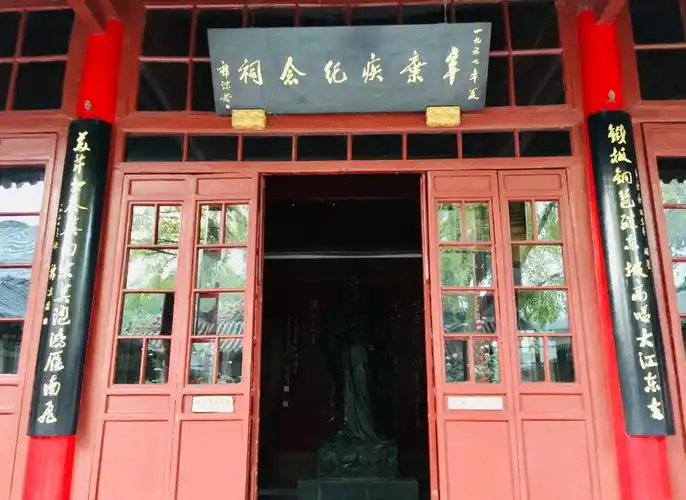 The shrine dates to 1904, when it was erected as a memorial to Li Zhaowei (brother of Qing statesman Li Hongzhang), before being rechristened in 1961 for Xin Qiji. A native of Jinan, Xin was born in 1140—just two decades after the fall of the Northern Song to the Jurchen Jin, an upheaval comparable in trauma to the loss of Normandy in 1066. Like a medieval knight-poet, he combined military command with literary genius, leading resistance armies against the Jin in campaigns that parallel the early Crusades. His career foreshadowed the bittersweet patriot-poets of later ages, from Camões to Byron.
The compound occupies roughly 1,400 square meters on a north-south axis, its grey-tiled roofs and whitewashed walls evoking the restrained dignity of a Cotswolds country house rather than Chinese imperial grandeur. Three sequential courtyards unfold in classic fashion, with a main hall, antechamber, waterside pavilion, and covered walkways linking the east and west wings. Lake stones, ancient scholar pines, and venerable scholar-trees shape the landscaping, while the rear pavilion opens directly onto Daming Lake's willow-fringed waters—a fusion of northern formality and southern lyricism recalling the intimate pavilions of Suzhou's classical gardens.
Inside, the heart of the experience is the bronze statue of Xin Qiji in battle array, capturing the warrior-poet duality that defined his era. Above hangs Guo Moruo's monumental couplet invoking "iron plates and bronze lutes"—a metaphor capturing Xin's thunderous heroic style. The east wing houses genuine and reproduced calligraphy of Xin's verses by Mao Zedong, while the corridor walls display modern masters' renderings of masterworks like "Breaking the Formation" and "Eternal Joy." Visitors can linger over immortal lines such as "By lamplight I draw my sword in dreams, returning to camps where bugles blow," feeling the resonance between verse and conflict.
A multimedia exhibition traces Xin's life from his teenage vow to restore the Song realms—made when he was barely twenty—to his long, frustrating years of political exile. Illustrated with documents, artifacts, and audiovisual displays, the narrative captures how his persistent advocacy for northern campaigns was repeatedly blocked by a complacent court, even as his verse elevated the heroic ci tradition to its zenith. This trajectory, from youthful ardor to resigned wisdom, echoes the arc of many Western patriot-poets, from Dante's exile in Verona to Victor Hugo's Channel Islands banishment.
The shrine is open daily from 8:00 a.m. to 5:30 p.m., with last entry at 5:00 p.m. Admission is modest—around 5 RMB, with free entry for holders of Jinan's annual park pass. Foreign visitors need only show a passport; no advance booking is required. Allow 30 to 45 minutes for a thoughtful visit. Smoking, eating, and loud conversation are prohibited, and modest attire is appreciated. Pairing the shrine with the adjacent Xuan Garden, Tie Gong Shrine, and Chaoran Tower creates a satisfying half-day cultural loop around Daming Lake; for thematic depth, continue to Baotu Spring to visit the Li Qingzhao Memorial Hall—together they illuminate the twin stars of Jinan's poetic legacy.
The shrine dates to 1904, when it was erected as a memorial to Li Zhaowei (brother of Qing statesman Li Hongzhang), before being rechristened in 1961 for Xin Qiji. A native of Jinan, Xin was born in 1140—just two decades after the fall of the Northern Song to the Jurchen Jin, an upheaval comparable in trauma to the loss of Normandy in 1066. Like a medieval knight-poet, he combined military command with literary genius, leading resistance armies against the Jin in campaigns that parallel the early Crusades. His career foreshadowed the bittersweet patriot-poets of later ages, from Camões to Byron.
The compound occupies roughly 1,400 square meters on a north-south axis, its grey-tiled roofs and whitewashed walls evoking the restrained dignity of a Cotswolds country house rather than Chinese imperial grandeur. Three sequential courtyards unfold in classic fashion, with a main hall, antechamber, waterside pavilion, and covered walkways linking the east and west wings. Lake stones, ancient scholar pines, and venerable scholar-trees shape the landscaping, while the rear pavilion opens directly onto Daming Lake's willow-fringed waters—a fusion of northern formality and southern lyricism recalling the intimate pavilions of Suzhou's classical gardens.
Inside, the heart of the experience is the bronze statue of Xin Qiji in battle array, capturing the warrior-poet duality that defined his era. Above hangs Guo Moruo's monumental couplet invoking "iron plates and bronze lutes"—a metaphor capturing Xin's thunderous heroic style. The east wing houses genuine and reproduced calligraphy of Xin's verses by Mao Zedong, while the corridor walls display modern masters' renderings of masterworks like "Breaking the Formation" and "Eternal Joy." Visitors can linger over immortal lines such as "By lamplight I draw my sword in dreams, returning to camps where bugles blow," feeling the resonance between verse and conflict.
A multimedia exhibition traces Xin's life from his teenage vow to restore the Song realms—made when he was barely twenty—to his long, frustrating years of political exile. Illustrated with documents, artifacts, and audiovisual displays, the narrative captures how his persistent advocacy for northern campaigns was repeatedly blocked by a complacent court, even as his verse elevated the heroic ci tradition to its zenith. This trajectory, from youthful ardor to resigned wisdom, echoes the arc of many Western patriot-poets, from Dante's exile in Verona to Victor Hugo's Channel Islands banishment.
The shrine is open daily from 8:00 a.m. to 5:30 p.m., with last entry at 5:00 p.m. Admission is modest—around 5 RMB, with free entry for holders of Jinan's annual park pass. Foreign visitors need only show a passport; no advance booking is required. Allow 30 to 45 minutes for a thoughtful visit. Smoking, eating, and loud conversation are prohibited, and modest attire is appreciated. Pairing the shrine with the adjacent Xuan Garden, Tie Gong Shrine, and Chaoran Tower creates a satisfying half-day cultural loop around Daming Lake; for thematic depth, continue to Baotu Spring to visit the Li Qingzhao Memorial Hall—together they illuminate the twin stars of Jinan's poetic legacy.