Black Tiger Spring

⭐ 4.70

South Bank of the City Moat, Foot of Liberation Pavilion, Lixia District, Jinan City, Shandong Province, China
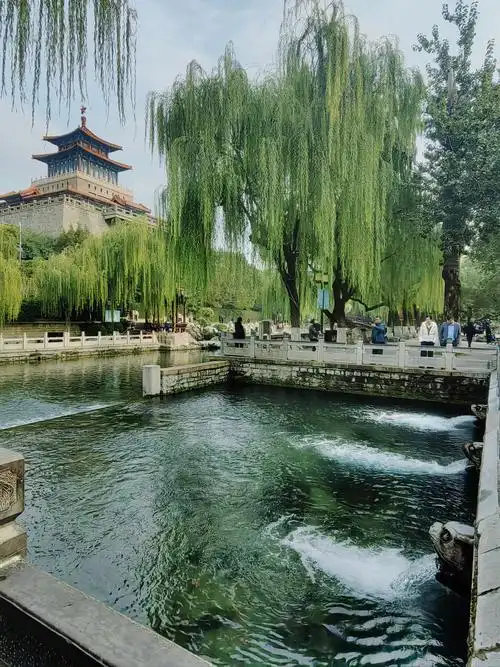
Black Tiger Spring
Black Tiger Spring belongs to a spring-water tradition that has shaped Jinan since antiquity. The 6th-century geographer Li Daoyuan praised these waters in his classic Commentary on the Water Classic, while earlier legends credit Qín-dynasty engineers with harnessing their flow. Comparable to the aqueduct-fed fountains of ancient Rome—where water once symbolized civic pride—Jinan's springs similarly defined urban identity. At peak flow, Black Tiger alone discharged up to 410,000 cubic meters daily, once topping all the city's springs and supplying drinking water to generations before modern plumbing arrived. The spring's design centers on three monumental stone tiger heads, each spouting a thick white column of water that crashes into a rectangular basin below before spilling into the encircling moat. This trio is flanked by fourteen lesser springs—including the lyrically named Pipa, Nine Maidens, and White Stone Springs—scattered along the moat's southern bank. The result resembles a miniature Trevi Fountain multiplied across a city wall, though here the spectacle remains startlingly raw: no ornamental balustrades, no admission gates, just rushing water, ancient stone, and the open sky. Unlike staged tourist attractions, Black Tiger Spring pulses with authentic daily ritual. At first light, residents arrive with shoulder-poles and buckets, drawing water the way their ancestors did for centuries. Children splash their hands, elders fill thermos flasks for the day, and the air fills with gossip and laughter—a scene echoing the medieval European tradition of communal village wells but preserved in modern urban China. This living interplay between citizens and water, where a geologically precious spring doubles as a neighborhood meeting place, gives the site its rare sociological texture. Visiting is refreshingly easy: the spring sits inside the free, 24-hour Number One Spring scenic zone, with no tickets, fences, or closing hours. Allow one to two hours, then combine with nearby Liberation Pavilion for panoramic city views, Kuanhouli's cobbled street-food alleys to sample sweet-and-sour carp or braised pork belly, and a moat cruise to Daming Lake. The prime windows are 6–8 a.m., when locals collect water, and 5–7 p.m., when evening cool brings the tiger-roar acoustics into full drama. Take Metro Line 2 to the Heihuquan Station. What makes Black Tiger Spring unique is its refusal to be museum-ified. Where Rome's Trevi, Vienna's baroque fountains, and even Versailles' Grand Canal have been polished for spectators, Jinan's spring remains embedded in the city's living tissue—a place where you can crouch beside a centuries-old water source and watch a grandmother teach her grandson how to fill a clay jug. For travelers weary of cordoned-off heritage sites, this is the rarest kind of attraction: one that doesn't perform for you, but simply invites you into the rhythm of a water city still true to its name.

Traveler reviews

Spring water tinkles away by Black Tiger Spring. The most beautiful melody of this thousand-year-old city is hidden in these bubbling clear waters. Water gushes from three stone-carved tiger heads, sounding like a tiger's roar, flowing day and ni...
⭐ 5 · Reese Expand
Black Tiger Spring is one of Jinan's three major spring groups, and it draws tons of visitors thanks to its dramatic gushing scenes and rich historical background. The most unique thing about it? Three streams of water burst right out of stone-carved tiger heads, splashing everywhere with a roar like a ...
⭐ 5 · Sage Expand