Lingyan Temple
⭐ 3.80
3.5 kilometers along Lüegao Road, Lüeyang County, Shaanxi Province, China
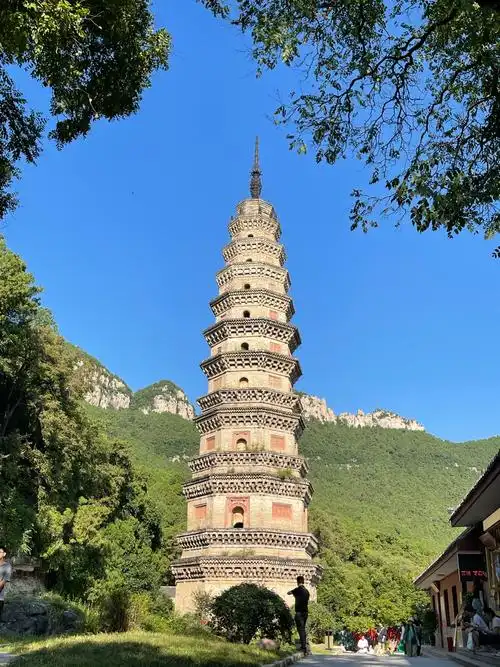 Lingyan Temple was founded during the Kaiyuan era (713–741 CE) under Tang Emperor Xuanzong, the same golden age that produced the poetry of Li Bai and the imperial grandeur of Chang'an. Situated on the ancient Qin–Shu Road, the legendary mountain corridor connecting China's heartland to Sichuan, the site drew pilgrims, officials, and stonemasons for centuries. Like the cave monasteries of Cappadocia or the rock-hewn churches of Matera in southern Italy, the temple is not built on its mountain so much as carved into it — two natural caves forming the structure's very bones. Generations of Tang, Song, Ming, and Qing craftsmen added tier upon tier of halls and pavilions, transforming geology into sacred geometry.
The temple's signature feature is its gravity-defying silhouette: pavilions and galleries cantilevered into cliff faces, linked by narrow walkways and seemingly floating above the Jialing River gorge far below. Inside the front cave, a Ming-dynasty bronze Buddha rests in gilded stillness, while the rear cave shelters a reclining Buddha among stalactites and a soaring natural column locals call the Jade Pillar. Cypress trees twist above the eaves, and vines trail down the pale limestone walls, giving the whole complex the air of a forgotten fortress-monastery. A newly installed glass skywalk and suspension bridge on the rear mountain now offer vertiginous views, balancing centuries of devotional quiet with a modern thrill.
The site earns its nickname, the "Stele Forest of Southern Shaanxi," from more than 140 cliff inscriptions and steles dating back to the Eastern Han dynasty (25–220 CE). The crown jewel, the Fugue Pavilion Ode, belongs to the celebrated "Three Odes of the Han" — alongside the Xi Xia Ode and Stone Gate Ode, a trio revered by Chinese calligraphers for fifteen centuries as the pinnacle of clerical script. Its text honors Han engineers who carved wooden plank roads into cliffs to open mountain trade routes. Equally intriguing is the Yizhiling Stele, often cited as China's oldest surviving traffic regulation, predating Europe's earliest highway codes by more than a millennium. For anyone interested in epigraphy, religion, or transport history, Lingyan is a living archive.
Lingyan Temple sits 110 km southwest of Hanzhong city center, perched halfway up Yùwén Mountain on the eastern bank of the Jialing River. Travelers should take a high-speed train to Lüeyang Station, then a 10-minute taxi ride or local bus to the entrance. Admission is a remarkably modest 8 yuan (subject to change), and opening hours run roughly 08:00 to 17:30, with slight seasonal adjustments. Allow two to three hours for the full circuit, including the cave interiors, the Wangjiang Pavilion overlook, and the glass skywalk. The site can be combined with a half-day visit to the nearby Jiangshen Temple, a cluster of Ming and Qing era riverside halls that round out Lüeyang's heritage trail.
In an age of mass tourism and bucket-list icons, Lingyan Temple rewards travelers who crave the road less traveled. It is the kind of place where a 1,300-year-old stele shares a wall with a stalactite that took a million years to form, and where the call of temple bells mingles with the wind roaring up the Jialing gorge. Few sites in China combine such rich epigraphic heritage, dramatic geology, and modern adventure infrastructure in one compact visit. Visitors leave with sharpened senses — and an abiding sense that, somewhere between the cliffs and the clouds, history is still being carved.
Lingyan Temple was founded during the Kaiyuan era (713–741 CE) under Tang Emperor Xuanzong, the same golden age that produced the poetry of Li Bai and the imperial grandeur of Chang'an. Situated on the ancient Qin–Shu Road, the legendary mountain corridor connecting China's heartland to Sichuan, the site drew pilgrims, officials, and stonemasons for centuries. Like the cave monasteries of Cappadocia or the rock-hewn churches of Matera in southern Italy, the temple is not built on its mountain so much as carved into it — two natural caves forming the structure's very bones. Generations of Tang, Song, Ming, and Qing craftsmen added tier upon tier of halls and pavilions, transforming geology into sacred geometry.
The temple's signature feature is its gravity-defying silhouette: pavilions and galleries cantilevered into cliff faces, linked by narrow walkways and seemingly floating above the Jialing River gorge far below. Inside the front cave, a Ming-dynasty bronze Buddha rests in gilded stillness, while the rear cave shelters a reclining Buddha among stalactites and a soaring natural column locals call the Jade Pillar. Cypress trees twist above the eaves, and vines trail down the pale limestone walls, giving the whole complex the air of a forgotten fortress-monastery. A newly installed glass skywalk and suspension bridge on the rear mountain now offer vertiginous views, balancing centuries of devotional quiet with a modern thrill.
The site earns its nickname, the "Stele Forest of Southern Shaanxi," from more than 140 cliff inscriptions and steles dating back to the Eastern Han dynasty (25–220 CE). The crown jewel, the Fugue Pavilion Ode, belongs to the celebrated "Three Odes of the Han" — alongside the Xi Xia Ode and Stone Gate Ode, a trio revered by Chinese calligraphers for fifteen centuries as the pinnacle of clerical script. Its text honors Han engineers who carved wooden plank roads into cliffs to open mountain trade routes. Equally intriguing is the Yizhiling Stele, often cited as China's oldest surviving traffic regulation, predating Europe's earliest highway codes by more than a millennium. For anyone interested in epigraphy, religion, or transport history, Lingyan is a living archive.
Lingyan Temple sits 110 km southwest of Hanzhong city center, perched halfway up Yùwén Mountain on the eastern bank of the Jialing River. Travelers should take a high-speed train to Lüeyang Station, then a 10-minute taxi ride or local bus to the entrance. Admission is a remarkably modest 8 yuan (subject to change), and opening hours run roughly 08:00 to 17:30, with slight seasonal adjustments. Allow two to three hours for the full circuit, including the cave interiors, the Wangjiang Pavilion overlook, and the glass skywalk. The site can be combined with a half-day visit to the nearby Jiangshen Temple, a cluster of Ming and Qing era riverside halls that round out Lüeyang's heritage trail.
In an age of mass tourism and bucket-list icons, Lingyan Temple rewards travelers who crave the road less traveled. It is the kind of place where a 1,300-year-old stele shares a wall with a stalactite that took a million years to form, and where the call of temple bells mingles with the wind roaring up the Jialing gorge. Few sites in China combine such rich epigraphic heritage, dramatic geology, and modern adventure infrastructure in one compact visit. Visitors leave with sharpened senses — and an abiding sense that, somewhere between the cliffs and the clouds, history is still being carved.