Confucius Temple and Confucius Family Mansion
⭐ 4.20
No. 185, Daming Lake Road, Lixia District, Jinan City, Shandong Province, China
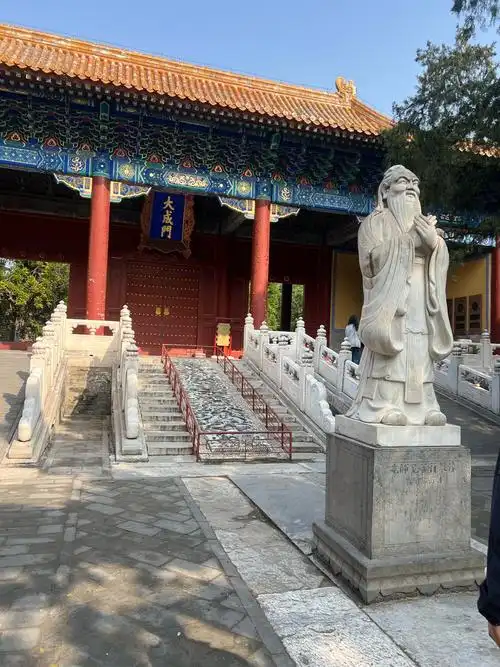 Confucius (551–479 BCE) lived during the same era as Socrates, Heraclitus, and the Buddha, yet his ideas arguably touched more lives than any other thinker's. The temple was begun just one year after his death, when the Duke of Lu ordered a shrine on Confucius's former residence. For the next two and a half millennia, emperors from every dynasty added to the complex, making it a living architectural chronicle of imperial China. Like St. Peter's Basilica in Rome, which grew over centuries into its present form, the temple evolved through continuous additions, with most surviving structures dating to the Ming and Qing dynasties.
The temple follows a strict north-south axis stretching over a kilometer, organized into nine sequential courtyards—far grander in sequence than most European cathedrals. The crown jewel is the Dacheng Hall, whose double-eaved, nine-ridged roof in imperial yellow tiles rivals the scale and ambition of a grand European throne room. Ten deep-relief dragon columns line its front platform, each carved from a single block of stone with serpents writhing through clouds—a technique that makes the columns of Westminster Abbey seem restrained by comparison. Flanking the main axis stand pavilions housing more than a thousand stone steles bearing imperial inscriptions and Confucian classics.
Just behind the temple sits the Confucius Family Mansion, rebuilt in 1377 and inhabited by the philosopher's direct descendants for more than six hundred years—longer than virtually any European noble house. It functions simultaneously as an administrative office, ancestral hall, family home, and garden estate, a hybrid arrangement almost unheard of in Western architecture. Comparable in scale to a minor European palace complex like the Palazzo Pitti in Florence, it offers an unusually intimate glimpse into how China's imperial bureaucracy merged with aristocratic family life. Don't miss the "Five Cypresses Embracing the Pagoda Tree," a living monument where ancient trees have grown together for centuries.
Confucianism became the ethical foundation of imperial China, Korea, Japan, and Vietnam, shaping government, family life, education, and art for two millennia—much as Christianity and classical philosophy shaped European civilization. The site received UNESCO World Heritage status in 1994, alongside the neighboring Cemetery of Confucius. For Western visitors, walking these grounds offers something rare: a chance to stand in the physical epicenter of a cultural tradition that still shapes the values, exams, and family structures of over 1.5 billion people today.
A common pitfall: there is no Confucius Temple in Jinan itself—the site lies in Qufu, a roughly 30-minute high-speed train ride from Jinan West Station to Qufu East Station, followed by a short taxi or bus ride into the old town. The three-site combo ticket (Temple, Mansion, and Cemetery) runs around 140 RMB and allows entry to all three; budget at least four to five hours for Temple and Mansion alone, and a full day for all three. Bring your passport for ticket purchase. Qufu gets extremely hot in summer with frequent rain, so comfortable flat shoes, sun protection, and rain gear are essential.
The biggest mistake visitors make is wandering without context—the buildings reward deep explanation. Book a licensed guide through the official site or rent an audio device at the gate; otherwise much of the symbolic meaning escapes notice. Observe the etiquette: do not step on thresholds, touch the steles, photograph inside halls where prohibited, or speak loudly in worship spaces. For families, students, and anyone interested in world history, this is the single most important cultural pilgrimage site in East Asia—the kind of place that quietly reframes how you understand a quarter of humanity.
Confucius (551–479 BCE) lived during the same era as Socrates, Heraclitus, and the Buddha, yet his ideas arguably touched more lives than any other thinker's. The temple was begun just one year after his death, when the Duke of Lu ordered a shrine on Confucius's former residence. For the next two and a half millennia, emperors from every dynasty added to the complex, making it a living architectural chronicle of imperial China. Like St. Peter's Basilica in Rome, which grew over centuries into its present form, the temple evolved through continuous additions, with most surviving structures dating to the Ming and Qing dynasties.
The temple follows a strict north-south axis stretching over a kilometer, organized into nine sequential courtyards—far grander in sequence than most European cathedrals. The crown jewel is the Dacheng Hall, whose double-eaved, nine-ridged roof in imperial yellow tiles rivals the scale and ambition of a grand European throne room. Ten deep-relief dragon columns line its front platform, each carved from a single block of stone with serpents writhing through clouds—a technique that makes the columns of Westminster Abbey seem restrained by comparison. Flanking the main axis stand pavilions housing more than a thousand stone steles bearing imperial inscriptions and Confucian classics.
Just behind the temple sits the Confucius Family Mansion, rebuilt in 1377 and inhabited by the philosopher's direct descendants for more than six hundred years—longer than virtually any European noble house. It functions simultaneously as an administrative office, ancestral hall, family home, and garden estate, a hybrid arrangement almost unheard of in Western architecture. Comparable in scale to a minor European palace complex like the Palazzo Pitti in Florence, it offers an unusually intimate glimpse into how China's imperial bureaucracy merged with aristocratic family life. Don't miss the "Five Cypresses Embracing the Pagoda Tree," a living monument where ancient trees have grown together for centuries.
Confucianism became the ethical foundation of imperial China, Korea, Japan, and Vietnam, shaping government, family life, education, and art for two millennia—much as Christianity and classical philosophy shaped European civilization. The site received UNESCO World Heritage status in 1994, alongside the neighboring Cemetery of Confucius. For Western visitors, walking these grounds offers something rare: a chance to stand in the physical epicenter of a cultural tradition that still shapes the values, exams, and family structures of over 1.5 billion people today.
A common pitfall: there is no Confucius Temple in Jinan itself—the site lies in Qufu, a roughly 30-minute high-speed train ride from Jinan West Station to Qufu East Station, followed by a short taxi or bus ride into the old town. The three-site combo ticket (Temple, Mansion, and Cemetery) runs around 140 RMB and allows entry to all three; budget at least four to five hours for Temple and Mansion alone, and a full day for all three. Bring your passport for ticket purchase. Qufu gets extremely hot in summer with frequent rain, so comfortable flat shoes, sun protection, and rain gear are essential.
The biggest mistake visitors make is wandering without context—the buildings reward deep explanation. Book a licensed guide through the official site or rent an audio device at the gate; otherwise much of the symbolic meaning escapes notice. Observe the etiquette: do not step on thresholds, touch the steles, photograph inside halls where prohibited, or speak loudly in worship spaces. For families, students, and anyone interested in world history, this is the single most important cultural pilgrimage site in East Asia—the kind of place that quietly reframes how you understand a quarter of humanity.