Qianfoshan Scenic Area
⭐ 4.50
Shengli Village, Dasijiazi Town, Zhangwu County, Fuxin City, Liaoning Province, China
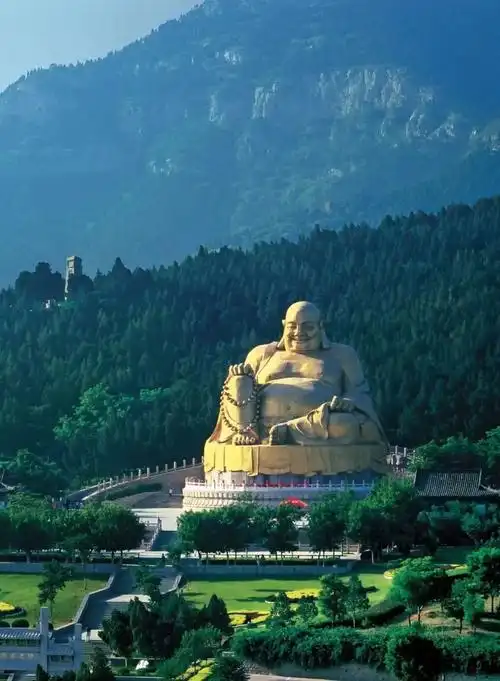 Tibetan Buddhism spread deep into the Mongol communities of the Manchurian frontier during the twilight of the Qing Dynasty. Between the 1870s and early 1900s, faithful herders and villagers carved more than 150 sacred images directly into the black basalt cliffs. The ambition recalls Europe's medieval pilgrimage landscapes, yet the practice stands closer in spirit to the rock-cut sanctuaries of India's Ajanta Caves or the painted chapels of Cappadocia. Scholars prize the site as a rare surviving record of how Han, Manchu, Mongol, and Tibetan cultures wove together in late imperial northeast China.
The sculptors worked with the natural contours of the volcanic stone, allowing figures to appear as if they were emerging from the mountain itself. The tallest statue reaches 3.25 meters, while subjects range from serene Buddhas to tantric dharma protectors and, remarkably, the loyalist general Guan Yu - a uniquely Chinese touch that reflects the syncretic nature of folk devotion at the frontier. Inside a small Guanyin cave, Qing-era inscriptions and poetic couplets survive in carved stone.
Comparable in concept, if not in scale, to the Longmen Grottoes near Luoyang or the cliff reliefs at Dambulla in Sri Lanka, Qianfoshan documents a moment when Buddhist artistry flourished at China's northernmost edge, far from the great monastic capitals. The pairing of Guan Yu alongside tantric deities mirrors how medieval European folk Christianity absorbed older heroes and saints into local devotion, creating a faith that spoke to ordinary believers.
The mountain itself rises only 246 meters, yet its crown of weathered basalt resembles a dark citadel above the surrounding sandy plains and maple forests. A loop trail circles the summit in roughly an hour, with two to three hours allowing time to study each carved niche. Spring brings wildflowers across the slopes, while autumn sets the maples ablaze in crimson and gold - arguably the most rewarding windows for visiting photographers and hikers.
The site lies 155 kilometers from Fuxin city and 45 kilometers from Zhangwu, accessible only by private car or hired driver; the nearest expressway exit at Baojia Tun is roughly 5.5 kilometers away. Standard admission runs about 20 yuan, with gates typically open from 8:00 a.m. to 6:00 p.m. Travelers should be aware that the mountain is currently closed for site improvements, so verify reopening before setting out. Should access remain restricted, the related cliff carvings at Haitang Shan in Fuxin offer an excellent alternative for lovers of Buddhist rock art.
Tibetan Buddhism spread deep into the Mongol communities of the Manchurian frontier during the twilight of the Qing Dynasty. Between the 1870s and early 1900s, faithful herders and villagers carved more than 150 sacred images directly into the black basalt cliffs. The ambition recalls Europe's medieval pilgrimage landscapes, yet the practice stands closer in spirit to the rock-cut sanctuaries of India's Ajanta Caves or the painted chapels of Cappadocia. Scholars prize the site as a rare surviving record of how Han, Manchu, Mongol, and Tibetan cultures wove together in late imperial northeast China.
The sculptors worked with the natural contours of the volcanic stone, allowing figures to appear as if they were emerging from the mountain itself. The tallest statue reaches 3.25 meters, while subjects range from serene Buddhas to tantric dharma protectors and, remarkably, the loyalist general Guan Yu - a uniquely Chinese touch that reflects the syncretic nature of folk devotion at the frontier. Inside a small Guanyin cave, Qing-era inscriptions and poetic couplets survive in carved stone.
Comparable in concept, if not in scale, to the Longmen Grottoes near Luoyang or the cliff reliefs at Dambulla in Sri Lanka, Qianfoshan documents a moment when Buddhist artistry flourished at China's northernmost edge, far from the great monastic capitals. The pairing of Guan Yu alongside tantric deities mirrors how medieval European folk Christianity absorbed older heroes and saints into local devotion, creating a faith that spoke to ordinary believers.
The mountain itself rises only 246 meters, yet its crown of weathered basalt resembles a dark citadel above the surrounding sandy plains and maple forests. A loop trail circles the summit in roughly an hour, with two to three hours allowing time to study each carved niche. Spring brings wildflowers across the slopes, while autumn sets the maples ablaze in crimson and gold - arguably the most rewarding windows for visiting photographers and hikers.
The site lies 155 kilometers from Fuxin city and 45 kilometers from Zhangwu, accessible only by private car or hired driver; the nearest expressway exit at Baojia Tun is roughly 5.5 kilometers away. Standard admission runs about 20 yuan, with gates typically open from 8:00 a.m. to 6:00 p.m. Travelers should be aware that the mountain is currently closed for site improvements, so verify reopening before setting out. Should access remain restricted, the related cliff carvings at Haitang Shan in Fuxin offer an excellent alternative for lovers of Buddhist rock art.