Baotu Spring Scenic Area

⭐ 4.50

Baotu Spring, Lixia District, Jinan City, Shandong Province, China
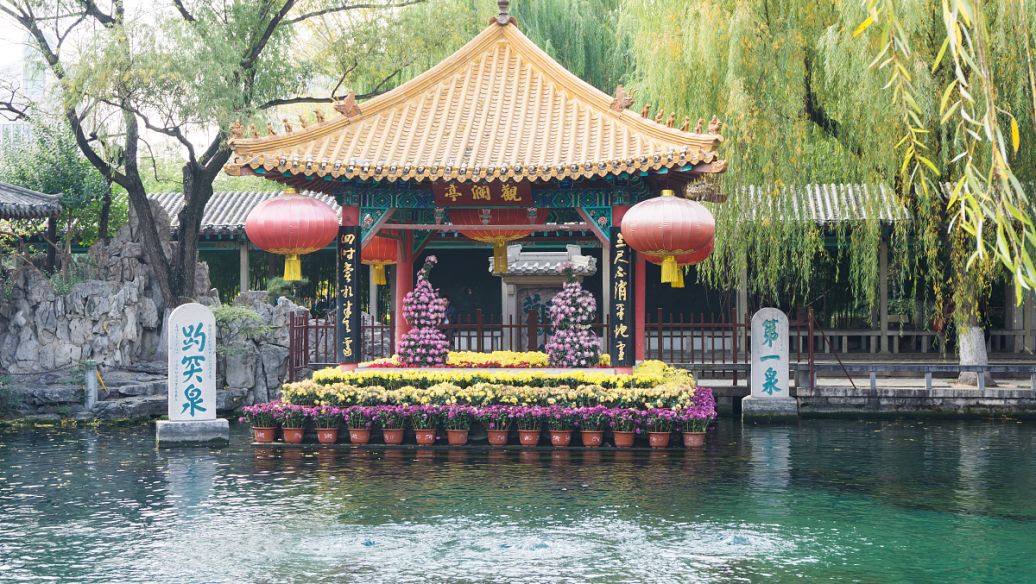
Baotu Spring Scenic Area
Baotu Spring, anciently known as Luo, has been celebrated in Chinese verse since at least the Song dynasty (960–1279)—roughly contemporary with the age of the Crusades and the raising of Europe's great Gothic cathedrals. Its fame peaked in 1751 when the Qianlong Emperor, comparable in cultural ambition to France's Louis XIV, paused his southern tour to taste the waters and bestowed the title "First Spring Under Heaven." That imperial endorsement cemented the spring's status as a national treasure. The three jets maintain a constant temperature of about 18°C year-round, and in winter their rising steam creates a "cloud-mist" effect reminiscent of Iceland's thermal springs, though here it is pure groundwater geology at work. The park unfolds like a Chinese counterpart to Europe's great landscape gardens at Versailles or Schönbrunn, but on an intimate scale better suited to contemplation. Standout structures include the Guanlan Pavilion, where visitors can still read Emperor Kangxi's calligraphic characters "Ji Tuan" (Rushing Torrent) and Qianlong's inscribed poetry steles. The Wan Zhu (Ten Thousand Bamboo) Garden, a protected national heritage site, marries the geometric elegance of Suzhou's classical gardens with northern architectural solidity—think of a fusion between Rome's Villa Borghese and a Ming dynasty scholar's retreat. Pavilions, zigzag bridges, and lotus ponds create a world where every step reveals a new vignette. The spring complex is inseparable from Li Qingzhao (1084–c.1155), often hailed as China's greatest female poet and frequently compared to Sappho or the Brontë sisters for the emotional intensity of her ci poetry. Her memorial hall, built beside the Shuyu Spring, recreates the literati atmosphere in which she wrote. Nearby, the Wanghu Pavilion teahouse continues a ritual as old as Chinese tea culture itself: brewing leaves with water drawn directly from the spring, which locals consider uniquely smooth and sweet. A boat ride along the ancient city moat links Baotu with Black Tiger, Pearl, and Five Dragon Pool springs—an urban waterway system unmatched in scale by anything in Europe outside of Venice or Amsterdam. Entry costs just 40 yuan (about $5.50). From April 10 to October 9, gates stay open until 19:00; the rest of the year they close at 18:00. Arrive between 7:00 and 9:00 to beat the crowds—much as one would at Venice's Doge's Palace or Barcelona's Sagrada Família. The recommended route hits Baotu first, then Li Qingzhao Hall, Wan Zhu Garden, and Luoyuan Hall. Exiting through the north gate connects you to the free Five Dragon Pool Park and the famous Daming Lake, creating an easy half-day loop of "one river, one lake, three springs." Metro Line 2 reaches the area via Quan Cheng Square Station; buses are plentiful. For Western travelers, Baotu Spring offers something genuinely rare: a landscape that is simultaneously a geological phenomenon, an imperial relic, and a living literary shrine—qualities that might individually draw visitors to Rome, Kyoto, or the English Lake District, but rarely combine in a single park. Few places compress so many layers of Chinese history into a few walkable acres. While China is celebrated for grand monuments like the Great Wall and the Forbidden City, Baotu Spring represents the country's quieter genius: a place where poetry, politics, and pure water meet beneath ancient willows. It is, quite simply, the soul of Jinan, offering a contemplative counterpoint to the more crowded imperial sites of Beijing and Xi'an.

Traveler reviews

Baotu Spring Park is a national AAAAA-level tourist attraction right in the heart of Jinan, famous for its spring water landscapes and historic sites. The...
⭐ 5 · Rowan Expand
The famous Baotu Spring—any trip to Jinan must include a visit to the "Number One Spring Under Heaven." The three jets of water surge ceaselessly, a powerful flow that has c...
⭐ 5 · Reese Expand