Guanlin Temple
⭐ 4.50
Luoyang City, Henan Province, China
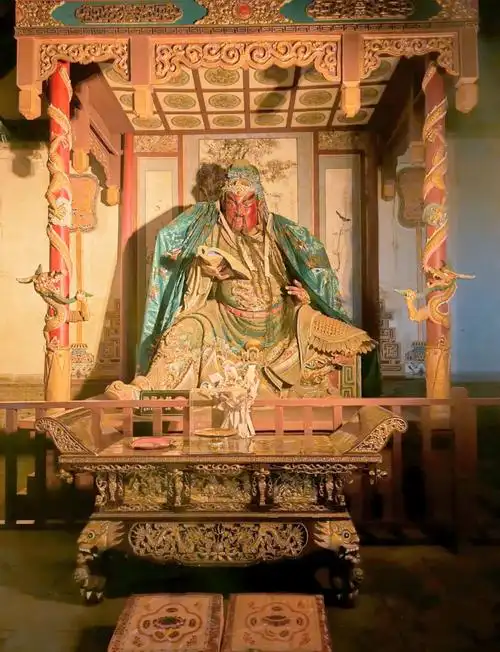 Guan Yu (160–219 AD) was a general who served the warlord Liu Bei during the fractious breakup of the Han Dynasty. Captured and executed by rivals, his severed head was reputedly brought to Luoyang, where it was buried with full honors. Miracles were soon attributed to his spirit, and by the Sui and Tang dynasties he had been elevated to a god of war; later emperors, including the Ming and Qing, granted him a princely title. To put this in perspective, his trajectory parallels that of European war-saints like St. George or the legendary Roland, whose mortal remains also became nationalist pilgrimage destinations. The current layout, however, dates to a grand Ming expansion in 1592, when the court bestowed the rare suffix "Lin"—forest—giving the site equal ritual standing with the Confucian cemetery at Qufu, a distinction unmatched anywhere else in China.
Built along a strict central axis, the complex reads like a miniature Forbidden City in miniature palace style. Visitors pass through the ceremonial gate, the Hall of Worship, the towering main hall, and the Spring and Autumn Hall, flanked by subsidiary shrines to Guan Yu's legendary lieutenants and his daughters. Inside the main hall, the gilded seated statue of Guan Yu in imperial robes is framed by towering calligraphic plaques gifted by the Guangxu Emperor and Empress Dowager Cixi. The stylistic restraint, deep eaves, and vermilion columns will feel familiar to anyone who has toured the Buddhist temples of Kyoto or the imperial complexes of Seoul; the scale is intimate, but the craftsmanship is impeccable.
The most photographed feature is the Hundred-Lion Corridor, a raised stone walkway lined on both sides by 104 Ming-era lions, each with a distinct face and posture—an eccentricity reminiscent of the grotesque carvings that delight visitors at England's Wells Cathedral or the balustrade menagerie at Florence's Ponte Vecchio. Beyond the carved stone archway, the grassy burial mound rises about ten meters high, ringed by a thousand ancient cypresses, including curiously named specimens like the "Dragon-Head Cypress" and "Phoenix-Tail Cypress." Nearby, a calligraphy pavilion shelters more than 300 Ming and Qing steles, including one bearing the Kangxi Emperor's own rubbing, altered three times in his own hand.
Guanlin remains a living rather than a museum site. It is the official home of the Guan Gong Beliefs, a national intangible cultural heritage, and every year on the twenty-ninth day of the ninth lunar month the grounds fill with pilgrims for the International Guandi Sacrifice Ceremony. The famous saying "his head rests in Luoyang, his body lies in Dangyang" makes this the spiritual anchor for overseas Chinese communities in Southeast Asia, where shrines to Guan Yu guard virtually every Chinese-owned shop and business. For Western visitors, it offers a vibrant, working example of how ancient military heroes can be transformed into universal patrons of loyalty, justice, and commerce—a role strikingly similar to the way the cult of St. Nicholas morphed across cultures.
The temple sits at 2 Guanlin South Street, in Luoyang's Luolong District, and is easily reached by city bus or taxi. Admission is 40 yuan, with discounts for students and seniors, and the gates open daily from 8:30 a.m. to 5:30 p.m. Most visitors spend between ninety minutes and two and a half hours on site, though culture enthusiasts who wish to study the steles in depth should allow three hours and consider hiring a guide. Travelers with extra time should pair the visit with the nearby Longmen Grottoes, a UNESCO World Heritage site of sixth-century Buddhist cave art, for a richly layered day exploring two of China's most extraordinary sacred landscapes.
Guan Yu (160–219 AD) was a general who served the warlord Liu Bei during the fractious breakup of the Han Dynasty. Captured and executed by rivals, his severed head was reputedly brought to Luoyang, where it was buried with full honors. Miracles were soon attributed to his spirit, and by the Sui and Tang dynasties he had been elevated to a god of war; later emperors, including the Ming and Qing, granted him a princely title. To put this in perspective, his trajectory parallels that of European war-saints like St. George or the legendary Roland, whose mortal remains also became nationalist pilgrimage destinations. The current layout, however, dates to a grand Ming expansion in 1592, when the court bestowed the rare suffix "Lin"—forest—giving the site equal ritual standing with the Confucian cemetery at Qufu, a distinction unmatched anywhere else in China.
Built along a strict central axis, the complex reads like a miniature Forbidden City in miniature palace style. Visitors pass through the ceremonial gate, the Hall of Worship, the towering main hall, and the Spring and Autumn Hall, flanked by subsidiary shrines to Guan Yu's legendary lieutenants and his daughters. Inside the main hall, the gilded seated statue of Guan Yu in imperial robes is framed by towering calligraphic plaques gifted by the Guangxu Emperor and Empress Dowager Cixi. The stylistic restraint, deep eaves, and vermilion columns will feel familiar to anyone who has toured the Buddhist temples of Kyoto or the imperial complexes of Seoul; the scale is intimate, but the craftsmanship is impeccable.
The most photographed feature is the Hundred-Lion Corridor, a raised stone walkway lined on both sides by 104 Ming-era lions, each with a distinct face and posture—an eccentricity reminiscent of the grotesque carvings that delight visitors at England's Wells Cathedral or the balustrade menagerie at Florence's Ponte Vecchio. Beyond the carved stone archway, the grassy burial mound rises about ten meters high, ringed by a thousand ancient cypresses, including curiously named specimens like the "Dragon-Head Cypress" and "Phoenix-Tail Cypress." Nearby, a calligraphy pavilion shelters more than 300 Ming and Qing steles, including one bearing the Kangxi Emperor's own rubbing, altered three times in his own hand.
Guanlin remains a living rather than a museum site. It is the official home of the Guan Gong Beliefs, a national intangible cultural heritage, and every year on the twenty-ninth day of the ninth lunar month the grounds fill with pilgrims for the International Guandi Sacrifice Ceremony. The famous saying "his head rests in Luoyang, his body lies in Dangyang" makes this the spiritual anchor for overseas Chinese communities in Southeast Asia, where shrines to Guan Yu guard virtually every Chinese-owned shop and business. For Western visitors, it offers a vibrant, working example of how ancient military heroes can be transformed into universal patrons of loyalty, justice, and commerce—a role strikingly similar to the way the cult of St. Nicholas morphed across cultures.
The temple sits at 2 Guanlin South Street, in Luoyang's Luolong District, and is easily reached by city bus or taxi. Admission is 40 yuan, with discounts for students and seniors, and the gates open daily from 8:30 a.m. to 5:30 p.m. Most visitors spend between ninety minutes and two and a half hours on site, though culture enthusiasts who wish to study the steles in depth should allow three hours and consider hiring a guide. Travelers with extra time should pair the visit with the nearby Longmen Grottoes, a UNESCO World Heritage site of sixth-century Buddhist cave art, for a richly layered day exploring two of China's most extraordinary sacred landscapes.