Lijing Gate
⭐ 3.80
Lijingmen Street, Xigong District, Luoyang City, Henan Province, China
 Rising from the plains of Henan, Luoyang served as China's imperial capital for thirteen dynasties across more than a millennium, rivaling the historical weight of Rome or Constantinople in the Western imagination. Lijing Gate traces its origins to the Sui Dynasty (581–618 CE) as the formal western entrance to the imperial city. Continuously rebuilt through the Jin, Yuan, Ming, and Qing eras, it remained a cornerstone of Luoyang's defensive system until standing at the threshold of a UNESCO-worthy cultural corridor linking the Longmen Grottoes and the ancient Silk Road.
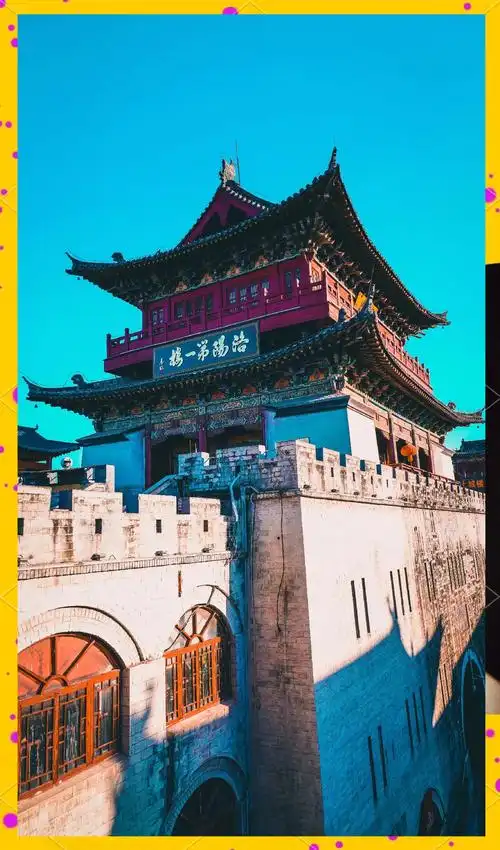
The architecture is a textbook study in classical Chinese gatehouse design. The soaring 30-meter tower combines the sweeping upturned eaves, painted beams, and intricate bracket sets characteristic of multiple dynasties. Below, the semicircular barbican (wengcheng)—a defensive enclosure unique to Chinese fortification—creates dramatic play of light and shadow through its narrow, curving passage, much like the fortified baileys of a Norman castle. Blue brick ramparts extend outward, inviting visitors to walk where soldiers once patrolled.
Beyond its military function, the gate serves as a cultural portal. Inside, the Imperial History Hall and the Heluo Culture Corridor trace the rise and fall of dynasties that shaped Chinese civilization, from the Eastern Zhou through the Tang. The bold calligraphy of the gate's plaque—three characters meaning "Gate of Beautiful Scenery"—anchors the structure as a spiritual threshold between past and present.
Practical details make visiting straightforward. The outer courtyards and barbican are free to explore at any hour, while ascending the tower costs 45 RMB for adults, 25 RMB for students and seniors aged 60–69, and is free for those over 70. Opening hours run from 08:30 to 22:00, with last entry at 21:00; the dramatic illumination sequence begins around 19:30 and runs until closing. Metro Line 1 delivers visitors directly to Lijing Gate Station, Exit B—a rare convenience in a city steeped in antiquity.
For the richest experience, arrive in the late afternoon to photograph the barbican in golden light, then climb the tower to watch sunset gild the rooftops of the old quarter. As darkness falls, descend into Cross Street night market for regional specialties like *bu fan tang* (peppery broth served in a clever no-stir bowl), *jiang mian tiao* (fermented rice-noodle soup), and peony-shaped pastries. Wear sturdy, non-slip shoes—those blue-brick steps can be unforgiving—and bring sun protection in summer. If time allows, continue on foot to the Drum Tower and the lantern-lit Luoyi Ancient City for an unforgettable half-day-plus-evening immersion.
Why visit? Few Chinese landmarks offer such an immediate, affordable connection between living tradition and reconstructed grandeur. Lijing Gate is less a museum than a working threshold—the same one travelers crossed for fifteen centuries—now framing craft beer stalls and selfie-toting tourists alongside ancient battlements. It is, quite simply, the most cinematic doorway into Luoyang.
Rising from the plains of Henan, Luoyang served as China's imperial capital for thirteen dynasties across more than a millennium, rivaling the historical weight of Rome or Constantinople in the Western imagination. Lijing Gate traces its origins to the Sui Dynasty (581–618 CE) as the formal western entrance to the imperial city. Continuously rebuilt through the Jin, Yuan, Ming, and Qing eras, it remained a cornerstone of Luoyang's defensive system until standing at the threshold of a UNESCO-worthy cultural corridor linking the Longmen Grottoes and the ancient Silk Road.
The architecture is a textbook study in classical Chinese gatehouse design. The soaring 30-meter tower combines the sweeping upturned eaves, painted beams, and intricate bracket sets characteristic of multiple dynasties. Below, the semicircular barbican (wengcheng)—a defensive enclosure unique to Chinese fortification—creates dramatic play of light and shadow through its narrow, curving passage, much like the fortified baileys of a Norman castle. Blue brick ramparts extend outward, inviting visitors to walk where soldiers once patrolled.
Beyond its military function, the gate serves as a cultural portal. Inside, the Imperial History Hall and the Heluo Culture Corridor trace the rise and fall of dynasties that shaped Chinese civilization, from the Eastern Zhou through the Tang. The bold calligraphy of the gate's plaque—three characters meaning "Gate of Beautiful Scenery"—anchors the structure as a spiritual threshold between past and present.
Practical details make visiting straightforward. The outer courtyards and barbican are free to explore at any hour, while ascending the tower costs 45 RMB for adults, 25 RMB for students and seniors aged 60–69, and is free for those over 70. Opening hours run from 08:30 to 22:00, with last entry at 21:00; the dramatic illumination sequence begins around 19:30 and runs until closing. Metro Line 1 delivers visitors directly to Lijing Gate Station, Exit B—a rare convenience in a city steeped in antiquity.
For the richest experience, arrive in the late afternoon to photograph the barbican in golden light, then climb the tower to watch sunset gild the rooftops of the old quarter. As darkness falls, descend into Cross Street night market for regional specialties like *bu fan tang* (peppery broth served in a clever no-stir bowl), *jiang mian tiao* (fermented rice-noodle soup), and peony-shaped pastries. Wear sturdy, non-slip shoes—those blue-brick steps can be unforgiving—and bring sun protection in summer. If time allows, continue on foot to the Drum Tower and the lantern-lit Luoyi Ancient City for an unforgettable half-day-plus-evening immersion.
Why visit? Few Chinese landmarks offer such an immediate, affordable connection between living tradition and reconstructed grandeur. Lijing Gate is less a museum than a working threshold—the same one travelers crossed for fifteen centuries—now framing craft beer stalls and selfie-toting tourists alongside ancient battlements. It is, quite simply, the most cinematic doorway into Luoyang.