Luoyang Museum
⭐ 4.80
Luoyang Museum, Luoyang City, Henan Province, China
 Founded in 1958 and relocated to its purpose-built home in 2011, Luoyang Museum chronicles thirteen dynasties that ruled from this ancient capital, spanning from the earliest Bronze Age cultures through the Northern Song period. When the first Shang kings established their court here around 1600 BCE, contemporary civilizations were raising the great pyramids of Egypt and constructing the palaces of Knossos. Few cities on earth can claim such continuous political importance across four thousand years, making this institution a vital window into the foundational centuries of East Asian civilization.
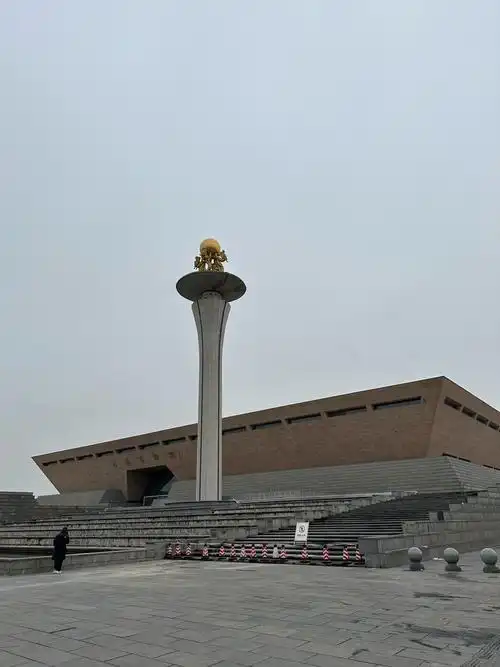
The new museum commands a vast 300-mu site of roughly 50 acres, with 62,000 square meters of floor space. Its exterior draws directly on the form of a "ding," the four-legged bronze ritual cauldron that symbolized imperial authority in ancient China, evoking the classical phrase "Ding Ding Luoyi," meaning to fix the imperial cauldron at Luoyang. The bold, monolithic design recalls the geometric severity of a Greek temple fused with the civic monumentality of a European national museum, while modern lighting and soaring galleries create an immersive setting for the treasures within.
The collection of more than 21,800 objects includes over 5,400 designated national treasures. Standouts feature bronze ritual vessels from the Xia, Shang, and Zhou dynasties, Han and Tang dynasty tomb figurines, and exquisite Tang sancai three-color ceramics. The signature piece, a pristine jade cup from the Cao Wei period, is hailed as the pinnacle of Wei-Jin aesthetic refinement. Equally breathtaking is a Tang black-glazed horse, one of only two surviving examples worldwide, alongside an eight-ton Han dynasty stone bixie, a mythological guardian creature that once flanked an imperial tomb.
Entry is free, but visitors must book through the museum's official WeChat mini-program up to three days in advance, with passport details required. The museum opens Tuesday through Sunday from 9:00 a.m. to 7:00 p.m., with last entry at 6:30 p.m., and is closed on Mondays except during Chinese public holidays. Bilingual audio guides in Chinese and English are available for rental, and free guided tours depart at scheduled times. Allow at least two and a half to three hours for a thorough visit, and note that facilities within the complex are well-equipped for international travelers.
Begin on the second floor in the Treasure Hall to admire the signature pieces, including the Cao Wei jade cup and the black-glazed horse, before descending through the chronological galleries covering Bronze Age ritual bronzes and Han-Tang funerary art. Light-colored clothing or traditional Hanfu photographs beautifully against the warm-toned stone interiors. Avoid weekend mornings when domestic tour groups peak, and ignore ticket scalvers near the entrance, as all services run through official channels.
Founded in 1958 and relocated to its purpose-built home in 2011, Luoyang Museum chronicles thirteen dynasties that ruled from this ancient capital, spanning from the earliest Bronze Age cultures through the Northern Song period. When the first Shang kings established their court here around 1600 BCE, contemporary civilizations were raising the great pyramids of Egypt and constructing the palaces of Knossos. Few cities on earth can claim such continuous political importance across four thousand years, making this institution a vital window into the foundational centuries of East Asian civilization.
The new museum commands a vast 300-mu site of roughly 50 acres, with 62,000 square meters of floor space. Its exterior draws directly on the form of a "ding," the four-legged bronze ritual cauldron that symbolized imperial authority in ancient China, evoking the classical phrase "Ding Ding Luoyi," meaning to fix the imperial cauldron at Luoyang. The bold, monolithic design recalls the geometric severity of a Greek temple fused with the civic monumentality of a European national museum, while modern lighting and soaring galleries create an immersive setting for the treasures within.
The collection of more than 21,800 objects includes over 5,400 designated national treasures. Standouts feature bronze ritual vessels from the Xia, Shang, and Zhou dynasties, Han and Tang dynasty tomb figurines, and exquisite Tang sancai three-color ceramics. The signature piece, a pristine jade cup from the Cao Wei period, is hailed as the pinnacle of Wei-Jin aesthetic refinement. Equally breathtaking is a Tang black-glazed horse, one of only two surviving examples worldwide, alongside an eight-ton Han dynasty stone bixie, a mythological guardian creature that once flanked an imperial tomb.
Entry is free, but visitors must book through the museum's official WeChat mini-program up to three days in advance, with passport details required. The museum opens Tuesday through Sunday from 9:00 a.m. to 7:00 p.m., with last entry at 6:30 p.m., and is closed on Mondays except during Chinese public holidays. Bilingual audio guides in Chinese and English are available for rental, and free guided tours depart at scheduled times. Allow at least two and a half to three hours for a thorough visit, and note that facilities within the complex are well-equipped for international travelers.
Begin on the second floor in the Treasure Hall to admire the signature pieces, including the Cao Wei jade cup and the black-glazed horse, before descending through the chronological galleries covering Bronze Age ritual bronzes and Han-Tang funerary art. Light-colored clothing or traditional Hanfu photographs beautifully against the warm-toned stone interiors. Avoid weekend mornings when domestic tour groups peak, and ignore ticket scalvers near the entrance, as all services run through official channels.