White Horse Temple
⭐ 4.70
Wenshan Prefecture, Yunnan, China
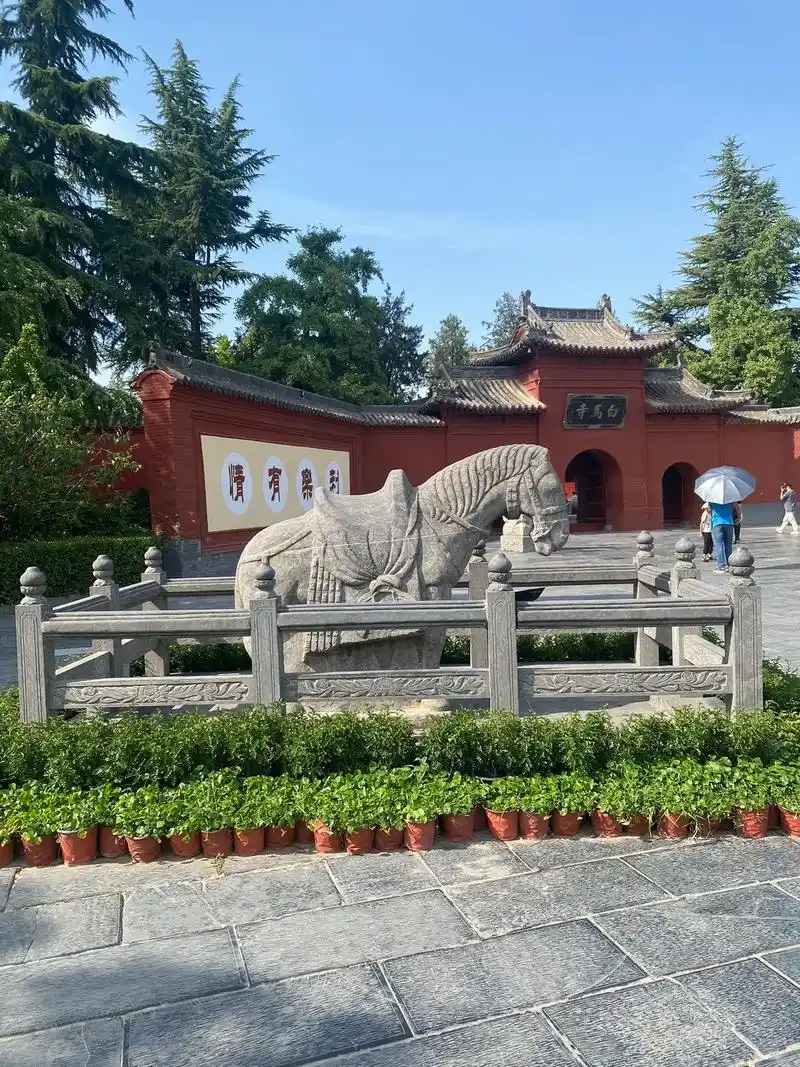 Founded in 68 AD—roughly when Rome was rebuilding after Nero's fire and just decades after Pompeii's destruction—White Horse Temple emerged from one of antiquity's most consequential cultural exchanges. According to tradition, Emperor Ming dispatched envoys west in search of Buddhist teachings; they returned bearing sutras on two white horses, prompting the emperor to commission a temple in their honor. Comparable to how Constantine later patronized Christianity in the Roman Empire, this act formalized Buddhism's recognition by the Chinese state and launched a spiritual tradition that would eventually reach Korea and Japan.
The temple follows a classic north-south axial layout typical of imperial Chinese sacred architecture, beginning with the Mountain Gate and progressing through the Hall of Heavenly Kings, the Great Buddha Hall, the Mahavira Hall, the Hall of Guidance, and concluding at the Cool Terrace, where Emperor Ming reportedly once studied. Flanking the axis stand bell and drum towers alongside east and west galleries. The Mahavira Hall shelters eighteen Yuan-dynasty Arhat statues crafted in the rare hollow dry-lacquer technique, an intricate method as painstakingly devotional as medieval European reliquary craftsmanship.
White Horse Temple is venerated as the "Ancestral Court" and "Source of the Teaching" of Han Buddhism, occupying a position similar to that of Canterbury for English Christianity or Saint Catherine's Monastery for Eastern Orthodox tradition. The Qiyun Pagoda, one of China's earliest surviving reliquary towers, traces the Indian stupa's transformation into a distinctly Chinese form. Yuan-era lacquer figures represent the pinnacle of ancient sculptural artistry, while the International Buddhist Garden, with replicas of temples from Thailand, Myanmar, and India, embodies the Silk Road's enduring legacy of cross-civilizational dialogue.
Entry requires advance reservation via the WeChat official account "Luoyang Baima Si" up to seven days ahead, with tickets priced at 35 RMB per person. The temple opens daily from 7:40 AM to 6:00 PM, with last admission at 5:30 PM. Vegetarian meals are available for just 15 RMB—a notable bargain—and visitors can pay via WeChat or Alipay. A cultural-creative shop offers affordable souvenirs. For inquiries, contact 0379-63789090. Weekends and holidays see heavier crowds, so early morning visits suit those seeking tranquility.
Plan a full morning or afternoon: the recommended route—Mountain Gate, Hall of Heavenly Kings, Mahavira Hall, Hall of Guidance, Cool Terrace, Qiyun Pagoda courtyard, and International Buddhist Garden—takes roughly four to six hours. Arriving early rewards visitors with serene atmosphere; the Silent Tea House near the entrance offers complimentary tea, and a daily 10:00 AM circumambulation ceremony at Qiyun Pagoda invites participation. After exploring, wander into Luoyang's old town to sample local specialties like peony silver-thread pastries, weaving together ancient temple serenity and the everyday rhythms of the Heluo region.
Founded in 68 AD—roughly when Rome was rebuilding after Nero's fire and just decades after Pompeii's destruction—White Horse Temple emerged from one of antiquity's most consequential cultural exchanges. According to tradition, Emperor Ming dispatched envoys west in search of Buddhist teachings; they returned bearing sutras on two white horses, prompting the emperor to commission a temple in their honor. Comparable to how Constantine later patronized Christianity in the Roman Empire, this act formalized Buddhism's recognition by the Chinese state and launched a spiritual tradition that would eventually reach Korea and Japan.
The temple follows a classic north-south axial layout typical of imperial Chinese sacred architecture, beginning with the Mountain Gate and progressing through the Hall of Heavenly Kings, the Great Buddha Hall, the Mahavira Hall, the Hall of Guidance, and concluding at the Cool Terrace, where Emperor Ming reportedly once studied. Flanking the axis stand bell and drum towers alongside east and west galleries. The Mahavira Hall shelters eighteen Yuan-dynasty Arhat statues crafted in the rare hollow dry-lacquer technique, an intricate method as painstakingly devotional as medieval European reliquary craftsmanship.
White Horse Temple is venerated as the "Ancestral Court" and "Source of the Teaching" of Han Buddhism, occupying a position similar to that of Canterbury for English Christianity or Saint Catherine's Monastery for Eastern Orthodox tradition. The Qiyun Pagoda, one of China's earliest surviving reliquary towers, traces the Indian stupa's transformation into a distinctly Chinese form. Yuan-era lacquer figures represent the pinnacle of ancient sculptural artistry, while the International Buddhist Garden, with replicas of temples from Thailand, Myanmar, and India, embodies the Silk Road's enduring legacy of cross-civilizational dialogue.
Entry requires advance reservation via the WeChat official account "Luoyang Baima Si" up to seven days ahead, with tickets priced at 35 RMB per person. The temple opens daily from 7:40 AM to 6:00 PM, with last admission at 5:30 PM. Vegetarian meals are available for just 15 RMB—a notable bargain—and visitors can pay via WeChat or Alipay. A cultural-creative shop offers affordable souvenirs. For inquiries, contact 0379-63789090. Weekends and holidays see heavier crowds, so early morning visits suit those seeking tranquility.
Plan a full morning or afternoon: the recommended route—Mountain Gate, Hall of Heavenly Kings, Mahavira Hall, Hall of Guidance, Cool Terrace, Qiyun Pagoda courtyard, and International Buddhist Garden—takes roughly four to six hours. Arriving early rewards visitors with serene atmosphere; the Silent Tea House near the entrance offers complimentary tea, and a daily 10:00 AM circumambulation ceremony at Qiyun Pagoda invites participation. After exploring, wander into Luoyang's old town to sample local specialties like peony silver-thread pastries, weaving together ancient temple serenity and the everyday rhythms of the Heluo region.