Longmen Grottoes
⭐ 5.00
Longmen Grottoes Scenic Area, Luoyang City, Henan Province, China
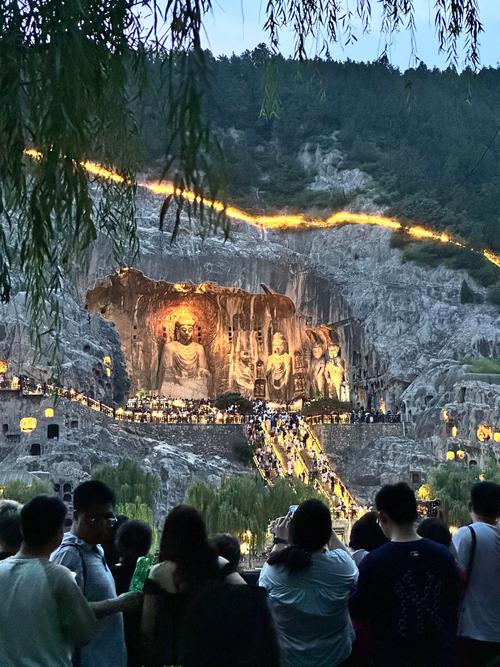 Excavation began around 493 AD when Emperor Xiaowen of Northern Wei moved his capital to Luoyang, then one of the world's largest cities alongside Constantinople and Ctesiphon. For more than four centuries, successive dynasties chiseled their devotion into the limestone cliffs flanking the Yi River. Comparable in ambition to the great medieval cathedrals of Europe—think Chartres or Cologne—the grottoes transformed a natural canyon into a vast open-air sanctuary. The Northern Wei and Tang periods produced the most iconic sculptures, mirroring artistic shifts seen in the West as classical restraint gave way to Baroque exuberance.
The site stretches along both western and eastern bluffs of the Yi River, where monks, court artisans, and common donors hollowed out 2,340 niches to house more than 100,000 Buddhist images. The undisputed masterpiece is the Vairocana Buddha at Fengxian Temple, standing 17.14 meters tall—roughly the height of a five-story building. Its serene, full-cheeked face is widely believed to be modeled on Empress Wu Zetian, China's only female emperor, whose political ambitions reshaped the Tang court much as powerful monarchs influenced cathedral patronage in medieval Europe.
Beyond Fengxian, the three Bingyang Grottoes display the restrained majesty of Northern Wei imperial patronage, their upright guardian figures echoing the stately procession of saints at cathedrals like Reims. The Guyang Cave holds some of China's finest early calligraphic inscriptions—the celebrated "Twenty Pieces of Longmen," a benchmark of Wei-style script comparable to the Carolingian minuscule of Latin Europe. Wanfo Cave lives up to its name ("Ten Thousand Buddhas"), its walls blanketed by thousands of miniature seated Buddhas—an effect reminiscent of jewel-encrusted medieval reliquaries.
Designated a UNESCO World Heritage Site in 2000, Longmen is far more than a scenic marvel. It functions as a stone archive of Chinese political, religious, and artistic history—inscribed poems reveal everyday life, steles document imperial decrees, and statues track the evolution of Buddhist iconography across dynasties. Scholars of calligraphy, architecture, and East Asian religion treat it as essential to their field as Chartres is to students of French Gothic. The caves embody a meeting of statecraft and popular devotion, with donors ranging from empresses to local merchants.
The scenic area charges 90 yuan (roughly $13) for a full ticket covering the western cliffs, eastern cliffs, Xiangshan Temple, and Bai Juyi's former garden. Tickets must be reserved in advance through the official Longmen Grottoes WeChat account under a real-name booking. Plan a route of Western Caves → footbridge → Eastern Caves → Xiangshan Temple → Bai Garden, allowing three to four hours total; a highlights-only western circuit takes under two. Mornings offer the softest light for photography, while summer evenings feature illuminated night tours.
Wear sturdy non-slip shoes—the trail covers three to four kilometers with many steps—and bring sun protection plus water in warmer months. Audio guides and licensed human guides are highly recommended to decode the symbolism behind each niche. Families can extend the visit with the adjacent Xiangshan Temple and the elegant garden tomb of Tang poet Bai Juyi. For Western travelers tracing the Silk Road's spiritual heritage, Longmen offers a moving counterpoint to Byzantium and Rome—places where Buddhist East and Christian West each shaped stone into enduring visions of the divine.
Excavation began around 493 AD when Emperor Xiaowen of Northern Wei moved his capital to Luoyang, then one of the world's largest cities alongside Constantinople and Ctesiphon. For more than four centuries, successive dynasties chiseled their devotion into the limestone cliffs flanking the Yi River. Comparable in ambition to the great medieval cathedrals of Europe—think Chartres or Cologne—the grottoes transformed a natural canyon into a vast open-air sanctuary. The Northern Wei and Tang periods produced the most iconic sculptures, mirroring artistic shifts seen in the West as classical restraint gave way to Baroque exuberance.
The site stretches along both western and eastern bluffs of the Yi River, where monks, court artisans, and common donors hollowed out 2,340 niches to house more than 100,000 Buddhist images. The undisputed masterpiece is the Vairocana Buddha at Fengxian Temple, standing 17.14 meters tall—roughly the height of a five-story building. Its serene, full-cheeked face is widely believed to be modeled on Empress Wu Zetian, China's only female emperor, whose political ambitions reshaped the Tang court much as powerful monarchs influenced cathedral patronage in medieval Europe.
Beyond Fengxian, the three Bingyang Grottoes display the restrained majesty of Northern Wei imperial patronage, their upright guardian figures echoing the stately procession of saints at cathedrals like Reims. The Guyang Cave holds some of China's finest early calligraphic inscriptions—the celebrated "Twenty Pieces of Longmen," a benchmark of Wei-style script comparable to the Carolingian minuscule of Latin Europe. Wanfo Cave lives up to its name ("Ten Thousand Buddhas"), its walls blanketed by thousands of miniature seated Buddhas—an effect reminiscent of jewel-encrusted medieval reliquaries.
Designated a UNESCO World Heritage Site in 2000, Longmen is far more than a scenic marvel. It functions as a stone archive of Chinese political, religious, and artistic history—inscribed poems reveal everyday life, steles document imperial decrees, and statues track the evolution of Buddhist iconography across dynasties. Scholars of calligraphy, architecture, and East Asian religion treat it as essential to their field as Chartres is to students of French Gothic. The caves embody a meeting of statecraft and popular devotion, with donors ranging from empresses to local merchants.
The scenic area charges 90 yuan (roughly $13) for a full ticket covering the western cliffs, eastern cliffs, Xiangshan Temple, and Bai Juyi's former garden. Tickets must be reserved in advance through the official Longmen Grottoes WeChat account under a real-name booking. Plan a route of Western Caves → footbridge → Eastern Caves → Xiangshan Temple → Bai Garden, allowing three to four hours total; a highlights-only western circuit takes under two. Mornings offer the softest light for photography, while summer evenings feature illuminated night tours.
Wear sturdy non-slip shoes—the trail covers three to four kilometers with many steps—and bring sun protection plus water in warmer months. Audio guides and licensed human guides are highly recommended to decode the symbolism behind each niche. Families can extend the visit with the adjacent Xiangshan Temple and the elegant garden tomb of Tang poet Bai Juyi. For Western travelers tracing the Silk Road's spiritual heritage, Longmen offers a moving counterpoint to Byzantium and Rome—places where Buddhist East and Christian West each shaped stone into enduring visions of the divine.