Huguo Temple
⭐ 3.20
Huguo Temple Scenic Area, Tianchang City, Chuzhou City, Anhui Province, China
 **Historical Origins**
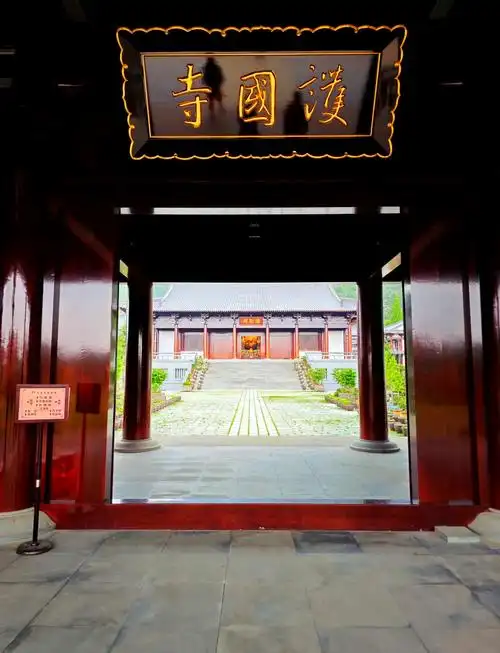
The temple was first raised in 1865, the fourth year of the Tongzhi reign of the Qing Dynasty—a year that resonates globally as the closing of America's Civil War and the unification campaigns of Italy and Germany. After repeated destruction through the early modern era, the site received approval for reconstruction in 1984, with rebuilding work beginning in 1987. Today the monastery occupies about 60 mu (roughly 4 hectares) with over 4,000 square meters of built space. The gate plaque carries the calligraphy of the late Zhao Puchu, the revered Buddhist leader credited with reviving Chinese Buddhism after the Cultural Revolution. Note: online sources sometimes wrongly label it a thousand-year-old site or place it in Nanchang—both are myths.
**Architecture and Layout**
Designed in the style of Suzhou and Yangzhou monasteries, the complex employs the traditional Chinese principle of "changing scenery with every step," a planning philosophy Western visitors may recognize from Italian Renaissance villa gardens such as Tivoli or Villa d'Este. The grounds divide neatly into a sacred zone and a leisure zone. The first contains the imperious Hall of Heavenly Kings, the majestic Mahavira Hall, and the Jade Buddha Tower; the second weaves around the Xing Garden, Yiran Pavilion, and Yicheng Fortlet, all threaded by lotus pools and ornamental plantings. The result is a compact yet richly varied experience fusing religious solemnity with Jiangnan garden lyricism.
**Cultural Treasures**
The temple's most distinctive monument is the Erxian Hall, or "Hall of Two Worthies," which uniquely venerates two local heroes side by side: the Northern Song magistrate Bao Zheng (999–1062), China's most celebrated incorruptible official—often likened to a folk Solomon or the medieval ideal of the just judge—and the filial son Zhu Shouchang, who legendarily traversed five provinces in search of his long-lost mother. Together they embody the Confucian ideals of integrity and filial piety that anchor Chinese civic culture. Elsewhere, Qing-dynasty stone lions, a curious boulder said to bear "immortal footprints," a nine-dragon wall, and a stele corridor inscribed with centuries of poetry reward the curious visitor.
**Practical Visit Information**
Admission is a modest 8 yuan (about one US dollar), and tickets can be purchased at the gate—no reservation required. Opening hours typically run 8:00–12:00 and 14:00–18:00. Self-drivers can simply set their navigation to "Tianchang Huguo Temple"; bus routes 1, 2, and 3 stop within a short walk. On-site amenities are limited, so bring your own water, wear sturdy non-slip shoes, and in summer pack insect repellent and sun protection. The temple is small enough to explore in one to two hours, and late-morning or late-afternoon visits are recommended for softer light and smaller crowds.
**Why Visit**
For travelers tracing Chinese civilization beyond the marquee sites of Beijing and Xi'an, Huguo Temple offers an unusually rich concentration of history, garden art, and folk ethics in a single stop. It pairs easily with a morning visit to the nearby Binghui Memorial Hall in central Tianchang, forming a relaxed half-day cultural walk. Whether you come for the lotus-filled reflections, the chance to stand where Bao Zheng's memory is honored, or simply a quiet hour away from tour buses, the temple delivers a genuinely contemplative experience—proof that China's spiritual heritage thrives well beyond its most famous mountains.
**Historical Origins**
The temple was first raised in 1865, the fourth year of the Tongzhi reign of the Qing Dynasty—a year that resonates globally as the closing of America's Civil War and the unification campaigns of Italy and Germany. After repeated destruction through the early modern era, the site received approval for reconstruction in 1984, with rebuilding work beginning in 1987. Today the monastery occupies about 60 mu (roughly 4 hectares) with over 4,000 square meters of built space. The gate plaque carries the calligraphy of the late Zhao Puchu, the revered Buddhist leader credited with reviving Chinese Buddhism after the Cultural Revolution. Note: online sources sometimes wrongly label it a thousand-year-old site or place it in Nanchang—both are myths.
**Architecture and Layout**
Designed in the style of Suzhou and Yangzhou monasteries, the complex employs the traditional Chinese principle of "changing scenery with every step," a planning philosophy Western visitors may recognize from Italian Renaissance villa gardens such as Tivoli or Villa d'Este. The grounds divide neatly into a sacred zone and a leisure zone. The first contains the imperious Hall of Heavenly Kings, the majestic Mahavira Hall, and the Jade Buddha Tower; the second weaves around the Xing Garden, Yiran Pavilion, and Yicheng Fortlet, all threaded by lotus pools and ornamental plantings. The result is a compact yet richly varied experience fusing religious solemnity with Jiangnan garden lyricism.
**Cultural Treasures**
The temple's most distinctive monument is the Erxian Hall, or "Hall of Two Worthies," which uniquely venerates two local heroes side by side: the Northern Song magistrate Bao Zheng (999–1062), China's most celebrated incorruptible official—often likened to a folk Solomon or the medieval ideal of the just judge—and the filial son Zhu Shouchang, who legendarily traversed five provinces in search of his long-lost mother. Together they embody the Confucian ideals of integrity and filial piety that anchor Chinese civic culture. Elsewhere, Qing-dynasty stone lions, a curious boulder said to bear "immortal footprints," a nine-dragon wall, and a stele corridor inscribed with centuries of poetry reward the curious visitor.
**Practical Visit Information**
Admission is a modest 8 yuan (about one US dollar), and tickets can be purchased at the gate—no reservation required. Opening hours typically run 8:00–12:00 and 14:00–18:00. Self-drivers can simply set their navigation to "Tianchang Huguo Temple"; bus routes 1, 2, and 3 stop within a short walk. On-site amenities are limited, so bring your own water, wear sturdy non-slip shoes, and in summer pack insect repellent and sun protection. The temple is small enough to explore in one to two hours, and late-morning or late-afternoon visits are recommended for softer light and smaller crowds.
**Why Visit**
For travelers tracing Chinese civilization beyond the marquee sites of Beijing and Xi'an, Huguo Temple offers an unusually rich concentration of history, garden art, and folk ethics in a single stop. It pairs easily with a morning visit to the nearby Binghui Memorial Hall in central Tianchang, forming a relaxed half-day cultural walk. Whether you come for the lotus-filled reflections, the chance to stand where Bao Zheng's memory is honored, or simply a quiet hour away from tour buses, the temple delivers a genuinely contemplative experience—proof that China's spiritual heritage thrives well beyond its most famous mountains.