Qianduo Scenic Area
⭐ 4.20
Qianduo Scenic Area, Xinghua City, Taizhou City, Jiangsu Province, China
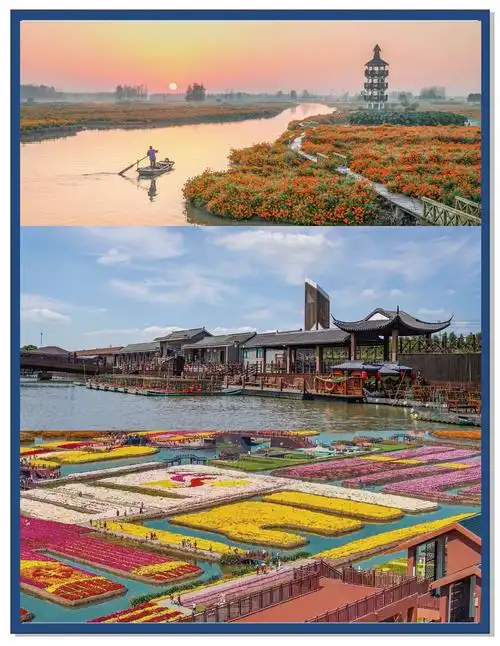 Sprawling across the low-lying marshlands of northern Jiangsu, Qianduo's distinctive "duotian" fields emerged roughly seven centuries ago when ancestors in the Xinghua region devised an ingenious solution to their waterlogged environment. Facing conditions similar to those that later challenged Dutch engineers building their famous polders, local farmers dredged mud from channels and piled it into raised platforms, creating thousands of individual arable islands surrounded by navigable waterways. This organic, generationally refined system—so different from Europe's mechanically drained farmland—represents a remarkable chapter in the global story of human adaptation to wetlands.
Each duotian plot rises several feet above the water surface, surrounded on all sides by canals that serve simultaneously as irrigation channels, flood buffers, and transportation routes. From an elevated observation tower, the patchwork resembles a vast golden chessboard in spring, or a mirror-strewn mosaic of emerald and ochre in other seasons. Visitors can wander elevated wooden boardwalks threading between the plots or glide through the narrow channels aboard traditional sculling boats, an experience often compared to drifting through a living Impressionist painting.
The undisputed highlight is the late-March to mid-April rapeseed bloom, when an estimated 10,000 mu (roughly 670 hectares) of duotian erupt simultaneously into brilliant yellow. The effect draws photographers from across Asia and beyond—imagine, on a far grander scale, the tulip fields of Holland reflected across a watery labyrinth. Canola cultivation here follows centuries-old rhythms, and the flowers eventually yield the seed pressed into the region's prized cooking oil, a process visitors can observe at the on-site traditional workshop.
Beyond its visual drama, Qianduo functions as a "living" heritage site where farming continues as it has for generations. UNESCO recognition in 2013 placed Xinghua's duotian alongside other agricultural marvels like Peru's Andean terraces and the Philippines' Banaue rice paddies, honoring indigenous land-management wisdom that modern engineering is only beginning to appreciate. The ancient oil-pressing demonstrations, using stone mills and wooden presses, complete the circle from blossom to bottle and offer a tangible connection to centuries of rural craftsmanship.
Located roughly 10 kilometers from Xinghua city center (about 2 hours' drive from Nanjing or 4 hours from Shanghai), the scenic area offers a combined ticket and boat pass for around 100 RMB during peak season. Allow two to three hours for a satisfying visit. Facilities include the observation tower, boat docks, boardwalks, and rest pavilions. For a tranquil experience and better photographs, arrive on weekday mornings when crowds thin out and soft light gilds the fields.
Qianduo offers something genuinely rare on the international tourism map: an encounter with an agricultural tradition still pulsing with life, paired with one of the planet's most photogenic seasonal flower displays. Travelers pairing the site with the nearby Li Zhong Water Forest and the historic Jindongmen Old Street can easily craft a rewarding two-day itinerary, sampling regional specialties like fish balls, drunken crab, and Shagou fish-head soup along the way.
Sprawling across the low-lying marshlands of northern Jiangsu, Qianduo's distinctive "duotian" fields emerged roughly seven centuries ago when ancestors in the Xinghua region devised an ingenious solution to their waterlogged environment. Facing conditions similar to those that later challenged Dutch engineers building their famous polders, local farmers dredged mud from channels and piled it into raised platforms, creating thousands of individual arable islands surrounded by navigable waterways. This organic, generationally refined system—so different from Europe's mechanically drained farmland—represents a remarkable chapter in the global story of human adaptation to wetlands.
Each duotian plot rises several feet above the water surface, surrounded on all sides by canals that serve simultaneously as irrigation channels, flood buffers, and transportation routes. From an elevated observation tower, the patchwork resembles a vast golden chessboard in spring, or a mirror-strewn mosaic of emerald and ochre in other seasons. Visitors can wander elevated wooden boardwalks threading between the plots or glide through the narrow channels aboard traditional sculling boats, an experience often compared to drifting through a living Impressionist painting.
The undisputed highlight is the late-March to mid-April rapeseed bloom, when an estimated 10,000 mu (roughly 670 hectares) of duotian erupt simultaneously into brilliant yellow. The effect draws photographers from across Asia and beyond—imagine, on a far grander scale, the tulip fields of Holland reflected across a watery labyrinth. Canola cultivation here follows centuries-old rhythms, and the flowers eventually yield the seed pressed into the region's prized cooking oil, a process visitors can observe at the on-site traditional workshop.
Beyond its visual drama, Qianduo functions as a "living" heritage site where farming continues as it has for generations. UNESCO recognition in 2013 placed Xinghua's duotian alongside other agricultural marvels like Peru's Andean terraces and the Philippines' Banaue rice paddies, honoring indigenous land-management wisdom that modern engineering is only beginning to appreciate. The ancient oil-pressing demonstrations, using stone mills and wooden presses, complete the circle from blossom to bottle and offer a tangible connection to centuries of rural craftsmanship.
Located roughly 10 kilometers from Xinghua city center (about 2 hours' drive from Nanjing or 4 hours from Shanghai), the scenic area offers a combined ticket and boat pass for around 100 RMB during peak season. Allow two to three hours for a satisfying visit. Facilities include the observation tower, boat docks, boardwalks, and rest pavilions. For a tranquil experience and better photographs, arrive on weekday mornings when crowds thin out and soft light gilds the fields.
Qianduo offers something genuinely rare on the international tourism map: an encounter with an agricultural tradition still pulsing with life, paired with one of the planet's most photogenic seasonal flower displays. Travelers pairing the site with the nearby Li Zhong Water Forest and the historic Jindongmen Old Street can easily craft a rewarding two-day itinerary, sampling regional specialties like fish balls, drunken crab, and Shagou fish-head soup along the way.