Qin Lake Wetland Park
⭐ 4.50
Qin Lake Wetland Park, Xinghua City, Taizhou City, Jiangsu Province, China
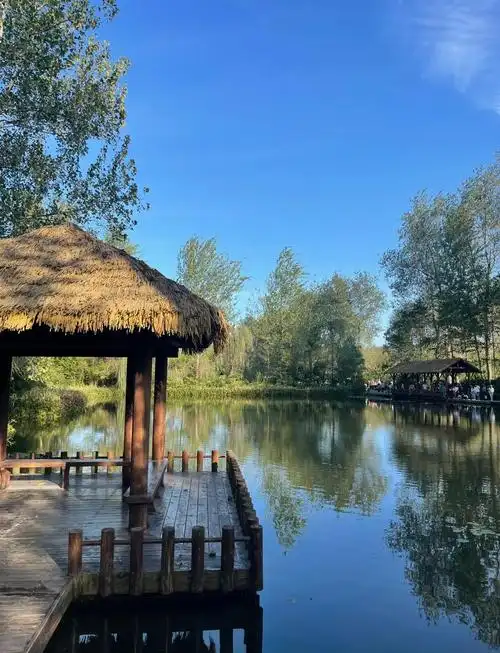 Qinhu Wetland Park sits in the heart of Jiangsu's Lixiahe lowlands, a region shaped by centuries of river management that recalls the marshy origins of Europe's great deltas. Covering roughly 807 hectares with 73 percent wetlands, the park centers on a 2.1-square-kilometer lake where nine rivers merge into a striking jade-pendant formation known locally as "Nine Dragons Facing the Throne"—a layout as singular as the branching channels of the Danube Delta. Water quality consistently meets China's Class II standards, and the area preserves one of East China's most intact wetland ecosystems, fed by tributaries that once linked grain barges to the imperial capital.
The park is a stronghold for creatures that have vanished from much of their former range, including the milu deer—better known in the West as Père David's deer, named for the 19th-century French missionary Armand David who first described them to European science. More than 180 of these animals now roam the park's dedicated reserve, joined by red-crowned cranes and the critically endangered Chinese alligator. In 2023, the site joined China's list of nationally important terrestrial wildlife habitats. Rowing-boat tours thread through reed labyrinths where boatwomen sing traditional water-town ballads, offering encounters reminiscent of a Norfolk Broads cruise, but in a distinctly Chinese setting.
Human history here stretches back over a thousand years. The surviving Shousheng Temple dates to the Song Dynasty (960–1279), contemporary with Europe's Norman cathedrals, and its pagoda still offers panoramic views across the lake and lotus fields. Equally compelling is the annual Qintong Boat Festival, a national-level intangible cultural heritage event held around the Qingming Festival, when thousands of decorated boats converge in a spectacle dubbed "the world's largest water-borne temple fair." Visitors arriving in spring can witness living folk traditions that rival Venice's historic regattas in scale and pageantry.
Families will find the park particularly rewarding. The three-story Wetland Science Museum features interactive exhibits titled "Tracing Qinhu" and "Kidneys of the Earth," teaching children about wetland ecology through hands-on displays. The dedicated milu deer enclosure allows safe, close-range photography, while shallow boardwalks let younger visitors spot frogs, dragonflies, and blooming lotus up close. Combined with gentle rowing-boat rides, the park functions as an open-air classroom where conservation concepts come alive far more vividly than any textbook.
Plan for four to six hours, mixing walking with boat rides, so comfortable walking shoes are essential. The park opens 08:30–17:00, with last entry at 15:30; adult tickets run 72–80 yuan and typically include the ferry shuttle, while rowing-boat experiences and deer-feeding activities cost extra. Children and seniors enjoy discounted admission. Drivers should navigate to "1 Qinhu Avenue"; parking costs about 10 yuan. Public transport via Taizhou Bus 818 is infrequent, so renting a car or hiring a driver is strongly recommended over relying on the bus.
Summer, especially August, brings blooming lotus flowers and temperatures 3–5°C cooler than nearby Taizhou city, making it an ideal hot-weather refuge. Spring delivers the unforgettable boat festival. After exploring the wetlands, visitors can stroll next door to Qintong Ancient Town, a Ming-Qing era canal settlement, and sample the celebrated "Eight Fresh Delicacies of Qinhu"—a catch of river fish, shrimp, and crab that rivals any Mediterranean seafood platter. Few places combine accessible wildlife viewing, deep cultural roots, and freshwater scenery this compelling within easy reach of Shanghai or Nanjing.
Qinhu Wetland Park sits in the heart of Jiangsu's Lixiahe lowlands, a region shaped by centuries of river management that recalls the marshy origins of Europe's great deltas. Covering roughly 807 hectares with 73 percent wetlands, the park centers on a 2.1-square-kilometer lake where nine rivers merge into a striking jade-pendant formation known locally as "Nine Dragons Facing the Throne"—a layout as singular as the branching channels of the Danube Delta. Water quality consistently meets China's Class II standards, and the area preserves one of East China's most intact wetland ecosystems, fed by tributaries that once linked grain barges to the imperial capital.
The park is a stronghold for creatures that have vanished from much of their former range, including the milu deer—better known in the West as Père David's deer, named for the 19th-century French missionary Armand David who first described them to European science. More than 180 of these animals now roam the park's dedicated reserve, joined by red-crowned cranes and the critically endangered Chinese alligator. In 2023, the site joined China's list of nationally important terrestrial wildlife habitats. Rowing-boat tours thread through reed labyrinths where boatwomen sing traditional water-town ballads, offering encounters reminiscent of a Norfolk Broads cruise, but in a distinctly Chinese setting.
Human history here stretches back over a thousand years. The surviving Shousheng Temple dates to the Song Dynasty (960–1279), contemporary with Europe's Norman cathedrals, and its pagoda still offers panoramic views across the lake and lotus fields. Equally compelling is the annual Qintong Boat Festival, a national-level intangible cultural heritage event held around the Qingming Festival, when thousands of decorated boats converge in a spectacle dubbed "the world's largest water-borne temple fair." Visitors arriving in spring can witness living folk traditions that rival Venice's historic regattas in scale and pageantry.
Families will find the park particularly rewarding. The three-story Wetland Science Museum features interactive exhibits titled "Tracing Qinhu" and "Kidneys of the Earth," teaching children about wetland ecology through hands-on displays. The dedicated milu deer enclosure allows safe, close-range photography, while shallow boardwalks let younger visitors spot frogs, dragonflies, and blooming lotus up close. Combined with gentle rowing-boat rides, the park functions as an open-air classroom where conservation concepts come alive far more vividly than any textbook.
Plan for four to six hours, mixing walking with boat rides, so comfortable walking shoes are essential. The park opens 08:30–17:00, with last entry at 15:30; adult tickets run 72–80 yuan and typically include the ferry shuttle, while rowing-boat experiences and deer-feeding activities cost extra. Children and seniors enjoy discounted admission. Drivers should navigate to "1 Qinhu Avenue"; parking costs about 10 yuan. Public transport via Taizhou Bus 818 is infrequent, so renting a car or hiring a driver is strongly recommended over relying on the bus.
Summer, especially August, brings blooming lotus flowers and temperatures 3–5°C cooler than nearby Taizhou city, making it an ideal hot-weather refuge. Spring delivers the unforgettable boat festival. After exploring the wetlands, visitors can stroll next door to Qintong Ancient Town, a Ming-Qing era canal settlement, and sample the celebrated "Eight Fresh Delicacies of Qinhu"—a catch of river fish, shrimp, and crab that rivals any Mediterranean seafood platter. Few places combine accessible wildlife viewing, deep cultural roots, and freshwater scenery this compelling within easy reach of Shanghai or Nanjing.