Taizhou Museum
⭐ 4.20
Taizhou Museum, Hailing District, Taizhou, Jiangsu Province, China
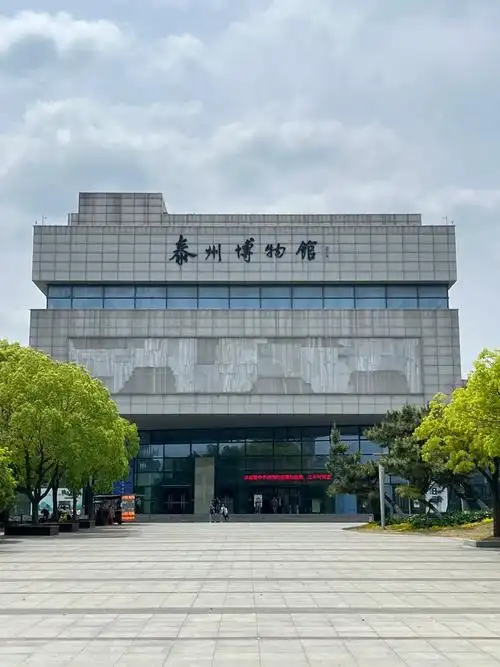 The Taizhou Museum occupies a 22,000-square-meter modern complex in the heart of the city's cultural district, just south of the historic Drum Tower. Taizhou has been a thriving settlement since the Neolithic era, and its position on the Grand Canal—one of humanity's most ambitious engineering feats, comparable in scale to the Roman road network—made it a vital hub from the Six Dynasties period (220–589 CE) onward. The permanent exhibition, "Ancient Prefecture of the Han and Tang," traces this two-thousand-year journey through pottery, stone inscriptions, and relics of Wang Gen, founder of the influential Taizhou School of philosophy during the Ming era.
Inside the spacious, climate-controlled halls, a tri-level layout guides visitors through three signature collections. The ground floor anchors the historical narrative; the second floor houses the celebrated "Ming Dynasty Costumes" gallery, featuring more than 300 excavated garments including an exceptionally rare third-rank civil official's robe—comparable in significance to the Tudor and Stuart wardrobes preserved at London's Hampton Court Palace. The third floor rotates displays of Six Dynasties celadon, including a stunning chicken-head ewer from the Southern Dynasties, alongside Ming hexagonal Yixing teapots, gilded Han Dynasty bronze mirrors, and Qing Dynasty ivory artifacts.
Among the museum's most talked-about exhibits are two naturally desiccated Ming Dynasty mummies, husband and wife, interred in their official court robes—an extraordinary preservation phenomenon that draws comparisons to Europe's peat bog bodies and the mummified remains in Sicily's Capuchin Catacombs. Equally intriguing is the world's only complete male elk subfossil, a paleontological marvel unearthed locally. For lovers of decorative arts, the Ming hexagonal Yixing teapots serve as standard reference pieces for collectors, while the calligraphy collection offers insight into a literary tradition that flourished alongside Renaissance Europe's manuscript culture.
Taizhou's role in shaping Chinese intellectual and commercial history cannot be overstated. The Wang Gen documents illuminate a philosophical movement that championed the innate wisdom of ordinary people—a parallel to Reformation-era emphasis on individual conscience. The museum's research contributions to Ming funerary costume studies have positioned it as an international reference point for textile historians, while its celadon holdings illustrate the technical mastery achieved by Chinese kilns centuries before Meissen introduced porcelain production to Europe in the early 18th century.
The museum opens Tuesday through Sunday from 9:00 AM to 5:00 PM, with last entry at 4:30 PM; Monday is the closing day, except during public holidays. During summer, Friday through Sunday hours extend to 6:00 PM. Admission is free, though advance reservation through the WeChat mini-program "Water Charm Jiangsu" is required for domestic visitors. Foreign tourists with a valid passport enjoy streamlined entry via facial recognition or staffed verification. Label text is primarily in Chinese, so visitors can use translation apps with QR scanning features; volunteer guides occasionally offer English-language tours—check announcements on arrival.
Allow two to three hours for a thorough experience, ideally arriving on a weekday morning when crowds thin. Photography is permitted without flash, but tripods and leaning on display cases are forbidden; some special exhibitions prohibit photography entirely. An interactive folk craft zone offers hands-on pottery and movable-type printing workshops—a rare opportunity similar to craft demonstrations at London's V&A or Paris's Musée des Arts Décoratifs. After touring, stroll to nearby Taizhou Old Street for crab-roe soup dumplings, or take an evening cruise on Fengcheng River to soak in the city's enchanting canal-side ambiance.
The Taizhou Museum occupies a 22,000-square-meter modern complex in the heart of the city's cultural district, just south of the historic Drum Tower. Taizhou has been a thriving settlement since the Neolithic era, and its position on the Grand Canal—one of humanity's most ambitious engineering feats, comparable in scale to the Roman road network—made it a vital hub from the Six Dynasties period (220–589 CE) onward. The permanent exhibition, "Ancient Prefecture of the Han and Tang," traces this two-thousand-year journey through pottery, stone inscriptions, and relics of Wang Gen, founder of the influential Taizhou School of philosophy during the Ming era.
Inside the spacious, climate-controlled halls, a tri-level layout guides visitors through three signature collections. The ground floor anchors the historical narrative; the second floor houses the celebrated "Ming Dynasty Costumes" gallery, featuring more than 300 excavated garments including an exceptionally rare third-rank civil official's robe—comparable in significance to the Tudor and Stuart wardrobes preserved at London's Hampton Court Palace. The third floor rotates displays of Six Dynasties celadon, including a stunning chicken-head ewer from the Southern Dynasties, alongside Ming hexagonal Yixing teapots, gilded Han Dynasty bronze mirrors, and Qing Dynasty ivory artifacts.
Among the museum's most talked-about exhibits are two naturally desiccated Ming Dynasty mummies, husband and wife, interred in their official court robes—an extraordinary preservation phenomenon that draws comparisons to Europe's peat bog bodies and the mummified remains in Sicily's Capuchin Catacombs. Equally intriguing is the world's only complete male elk subfossil, a paleontological marvel unearthed locally. For lovers of decorative arts, the Ming hexagonal Yixing teapots serve as standard reference pieces for collectors, while the calligraphy collection offers insight into a literary tradition that flourished alongside Renaissance Europe's manuscript culture.
Taizhou's role in shaping Chinese intellectual and commercial history cannot be overstated. The Wang Gen documents illuminate a philosophical movement that championed the innate wisdom of ordinary people—a parallel to Reformation-era emphasis on individual conscience. The museum's research contributions to Ming funerary costume studies have positioned it as an international reference point for textile historians, while its celadon holdings illustrate the technical mastery achieved by Chinese kilns centuries before Meissen introduced porcelain production to Europe in the early 18th century.
The museum opens Tuesday through Sunday from 9:00 AM to 5:00 PM, with last entry at 4:30 PM; Monday is the closing day, except during public holidays. During summer, Friday through Sunday hours extend to 6:00 PM. Admission is free, though advance reservation through the WeChat mini-program "Water Charm Jiangsu" is required for domestic visitors. Foreign tourists with a valid passport enjoy streamlined entry via facial recognition or staffed verification. Label text is primarily in Chinese, so visitors can use translation apps with QR scanning features; volunteer guides occasionally offer English-language tours—check announcements on arrival.
Allow two to three hours for a thorough experience, ideally arriving on a weekday morning when crowds thin. Photography is permitted without flash, but tripods and leaning on display cases are forbidden; some special exhibitions prohibit photography entirely. An interactive folk craft zone offers hands-on pottery and movable-type printing workshops—a rare opportunity similar to craft demonstrations at London's V&A or Paris's Musée des Arts Décoratifs. After touring, stroll to nearby Taizhou Old Street for crab-roe soup dumplings, or take an evening cruise on Fengcheng River to soak in the city's enchanting canal-side ambiance.