Mei Lanfang Memorial Hall
⭐ 3.50
Mei Lanfang Memorial Hall, Hailing District, Taizhou City, Jiangsu Province, China
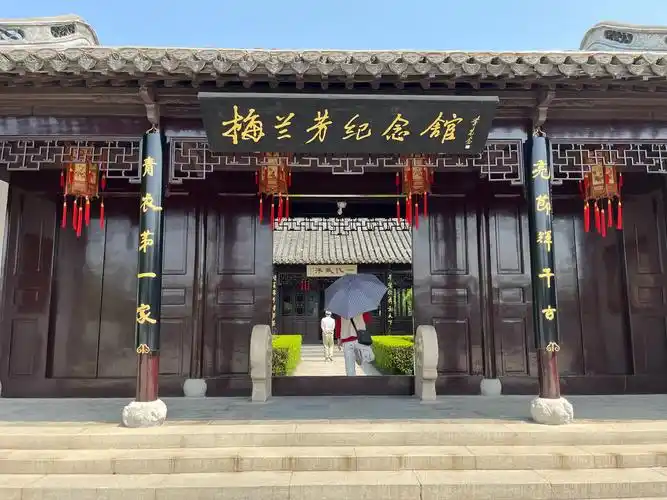 Mei Lanfang (1894–1961) ranks among the most celebrated performing artists of the modern era, often compared to Western theatrical luminaries like Sarah Bernhardt or Laurence Olivier for his transformative influence on his art form. Born in Beijing to a family originally from Taizhou, he founded the "Mei School" and led the legendary "Four Great Dan" actresses, just as the great opera divas defined European stages. His signature roles in "Farewell My Concubine" and "The Drunken Beauty" earned international acclaim, while his defiant refusal to perform during the Japanese occupation—growing a beard as a mark of resistance—echoes the moral courage of artists who became cultural guardians during wartime. The hall's collections trace this remarkable journey from prodigy to international icon.
The complex embodies classical Ming-Qing architectural refinement, comparable in spirit to Europe's Renaissance-era villa museums where art and landscape design merge into a unified aesthetic experience. Three sides embrace the river, with pavilions, towers, and covered walkways arranged around Phoenix Mound in the manner of a classical Jiangnan garden—think of an Oriental counterpart to the Italian Renaissance garden at Villa d'Este, where every vista rewards contemplation. At the heart stands a dignified white-marble seated statue of Mei, while a reconstructed ancient theater stage with painted beams and bracket sets offers an evocative space for periodic performances. Wisteria-draped corridors and riverside pavilions complete the picturesque setting.
Five thematic galleries deploy sound, light, and video technology to bring Mei's artistic achievements and patriotic spirit vividly to life, progressing from "Plum Blossoms Across China" to "Roots in Taizhou"—a narrative arc that links personal genius to homeland heritage. Beyond its appeal to opera enthusiasts, the museum serves as a living classroom where younger visitors encounter traditional Chinese aesthetics and the values of cultural resilience. Its compact scale belies a cultural significance that resonates far beyond Taizhou, situating Mei alongside those rare artists who shaped not only their art but their nation's identity on the world stage.
The memorial is located at 90 Yingchun East Road, Hailing District, inside Meiyuan (Plum Garden), within easy walking distance of the historic Wanghailou Tower and Taoyuan. It is open Tuesday through Sunday from 9:00 a.m. to 4:30 p.m., with last entry at 4:00 p.m.; Monday closures apply except during national holidays. Visitors should bring a passport or ID for entry registration. Children under 1.2 meters and seniors over 70 enter free, and advance phone confirmation is recommended before visiting.
Allow roughly 1.5 to 2 hours for a thorough visit, following the suggested route: statue square, five galleries, opera colonnade, ancient theater stage, and riverside pavilions. Spring, when plum blossoms perfume the grounds, offers the most photogenic experience. The site pairs naturally with the historic Taizhou Old Street, Wanghailou, and Taoyuan along the Fengcheng River scenic corridor. Visitors may encounter impromptu performances by amateur opera enthusiasts, while study groups can arrange guided tours in advance for richer cultural context.
This is a destination where world-class artistic heritage meets the tranquil beauty of a classical Chinese garden—rarely can a museum claim such dual distinction. Whether you arrive as a devoted fan of Chinese opera or simply a curious traveler seeking a more contemplative experience beyond Taizhou's busier sights, the Mei Lanfang Memorial Hall rewards those who approach it with patience and curiosity.
Mei Lanfang (1894–1961) ranks among the most celebrated performing artists of the modern era, often compared to Western theatrical luminaries like Sarah Bernhardt or Laurence Olivier for his transformative influence on his art form. Born in Beijing to a family originally from Taizhou, he founded the "Mei School" and led the legendary "Four Great Dan" actresses, just as the great opera divas defined European stages. His signature roles in "Farewell My Concubine" and "The Drunken Beauty" earned international acclaim, while his defiant refusal to perform during the Japanese occupation—growing a beard as a mark of resistance—echoes the moral courage of artists who became cultural guardians during wartime. The hall's collections trace this remarkable journey from prodigy to international icon.
The complex embodies classical Ming-Qing architectural refinement, comparable in spirit to Europe's Renaissance-era villa museums where art and landscape design merge into a unified aesthetic experience. Three sides embrace the river, with pavilions, towers, and covered walkways arranged around Phoenix Mound in the manner of a classical Jiangnan garden—think of an Oriental counterpart to the Italian Renaissance garden at Villa d'Este, where every vista rewards contemplation. At the heart stands a dignified white-marble seated statue of Mei, while a reconstructed ancient theater stage with painted beams and bracket sets offers an evocative space for periodic performances. Wisteria-draped corridors and riverside pavilions complete the picturesque setting.
Five thematic galleries deploy sound, light, and video technology to bring Mei's artistic achievements and patriotic spirit vividly to life, progressing from "Plum Blossoms Across China" to "Roots in Taizhou"—a narrative arc that links personal genius to homeland heritage. Beyond its appeal to opera enthusiasts, the museum serves as a living classroom where younger visitors encounter traditional Chinese aesthetics and the values of cultural resilience. Its compact scale belies a cultural significance that resonates far beyond Taizhou, situating Mei alongside those rare artists who shaped not only their art but their nation's identity on the world stage.
The memorial is located at 90 Yingchun East Road, Hailing District, inside Meiyuan (Plum Garden), within easy walking distance of the historic Wanghailou Tower and Taoyuan. It is open Tuesday through Sunday from 9:00 a.m. to 4:30 p.m., with last entry at 4:00 p.m.; Monday closures apply except during national holidays. Visitors should bring a passport or ID for entry registration. Children under 1.2 meters and seniors over 70 enter free, and advance phone confirmation is recommended before visiting.
Allow roughly 1.5 to 2 hours for a thorough visit, following the suggested route: statue square, five galleries, opera colonnade, ancient theater stage, and riverside pavilions. Spring, when plum blossoms perfume the grounds, offers the most photogenic experience. The site pairs naturally with the historic Taizhou Old Street, Wanghailou, and Taoyuan along the Fengcheng River scenic corridor. Visitors may encounter impromptu performances by amateur opera enthusiasts, while study groups can arrange guided tours in advance for richer cultural context.
This is a destination where world-class artistic heritage meets the tranquil beauty of a classical Chinese garden—rarely can a museum claim such dual distinction. Whether you arrive as a devoted fan of Chinese opera or simply a curious traveler seeking a more contemplative experience beyond Taizhou's busier sights, the Mei Lanfang Memorial Hall rewards those who approach it with patience and curiosity.