Jiangyan Beishan Temple
⭐ 2.50
Beishan Temple, Jiangyan District, Taizhou City, Jiangsu Province, China
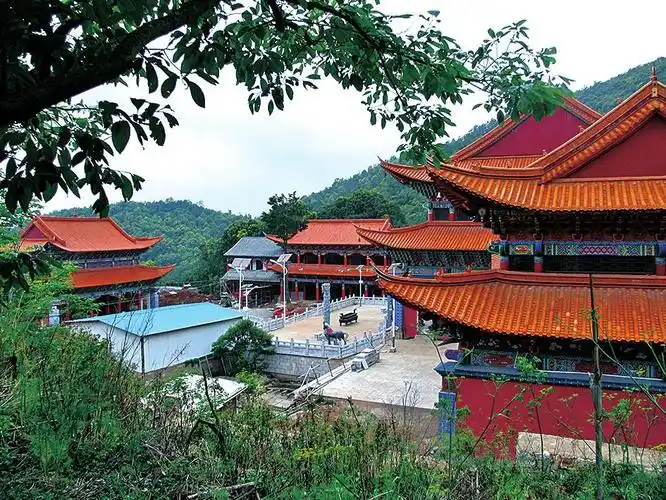 Beishan Temple traces its origins to 825 AD, during the Baoli era of the Tang Dynasty—a period when Chinese civilization flourished along the Silk Road while much of Western Europe was still consolidating after the fall of Rome. Comparable in age to early medieval European foundations such as England's Canterbury or Germany's Reichenau, the temple received its current name in the Song Dynasty and became one of Taizhou's "Nine Great Monasteries." Eminent monks including Chan master Zhiguang and the unconventional Deng Huoqu once resided here, lending the site deep historical gravitas that few provincial Chinese temples can match.
The temple's centerpiece is the Mahavira Hall, reconstructed in 1626 during the late Ming Dynasty—contemporary with Europe's Thirty Years' War. The hall's roof collapsed during a devastating 2008 snowstorm, but craftsmen painstakingly restored its original double-eaved, hip-and-gable silhouette by 2010. Inside, the intricate dougong bracket system and timber frame survive remarkably intact, representing a rare example of official Ming construction technique in the Taizhou region. Visitors familiar with Beijing's Forbidden City will recognize the same architectural grammar, here scaled down for provincial use.
Beyond its Buddhist function, Beishan Temple intertwines with the Taizhou School of philosophy, a Ming-era Confucian movement emphasizing innate moral knowledge and accessible learning for ordinary people. The site thus bridges two great currents of Chinese thought—Chan Buddhism and the humanistic Taizhou School led by thinkers such as Wang Gen and Yan Jun. The adjacent Zhuoxi Spring, an ancient well linked to legends of a meditating monk striking his staff into the earth to summon water, forms the temple's second cultural anchor. Together, hall and spring create a layered space where religious devotion and folk memory coexist.
Located on the north side of Yangzhou Road in Hailing District's old quarter, the temple is small, quiet, and free to enter, with hours typically running 6:30 AM to 5:30 PM, adjusted to religious observances. As an active place of worship, visitors should dress modestly, speak softly, and refrain from photographing the main hall interior. English signage is essentially nonexistent, so foreign travelers should save the Chinese address in advance or use a translation app. Allow 15 to 30 minutes on site.
Though modest in scale, Beishan Temple rewards travelers seeking authentic atmosphere over blockbuster monuments. Its location in Taizhou's historic core invites pairing with the winding lanes and courtyard homes of the nearby Daohe Ancient Block, the larger Guangxiao Temple, and the Mei Lanfang Memorial Hall honoring the legendary Peking opera artist born in this city. The surrounding old town offers limited parking, so a taxi or public bus is recommended. Confirm current opening status via the local cultural tourism WeChat account before setting out, and enjoy a contemplative detour far from the typical tour bus circuit.
Beishan Temple traces its origins to 825 AD, during the Baoli era of the Tang Dynasty—a period when Chinese civilization flourished along the Silk Road while much of Western Europe was still consolidating after the fall of Rome. Comparable in age to early medieval European foundations such as England's Canterbury or Germany's Reichenau, the temple received its current name in the Song Dynasty and became one of Taizhou's "Nine Great Monasteries." Eminent monks including Chan master Zhiguang and the unconventional Deng Huoqu once resided here, lending the site deep historical gravitas that few provincial Chinese temples can match.
The temple's centerpiece is the Mahavira Hall, reconstructed in 1626 during the late Ming Dynasty—contemporary with Europe's Thirty Years' War. The hall's roof collapsed during a devastating 2008 snowstorm, but craftsmen painstakingly restored its original double-eaved, hip-and-gable silhouette by 2010. Inside, the intricate dougong bracket system and timber frame survive remarkably intact, representing a rare example of official Ming construction technique in the Taizhou region. Visitors familiar with Beijing's Forbidden City will recognize the same architectural grammar, here scaled down for provincial use.
Beyond its Buddhist function, Beishan Temple intertwines with the Taizhou School of philosophy, a Ming-era Confucian movement emphasizing innate moral knowledge and accessible learning for ordinary people. The site thus bridges two great currents of Chinese thought—Chan Buddhism and the humanistic Taizhou School led by thinkers such as Wang Gen and Yan Jun. The adjacent Zhuoxi Spring, an ancient well linked to legends of a meditating monk striking his staff into the earth to summon water, forms the temple's second cultural anchor. Together, hall and spring create a layered space where religious devotion and folk memory coexist.
Located on the north side of Yangzhou Road in Hailing District's old quarter, the temple is small, quiet, and free to enter, with hours typically running 6:30 AM to 5:30 PM, adjusted to religious observances. As an active place of worship, visitors should dress modestly, speak softly, and refrain from photographing the main hall interior. English signage is essentially nonexistent, so foreign travelers should save the Chinese address in advance or use a translation app. Allow 15 to 30 minutes on site.
Though modest in scale, Beishan Temple rewards travelers seeking authentic atmosphere over blockbuster monuments. Its location in Taizhou's historic core invites pairing with the winding lanes and courtyard homes of the nearby Daohe Ancient Block, the larger Guangxiao Temple, and the Mei Lanfang Memorial Hall honoring the legendary Peking opera artist born in this city. The surrounding old town offers limited parking, so a taxi or public bus is recommended. Confirm current opening status via the local cultural tourism WeChat account before setting out, and enjoy a contemplative detour far from the typical tour bus circuit.