Fengcheng River Scenic Area
⭐ 4.20
Fengcheng River Scenic Area, Hailing District, Taizhou City, Jiangsu Province, China
 The Fengcheng Moat was first excavated in 958 AD during the Southern Tang dynasty, in an era when Western Europe was still under the shadow of the Holy Roman Empire's Otto I and Byzantium's militarized frontiers. Its 11-kilometer course made Taizhou a vital node on China's Grand Canal salt-trade network, much as Bruges or Lübeck rose to prosperity through waterborne commerce in medieval Europe. The moat's distinctive "double-water" design—where two linked channels fully embrace the old walled city—remains one of the most complete urban moat systems surviving in East Asia, comparable in defensive urbanism to the fortified canals of Dutch towns like Amersfoort.
The moat threads together more than thirty points of interest, anchored by Wanghai Tower, the so-called "First Tower of the Jianghuai Region." Rising at the southern corner, this multi-story pavilion echoes the belvedere watchtowers of Italian Renaissance cities such as Bergamo and offers a sweeping panorama of the entire water system. Nearby, the Plum Garden commemorates Peking opera legend Mei Lanfang, while the Peach Garden evokes the Qing-dynasty retreat of scholar Chen An. Lined with willow, pagoda silhouettes, and reflective waters, the embankments form a layered historical canvas where every bend reveals a temple, ancestral hall, or restored city wall fragment.
Taizhou's identity as China's "Hometown of Opera" finds its stage along these very banks. The Plum Garden houses the memorial to Mei Lanfang, a theatrical figure whose global influence on stagecraft parallels that of Sarah Bernhardt or Enrico Caruso in the West. Throughout the year, performers stage Kunqu and Peking opera excerpts beside the water, while evening light installations transform centuries-old embankments into open-air galleries. The moat itself witnessed Taizhou's transformation from a salt-trade powerbroker under the Ming and Qing dynasties into a regional cultural capital, embodying the East Asian ideal where commerce, art, and civic life intertwine.
Access is refreshingly easy. Public pedestrian walkways along both moat banks are open free of charge around the clock, while individual historic sites such as Wanghai Tower and the Peach Garden typically operate from 08:30 to 17:30. The signature experience is the 45-minute illuminated boat tour, departing from the Ancient Salt Canal dock at roughly 60–80 yuan per person; in summer, sailings are concentrated between 19:30 and 21:30 when light-and-water projections are at their most dramatic. Tickets for some gardens are sold separately and can be reserved through the official tourism platform or your hotel concierge.
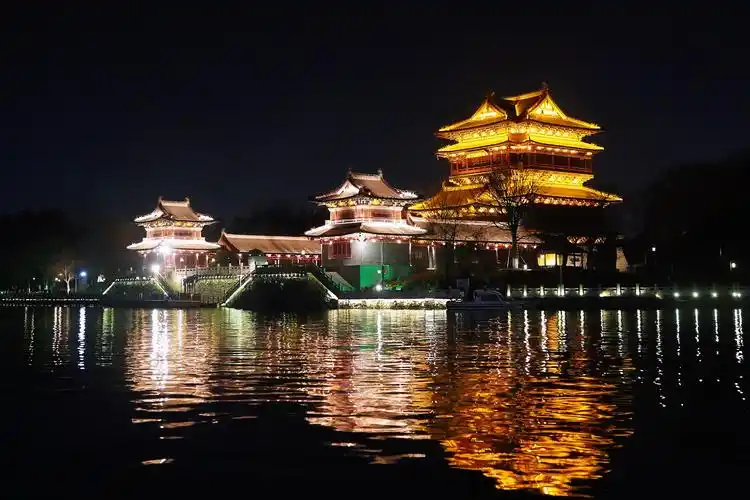
The Fengcheng Moat shines brightest between dusk and nightfall, when lantern-lit reflections blur the line between water and architecture. A classic route begins with a sunset climb up Wanghai Tower for the bird's-eye view, followed by a leisurely cruise to take in the illuminated bridges and floating light shows, and ends with a wander through Taizhou Old Street, where vendors sell dalou shaobing (crisp layered flatbreads) and the legendary yutang mian, a delicate fish-broth noodle soup. Spring visitors should time their trip for late March or April, when peach blossoms crowd the riverside; summer travelers will want to choose early-morning or post-sunset hours and pack sunscreen and mosquito repellent.
The Fengcheng Moat was first excavated in 958 AD during the Southern Tang dynasty, in an era when Western Europe was still under the shadow of the Holy Roman Empire's Otto I and Byzantium's militarized frontiers. Its 11-kilometer course made Taizhou a vital node on China's Grand Canal salt-trade network, much as Bruges or Lübeck rose to prosperity through waterborne commerce in medieval Europe. The moat's distinctive "double-water" design—where two linked channels fully embrace the old walled city—remains one of the most complete urban moat systems surviving in East Asia, comparable in defensive urbanism to the fortified canals of Dutch towns like Amersfoort.
The moat threads together more than thirty points of interest, anchored by Wanghai Tower, the so-called "First Tower of the Jianghuai Region." Rising at the southern corner, this multi-story pavilion echoes the belvedere watchtowers of Italian Renaissance cities such as Bergamo and offers a sweeping panorama of the entire water system. Nearby, the Plum Garden commemorates Peking opera legend Mei Lanfang, while the Peach Garden evokes the Qing-dynasty retreat of scholar Chen An. Lined with willow, pagoda silhouettes, and reflective waters, the embankments form a layered historical canvas where every bend reveals a temple, ancestral hall, or restored city wall fragment.
Taizhou's identity as China's "Hometown of Opera" finds its stage along these very banks. The Plum Garden houses the memorial to Mei Lanfang, a theatrical figure whose global influence on stagecraft parallels that of Sarah Bernhardt or Enrico Caruso in the West. Throughout the year, performers stage Kunqu and Peking opera excerpts beside the water, while evening light installations transform centuries-old embankments into open-air galleries. The moat itself witnessed Taizhou's transformation from a salt-trade powerbroker under the Ming and Qing dynasties into a regional cultural capital, embodying the East Asian ideal where commerce, art, and civic life intertwine.
Access is refreshingly easy. Public pedestrian walkways along both moat banks are open free of charge around the clock, while individual historic sites such as Wanghai Tower and the Peach Garden typically operate from 08:30 to 17:30. The signature experience is the 45-minute illuminated boat tour, departing from the Ancient Salt Canal dock at roughly 60–80 yuan per person; in summer, sailings are concentrated between 19:30 and 21:30 when light-and-water projections are at their most dramatic. Tickets for some gardens are sold separately and can be reserved through the official tourism platform or your hotel concierge.
The Fengcheng Moat shines brightest between dusk and nightfall, when lantern-lit reflections blur the line between water and architecture. A classic route begins with a sunset climb up Wanghai Tower for the bird's-eye view, followed by a leisurely cruise to take in the illuminated bridges and floating light shows, and ends with a wander through Taizhou Old Street, where vendors sell dalou shaobing (crisp layered flatbreads) and the legendary yutang mian, a delicate fish-broth noodle soup. Spring visitors should time their trip for late March or April, when peach blossoms crowd the riverside; summer travelers will want to choose early-morning or post-sunset hours and pack sunscreen and mosquito repellent.