Yingxiongshan Park
⭐ 2.00
Yingxiongshan Park, Taishan District, Tai'an City, Shandong Province, China
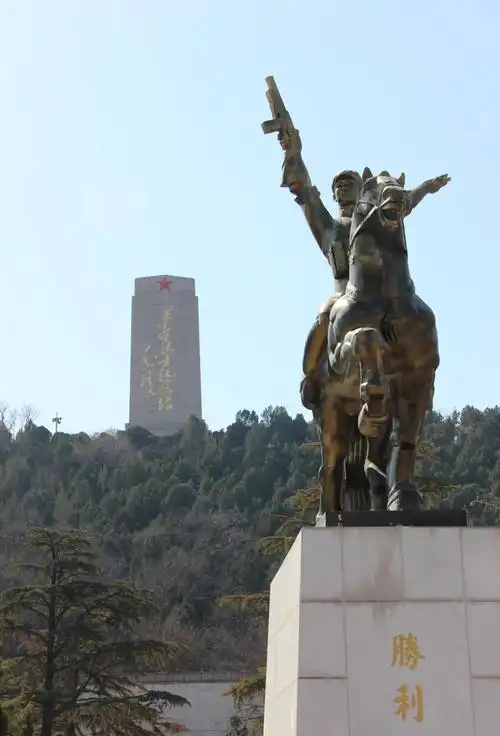 Heroes Mountain occupies a singular place in China's imperial cosmology, functioning for over two thousand years as the ritual counterpart to nearby Mount Tai. While Mount Tai—analogous in spiritual stature to Olympus or the sacred peaks of Delphi—represented the realm of the living and the emperor's mandate to govern, Heroes Mountain (ancient Gaoli Shan) embodied the domain of the dead, the place where human souls were believed to descend after death. This "birth belongs to Tai, death returns to Gaoli" duality shaped state ceremonies from the Han dynasty onward. Emperors performing the feng and shan sacrifices on Mount Tai would descend to Heroes Mountain to complete the ritual with earth-honoring rites, asking for prosperity and stability for the empire below.
The hill's original sacred architecture has not survived. Grand temple complexes such as the Senluo Hall once crowned the ridge, but these structures fell victim to centuries of war, neglect, and the upheavals of the early twentieth century. No reconstructions have been attempted, and the summit today carries only fragments of carved stone and simple memorial markers. The bare, weathered limestone crest gives the site an austere dignity that many visitors find more moving than polished restoration. It is a place where absence speaks as loudly as presence, inviting reflection on the layers of history compressed into a single, unassuming hill.
Culturally, Heroes Mountain exemplifies what might be called "palimpsest heritage"—a single landscape inscribed with radically different meanings across eras. The first layer is imperial China's cosmological worldview, in which a modest hilltop could carry the metaphysical weight of an entire civilization's relationship with life, death, and cosmic order. The second layer is the founding of the Tai'an Communist Party branch in 1926, an event that transformed the hill into a site of revolutionary memory and gave it the name "Heroes Mountain." For visitors familiar with European sites such as Rome's Quirinal Hill or Athens's Pnyx—where political and sacred functions have layered atop one another for millennia—this compact hill offers a remarkably concentrated example of the same phenomenon.
Practical information for visiting is straightforward and welcoming. The park sits immediately south of Tai'an Railway Station, bounded by Yuhuan Road and Heroes Mountain Road, with multiple bus routes stopping nearby. Admission is free, no reservation is required, and the site is open throughout the day. A complete walking tour takes only twenty to forty minutes, making it ideal for travelers of any age or fitness level. Parking is limited, so those arriving by car should consider public transport. Morning or late-afternoon visits are recommended to avoid Tai'an's harsh midday sun and winter winds, and bringing water is advisable during summer months.
The site's modest scale is precisely its appeal for thoughtful travelers. Because so little remains by way of built structures, visitors are invited to engage with ideas rather than monuments—standing where Han emperors once sought to secure the mandate of heaven, then contemplating the same ridge where early Communist organizers plotted a very different vision of China's future. Beneath your feet, the limestone belongs to the late Cambrian period and contains trilobite fossils roughly five hundred million years old, a quiet reminder that human history occupies only the briefest moment in the hill's existence. Pair a visit here with the Tai'an Municipal Museum for essential context, and allow Heroes Mountain to serve as a meditative counterpoint to the monumental grandeur of Mount Tai itself.
Heroes Mountain occupies a singular place in China's imperial cosmology, functioning for over two thousand years as the ritual counterpart to nearby Mount Tai. While Mount Tai—analogous in spiritual stature to Olympus or the sacred peaks of Delphi—represented the realm of the living and the emperor's mandate to govern, Heroes Mountain (ancient Gaoli Shan) embodied the domain of the dead, the place where human souls were believed to descend after death. This "birth belongs to Tai, death returns to Gaoli" duality shaped state ceremonies from the Han dynasty onward. Emperors performing the feng and shan sacrifices on Mount Tai would descend to Heroes Mountain to complete the ritual with earth-honoring rites, asking for prosperity and stability for the empire below.
The hill's original sacred architecture has not survived. Grand temple complexes such as the Senluo Hall once crowned the ridge, but these structures fell victim to centuries of war, neglect, and the upheavals of the early twentieth century. No reconstructions have been attempted, and the summit today carries only fragments of carved stone and simple memorial markers. The bare, weathered limestone crest gives the site an austere dignity that many visitors find more moving than polished restoration. It is a place where absence speaks as loudly as presence, inviting reflection on the layers of history compressed into a single, unassuming hill.
Culturally, Heroes Mountain exemplifies what might be called "palimpsest heritage"—a single landscape inscribed with radically different meanings across eras. The first layer is imperial China's cosmological worldview, in which a modest hilltop could carry the metaphysical weight of an entire civilization's relationship with life, death, and cosmic order. The second layer is the founding of the Tai'an Communist Party branch in 1926, an event that transformed the hill into a site of revolutionary memory and gave it the name "Heroes Mountain." For visitors familiar with European sites such as Rome's Quirinal Hill or Athens's Pnyx—where political and sacred functions have layered atop one another for millennia—this compact hill offers a remarkably concentrated example of the same phenomenon.
Practical information for visiting is straightforward and welcoming. The park sits immediately south of Tai'an Railway Station, bounded by Yuhuan Road and Heroes Mountain Road, with multiple bus routes stopping nearby. Admission is free, no reservation is required, and the site is open throughout the day. A complete walking tour takes only twenty to forty minutes, making it ideal for travelers of any age or fitness level. Parking is limited, so those arriving by car should consider public transport. Morning or late-afternoon visits are recommended to avoid Tai'an's harsh midday sun and winter winds, and bringing water is advisable during summer months.
The site's modest scale is precisely its appeal for thoughtful travelers. Because so little remains by way of built structures, visitors are invited to engage with ideas rather than monuments—standing where Han emperors once sought to secure the mandate of heaven, then contemplating the same ridge where early Communist organizers plotted a very different vision of China's future. Beneath your feet, the limestone belongs to the late Cambrian period and contains trilobite fossils roughly five hundred million years old, a quiet reminder that human history occupies only the briefest moment in the hill's existence. Pair a visit here with the Tai'an Municipal Museum for essential context, and allow Heroes Mountain to serve as a meditative counterpoint to the monumental grandeur of Mount Tai itself.