Mount Tai Stone Inscriptions
⭐ 4.20
Mount Tai, Taishan District, Tai'an City, Shandong Province, China
 The story begins in 219 BC, when Emperor Qin Shi Huang—contemporary with Rome's Second Punic War—erected the original stele to proclaim his unification of China. What started as a single imperial monument blossomed into a two-thousand-year tradition of imperial pilgrimages, Buddhist devotion, and literati expression. Successive dynasties added their voices, making the mountain a stone chronicle of Chinese history rivaling the Bayeux Tapestry in scope and ambition. Each major era contributed landmark works, creating a complete lineage of Chinese calligraphy written not on silk or paper, but into the bedrock of sacred Mount Tai itself.
The inscriptions unfold along the traditional pilgrimage route in a carefully orchestrated progression. The journey begins at the Dai Temple at the mountain's foot, home to 157 steles including fragments of Li Si's original Qin inscription. As climbers ascend through the Red Gate and toward the Middle Gate, steles and cliff carvings appear with increasing density. The route crescendos at the Diamond Sutra Valley, where the Northern Qi masterpiece dominates, then concludes at the spectacular cliff-face galleries of the summit's Grand View Peak—featuring Tang monumental calligraphy alongside the instantly recognizable "First of the Five Sacred Mountains" inscription.
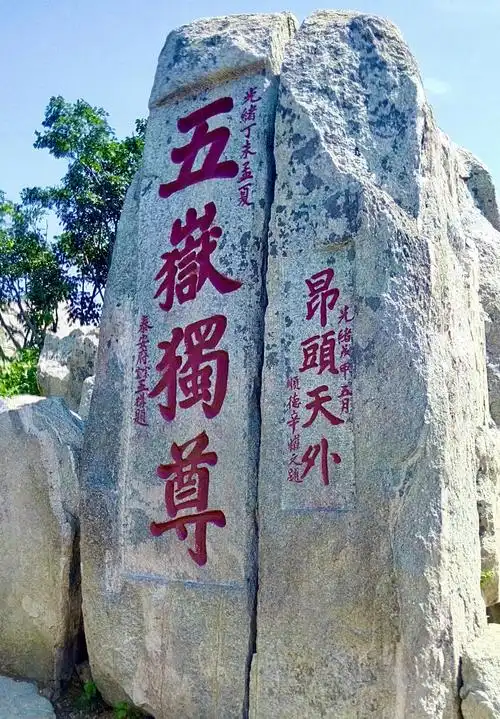
Among the treasures, three stand out for international visitors. Li Si's Qin Dynasty stele represents the only surviving example of standardized small seal script in its original context—a calligraphic form as historically significant to Chinese writing as Trajan's Column inscriptions were to Roman monumental lettering. The Northern Qi Diamond Sutra, with characters exceeding half a meter in height, transforms Buddhist scripture into an awe-inspiring landscape feature. Emperor Xuanzong's 1013-character Tang edict, carved directly into a vast cliff face, rivals the ambition of Roman triumphal inscriptions, while the Qing-dynasty "First of the Five Sacred Mountains" characters became iconic as the backdrop on China's five-yuan banknote.
The cultural significance extends beyond calligraphy into the very heart of Chinese civilization. Mount Tai was considered the earthly gateway to heaven, where emperors performed the Feng and Shan sacrifices to legitimize their rule—making these inscriptions nothing less than the documentary record of two millennia of imperial theology. The works showcase all five major script styles and address Buddhist scripture, Confucian philosophy, and poetic landscape appreciation simultaneously. In 2001, UNESCO recognized this outdoor gallery as part of Mount Tai's World Heritage designation, placing it alongside other cultural landscapes like Stonehenge and Delphi in global significance.
For practical planning, the classic Red Gate walking route covers approximately 9.5 kilometers with nearly 8,000 stone steps—comparable to ascending a small mountain in the Alps. Fit visitors should allow a full day and reserve three hours for descent, with mandatory stops at the Diamond Sutra Valley, the grueling Eighteen Turns staircase, and the summit's Grand View Peak. Less ambitious travelers can begin at the Dai Temple to view the Qin stele fragments before taking the cable car to the summit, which shortens the climb to roughly thirty minutes. Smartphone audio guides are strongly recommended, as they decode crucial phrases like "Boundless Wind and Moon"—a Qing-era pun hidden in plain sight at the summit—and illuminate the layered meanings behind each inscription.
This is not merely a hike with historical decoration, but a journey through the soul of Chinese civilization rendered in stone. Where European cathedrals preserve medieval theology in stained glass and vaulted ceilings, Mount Tai preserves two thousand years of imperial ambition, religious devotion, and artistic refinement in the most permanent medium available. For travelers seeking to understand China beyond its modern cities, the inscriptions offer an unmatched direct connection to its literary, spiritual, and political heritage—an experience as intellectually rewarding as walking through the Parthenon frieze or the corridors of the Vatican, yet entirely unique in its open-air setting.
The story begins in 219 BC, when Emperor Qin Shi Huang—contemporary with Rome's Second Punic War—erected the original stele to proclaim his unification of China. What started as a single imperial monument blossomed into a two-thousand-year tradition of imperial pilgrimages, Buddhist devotion, and literati expression. Successive dynasties added their voices, making the mountain a stone chronicle of Chinese history rivaling the Bayeux Tapestry in scope and ambition. Each major era contributed landmark works, creating a complete lineage of Chinese calligraphy written not on silk or paper, but into the bedrock of sacred Mount Tai itself.
The inscriptions unfold along the traditional pilgrimage route in a carefully orchestrated progression. The journey begins at the Dai Temple at the mountain's foot, home to 157 steles including fragments of Li Si's original Qin inscription. As climbers ascend through the Red Gate and toward the Middle Gate, steles and cliff carvings appear with increasing density. The route crescendos at the Diamond Sutra Valley, where the Northern Qi masterpiece dominates, then concludes at the spectacular cliff-face galleries of the summit's Grand View Peak—featuring Tang monumental calligraphy alongside the instantly recognizable "First of the Five Sacred Mountains" inscription.
Among the treasures, three stand out for international visitors. Li Si's Qin Dynasty stele represents the only surviving example of standardized small seal script in its original context—a calligraphic form as historically significant to Chinese writing as Trajan's Column inscriptions were to Roman monumental lettering. The Northern Qi Diamond Sutra, with characters exceeding half a meter in height, transforms Buddhist scripture into an awe-inspiring landscape feature. Emperor Xuanzong's 1013-character Tang edict, carved directly into a vast cliff face, rivals the ambition of Roman triumphal inscriptions, while the Qing-dynasty "First of the Five Sacred Mountains" characters became iconic as the backdrop on China's five-yuan banknote.
The cultural significance extends beyond calligraphy into the very heart of Chinese civilization. Mount Tai was considered the earthly gateway to heaven, where emperors performed the Feng and Shan sacrifices to legitimize their rule—making these inscriptions nothing less than the documentary record of two millennia of imperial theology. The works showcase all five major script styles and address Buddhist scripture, Confucian philosophy, and poetic landscape appreciation simultaneously. In 2001, UNESCO recognized this outdoor gallery as part of Mount Tai's World Heritage designation, placing it alongside other cultural landscapes like Stonehenge and Delphi in global significance.
For practical planning, the classic Red Gate walking route covers approximately 9.5 kilometers with nearly 8,000 stone steps—comparable to ascending a small mountain in the Alps. Fit visitors should allow a full day and reserve three hours for descent, with mandatory stops at the Diamond Sutra Valley, the grueling Eighteen Turns staircase, and the summit's Grand View Peak. Less ambitious travelers can begin at the Dai Temple to view the Qin stele fragments before taking the cable car to the summit, which shortens the climb to roughly thirty minutes. Smartphone audio guides are strongly recommended, as they decode crucial phrases like "Boundless Wind and Moon"—a Qing-era pun hidden in plain sight at the summit—and illuminate the layered meanings behind each inscription.
This is not merely a hike with historical decoration, but a journey through the soul of Chinese civilization rendered in stone. Where European cathedrals preserve medieval theology in stained glass and vaulted ceilings, Mount Tai preserves two thousand years of imperial ambition, religious devotion, and artistic refinement in the most permanent medium available. For travelers seeking to understand China beyond its modern cities, the inscriptions offer an unmatched direct connection to its literary, spiritual, and political heritage—an experience as intellectually rewarding as walking through the Parthenon frieze or the corridors of the Vatican, yet entirely unique in its open-air setting.