Mount Jiuri
⭐ 3.80
Mount Jiuri Scenic Area, Fengze District, Quanzhou City, Fujian Province, China
 **A Sacred Maritime Outpost**
Long before the Portuguese rounded the Cape of Good Hope, Quanzhou ranked alongside Constantinople and Venice as one of the most cosmopolitan ports on earth. By the 12th century, Arab, Persian, and Southeast Asian merchants crowded its quays, and Chinese officials dubbed it the "First Great Port of the East." A short ride inland brings you to Jiuri Mountain, where the men who governed this maritime boom climbed each year to pray for safe passage. The site is best understood as Quanzhou's answer to a Mediterranean cathedral town—humble in scale, monumental in what it represents.
**The Prayer-for-Wind Steles**
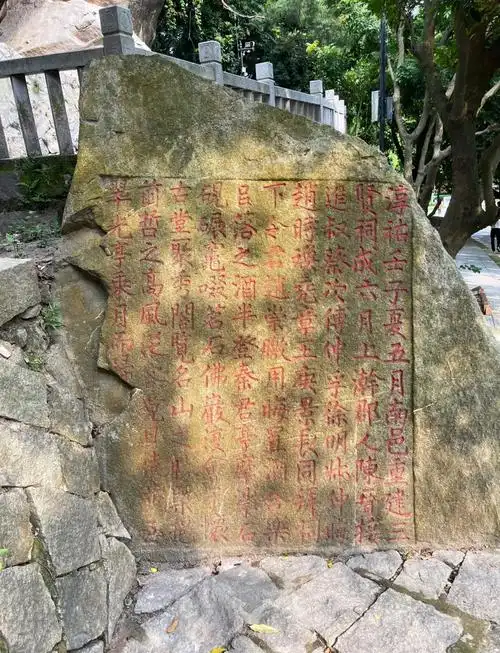
The mountain's crown jewels are ten Song-era inscriptions carved into the cliff faces of the eastern and western peaks. Spanning the reign of Emperor Xiaozong through Emperor Lizong (roughly 1174–1258), they record in meticulous detail the officials of the Maritime Trade Bureau, members of the imperial clan, and foreign envoys who gathered to beseech the gods for favourable winds. Comparable in importance to the Rosetta Stone for deciphering ancient bureaucratic ritual, they are the only such documents to survive anywhere on the planet. In 1991, a UNESCO "Maritime Silk Road" expedition hiked up to view them and left its own commemorative plaque.
**Three Peaks, Three Eras**
Jiuri is shaped like a natural amphitheatre of three wooded summits. The eastern peak, known as Jiang Xiang Peak, holds the tomb of a Tang-dynasty chancellor and bears inscriptions by the Neo-Confucian philosopher Zhu Xi. The western peak, the Gaoshi, is named for a Tang hermit and crowned by a weathered sandstone Amitabha Buddha standing 4.5 metres tall—the earliest surviving rock-carved Buddha in the Quanzhou region, dating to the Five Dynasties period (10th century). The northern slopes cradle the ruins of Yanfu Temple, Zhaohui Shrine, and a granite bridge built during the Song dynasty.
**A Library Carved in Stone**
Beyond the prayer steles, the mountain preserves 78 cliff inscriptions dating from the Song to the Qing dynasties—poems, travelogues, and official notices carved by literati, officials, and foreign visitors. Together they function much like an open-air archive, offering one of the richest epigraphic records of premodern Chinese maritime culture. The site earned designation as a national key cultural relic in 1988 and joined UNESCO's World Heritage List in 2021, placing this quiet hill among the ranks of such globally recognised landmarks as Venice's Rialto or Amsterdam's historic port.
**Planning Your Visit**
Jiuri Mountain is a national AAAA scenic area and free to all visitors, with no advance booking required. It lies in Fengzhou Town of Nan'an city, roughly 7 kilometres southwest of central Quanzhou. Buses are infrequent, so a taxi or ride-hail to the "Jiuri Mountain Scenic Area Parking Lot" is the most reliable option. Gates typically open 08:00–18:00; allow 90 minutes to two hours for a relaxed circuit. Trails are gentle and shaded, suitable for families and older travellers, though the mossy stone steps call for sturdy non-slip footwear.
**Why It Belongs on Your Itinerary**
Most travellers come to Quanzhou for the more famous Kaiyuan Temple or Luoyang Bridge, but Jiuri offers something rarer: an intimate, uncrowded encounter with the human side of the Maritime Silk Road. Visit in spring or autumn, ideally with a local guide or a little preparatory reading on the Song Maritime Trade Bureau, and the stones will reveal an extraordinary story of how medieval China sailed, traded, and prayed. Pair it with the nearby Quanzhou Museum of Maritime History for a full picture of Song-Yuan oceangoing civilisation.
**A Sacred Maritime Outpost**
Long before the Portuguese rounded the Cape of Good Hope, Quanzhou ranked alongside Constantinople and Venice as one of the most cosmopolitan ports on earth. By the 12th century, Arab, Persian, and Southeast Asian merchants crowded its quays, and Chinese officials dubbed it the "First Great Port of the East." A short ride inland brings you to Jiuri Mountain, where the men who governed this maritime boom climbed each year to pray for safe passage. The site is best understood as Quanzhou's answer to a Mediterranean cathedral town—humble in scale, monumental in what it represents.
**The Prayer-for-Wind Steles**
The mountain's crown jewels are ten Song-era inscriptions carved into the cliff faces of the eastern and western peaks. Spanning the reign of Emperor Xiaozong through Emperor Lizong (roughly 1174–1258), they record in meticulous detail the officials of the Maritime Trade Bureau, members of the imperial clan, and foreign envoys who gathered to beseech the gods for favourable winds. Comparable in importance to the Rosetta Stone for deciphering ancient bureaucratic ritual, they are the only such documents to survive anywhere on the planet. In 1991, a UNESCO "Maritime Silk Road" expedition hiked up to view them and left its own commemorative plaque.
**Three Peaks, Three Eras**
Jiuri is shaped like a natural amphitheatre of three wooded summits. The eastern peak, known as Jiang Xiang Peak, holds the tomb of a Tang-dynasty chancellor and bears inscriptions by the Neo-Confucian philosopher Zhu Xi. The western peak, the Gaoshi, is named for a Tang hermit and crowned by a weathered sandstone Amitabha Buddha standing 4.5 metres tall—the earliest surviving rock-carved Buddha in the Quanzhou region, dating to the Five Dynasties period (10th century). The northern slopes cradle the ruins of Yanfu Temple, Zhaohui Shrine, and a granite bridge built during the Song dynasty.
**A Library Carved in Stone**
Beyond the prayer steles, the mountain preserves 78 cliff inscriptions dating from the Song to the Qing dynasties—poems, travelogues, and official notices carved by literati, officials, and foreign visitors. Together they function much like an open-air archive, offering one of the richest epigraphic records of premodern Chinese maritime culture. The site earned designation as a national key cultural relic in 1988 and joined UNESCO's World Heritage List in 2021, placing this quiet hill among the ranks of such globally recognised landmarks as Venice's Rialto or Amsterdam's historic port.
**Planning Your Visit**
Jiuri Mountain is a national AAAA scenic area and free to all visitors, with no advance booking required. It lies in Fengzhou Town of Nan'an city, roughly 7 kilometres southwest of central Quanzhou. Buses are infrequent, so a taxi or ride-hail to the "Jiuri Mountain Scenic Area Parking Lot" is the most reliable option. Gates typically open 08:00–18:00; allow 90 minutes to two hours for a relaxed circuit. Trails are gentle and shaded, suitable for families and older travellers, though the mossy stone steps call for sturdy non-slip footwear.
**Why It Belongs on Your Itinerary**
Most travellers come to Quanzhou for the more famous Kaiyuan Temple or Luoyang Bridge, but Jiuri offers something rarer: an intimate, uncrowded encounter with the human side of the Maritime Silk Road. Visit in spring or autumn, ideally with a local guide or a little preparatory reading on the Song Maritime Trade Bureau, and the stones will reveal an extraordinary story of how medieval China sailed, traded, and prayed. Pair it with the nearby Quanzhou Museum of Maritime History for a full picture of Song-Yuan oceangoing civilisation.