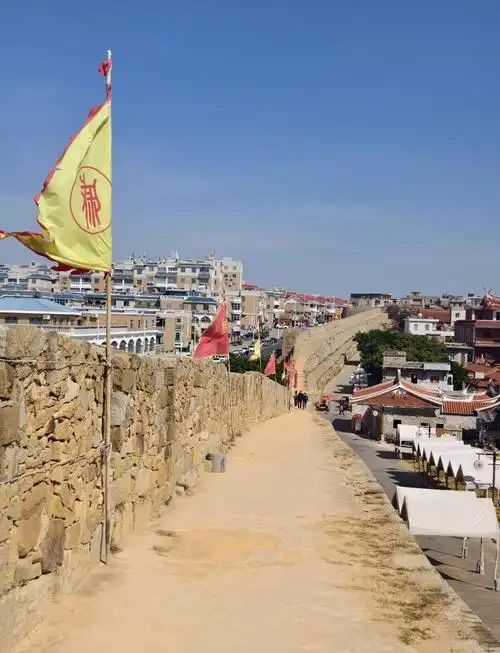
Built in 1387 under orders from the Hongwu Emperor Zhu Yuanzhang, founder of the Ming Dynasty, Chongwu formed the southern anchor of China's anti-pirate defense network along the Fujian coast. Commander Zhou Dexing supervised construction during the same era that witnessed the Hundred Years' War unfold in Europe. While European contemporaries raised curtain walls like those still standing at Beaumaris in Wales or along the Adriatic at Dubrovnik, Ming engineers here fashioned a T-shaped fortress of granite blocks designed to withstand both cannon fire and typhoons. For over six centuries it has stood as a tangible witness to the maritime conflicts that shaped the South China Sea.
The fortress walls stretch 2,467 meters in a distinctive T-formation, built from locally quarried granite ashlar laid with remarkable precision. Standing seven meters tall and broad enough at the summit for a horse patrol, the ramparts incorporate a sophisticated defensive vocabulary: sentinel shelters, elevated watchtowers, half-moon bastions, and a water gate controlling maritime access. Visitors can climb a surviving beacon tower for sweeping views where ancient masonry meets the horizon of the Taiwan Strait. The architectural sophistication echoes Ming's most celebrated projects, such as the Great Wall at Mutianyu or the Forbidden City, yet here the focus is purely martial and coastal.
Beyond its martial heritage, Chongwu harbors a vibrant living community, particularly famous for its Hui'an women, whose distinctive costume of floral headscarf, short-sleeved blouse, and wide silver belt has been recognized as national intangible cultural heritage. Within the ramparts, centuries-old temples like the Song-dynasty Haichao Nunnery and Qing-era Guandi Temple remain active places of worship, while ancestral mansions such as the Zhan and Dafu residences open windows onto the clan-based social fabric of southern Fujian. Stone-carving workshops continue a tradition stretching back generations, producing the carved figures and architectural ornaments that decorate the region. Few Chinese fortifications remain this alive.
The site sits approximately one hour by car or chartered minivan from central Quanzhou, with the Quanyun Travel shuttle providing a budget-friendly alternative. Admission costs 40 yuan per person, which includes access to the Stone Carving Crafts Garden and the wall-walking experience; children under 1.2 meters and visitors over 65 enter free. Summer hours run from 7:00 to 17:30, while winter hours shift to 7:30 to 18:30. Allow at least two to three hours. The recommended route begins at the Shuiguan (Water Gate) entrance, climbs the lighthouse observation platform, then follows the wall-walk clockwise back to the historic core.
What distinguishes Chongwu from China's better-known walled cities like Pingyao or the more heavily restored ramparts of Xi'an is the simultaneous presence of fortification, fishing village, craft tradition, and wild seascape. Few places allow you to trace a Ming sentry's patrol route one hour and watch local fishermen mend nets the next. Sunset over the Taiwan Strait, with the ancient walls silhouetted against orange light, provides one of Fujian's most photographed vistas. Travelers interested in maritime history, ethnographic photography, or escaping the more trodden paths of eastern China will find Chongwu an unexpectedly rewarding detour.