Zhongshan Road Pedestrian Street
⭐ 4.20
Zhongshan Road Pedestrian Street, Licheng District, Quanzhou City, Fujian Province, China
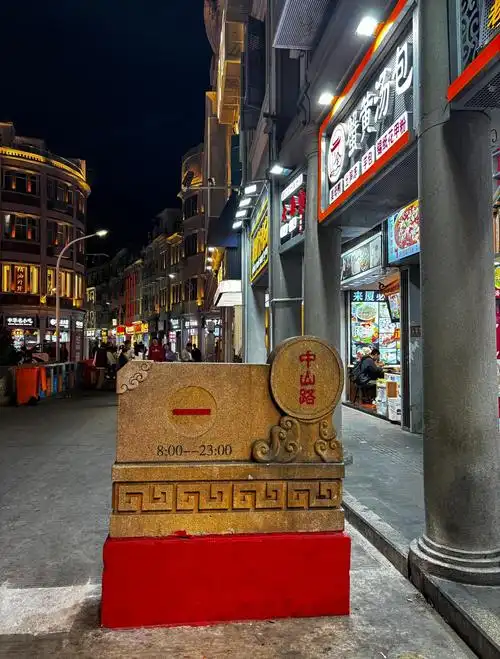 Quanzhou was once among the world's great ports, ranked by Marco Polo alongside Alexandria as one of the planet's most prosperous trading hubs in the 13th century. Zhongshan Road, laid out in 1924 as the commercial spine of this walled city, traces the same north-south axis that has guided travelers for centuries. From the Clock Tower to the ancient Deji Gate ruins and the Tianhou Temple—dedicated to the seafaring goddess Mazu—the avenue carries echoes of Arab, Persian, and European merchants who made this city a cosmopolitan crossroads. Today it stands as a vibrant reminder of when East and West traded freely along the Maritime Silk Road.
The street's defining feature is its remarkable arcade, locally nicknamed "five-foot rack" for the sheltered walkway formed by columns extending from the buildings over the pavement. This ingenious design, reminiscent of Bologna's medieval porticoes or Lisbon's late-19th-century arcades, offers pedestrians refuge from both subtropical sun and sudden rain while creating a continuous covered promenade. The facades fuse three traditions: the warm red brick of Minnan traditional houses, graceful curved colonnades inspired by Singaporean and Penang shophouses brought home by returning overseas Chinese, and ornate Western pediments from the Republican era. The result is a uniquely layered streetscape found nowhere else in China.
Along the route, weathered landmarks tell Quanzhou's layered story: the spire of Quannan Christian Church rises beside the incense-scented Ciji Palace, while vintage shopfronts like the Old Shanghai Barber and a lovingly preserved Xinhua Bookstore recall mid-20th-century daily life. The Overseas Chinese Letter Archive—part of Quanzhou's recognition as a UNESCO World Heritage city since 2021—reveals poignant family correspondence that once connected this port to communities across Southeast Asia. Tucked down narrow side alleys, master craftsmen still practice lacquerware and puppet-head carving, both designated intangible cultural heritage skills.
Zhongshan Road is entirely free to explore and open around the clock, though evening visits are magical when warm lighting traces the arcaded silhouettes. Plan 1.5 to 2 hours for a leisurely walk, pausing at heritage food stalls for stone-flower jelly, silky vermicelli soup, sea-worm jelly, ginger-braised duck, or the celebrated Mass Beef Noodles. Combine your stroll with adjacent West Street, the Confucius Temple, and Kaiyuan Temple for a fuller taste of Quanzhou's UNESCO-listed treasures. Wear flat, non-slip shoes—the original stone paving rewards comfortable footwear, especially during crowded festival periods.
In an era of glass-and-steel shopping malls, Zhongshan Road offers something increasingly rare: a pedestrian street where every column, cornice, and cracked tile tells a story. It is not a reconstructed theme park but a working neighborhood where residents still worship, shop, and gather as their grandparents did a century ago. For travelers seeking an authentic slice of southern Chinese urban heritage—without the crowds or ticket queues of better-known sites—this 2.4-kilometer boulevard delivers an unforgettable, photogenic journey through living history, best savored slowly and with an appetite.
Quanzhou was once among the world's great ports, ranked by Marco Polo alongside Alexandria as one of the planet's most prosperous trading hubs in the 13th century. Zhongshan Road, laid out in 1924 as the commercial spine of this walled city, traces the same north-south axis that has guided travelers for centuries. From the Clock Tower to the ancient Deji Gate ruins and the Tianhou Temple—dedicated to the seafaring goddess Mazu—the avenue carries echoes of Arab, Persian, and European merchants who made this city a cosmopolitan crossroads. Today it stands as a vibrant reminder of when East and West traded freely along the Maritime Silk Road.
The street's defining feature is its remarkable arcade, locally nicknamed "five-foot rack" for the sheltered walkway formed by columns extending from the buildings over the pavement. This ingenious design, reminiscent of Bologna's medieval porticoes or Lisbon's late-19th-century arcades, offers pedestrians refuge from both subtropical sun and sudden rain while creating a continuous covered promenade. The facades fuse three traditions: the warm red brick of Minnan traditional houses, graceful curved colonnades inspired by Singaporean and Penang shophouses brought home by returning overseas Chinese, and ornate Western pediments from the Republican era. The result is a uniquely layered streetscape found nowhere else in China.
Along the route, weathered landmarks tell Quanzhou's layered story: the spire of Quannan Christian Church rises beside the incense-scented Ciji Palace, while vintage shopfronts like the Old Shanghai Barber and a lovingly preserved Xinhua Bookstore recall mid-20th-century daily life. The Overseas Chinese Letter Archive—part of Quanzhou's recognition as a UNESCO World Heritage city since 2021—reveals poignant family correspondence that once connected this port to communities across Southeast Asia. Tucked down narrow side alleys, master craftsmen still practice lacquerware and puppet-head carving, both designated intangible cultural heritage skills.
Zhongshan Road is entirely free to explore and open around the clock, though evening visits are magical when warm lighting traces the arcaded silhouettes. Plan 1.5 to 2 hours for a leisurely walk, pausing at heritage food stalls for stone-flower jelly, silky vermicelli soup, sea-worm jelly, ginger-braised duck, or the celebrated Mass Beef Noodles. Combine your stroll with adjacent West Street, the Confucius Temple, and Kaiyuan Temple for a fuller taste of Quanzhou's UNESCO-listed treasures. Wear flat, non-slip shoes—the original stone paving rewards comfortable footwear, especially during crowded festival periods.
In an era of glass-and-steel shopping malls, Zhongshan Road offers something increasingly rare: a pedestrian street where every column, cornice, and cracked tile tells a story. It is not a reconstructed theme park but a working neighborhood where residents still worship, shop, and gather as their grandparents did a century ago. For travelers seeking an authentic slice of southern Chinese urban heritage—without the crowds or ticket queues of better-known sites—this 2.4-kilometer boulevard delivers an unforgettable, photogenic journey through living history, best savored slowly and with an appetite.