East and West Pagodas
⭐ 4.20
East and West Pagodas, Licheng District, Quanzhou City, Fujian Province, China
 **Historical Context**
The East and West Pagodas were originally wooden structures dating back to the Tang and Five Dynasties periods, but repeated fires prompted wealthy patrons to fund their conversion into stone between 1228 and 1250. This was no small feat: their construction spanned over two decades, contemporary with the building of Notre-Dame de Paris and the great Gothic cathedrals of Europe. For 700 years they have withstood typhoons and earthquakes—a remarkable engineering record that places them alongside Pisa's Leaning Tower (their Italian contemporary at 56 m) as among the most ambitious medieval stone towers ever built. They are the principal monuments of Quanzhou's UNESCO inscription as the "Emporium of the World in Song-Yuan China," recognized in 2021.
**Architecture and Craftsmanship**
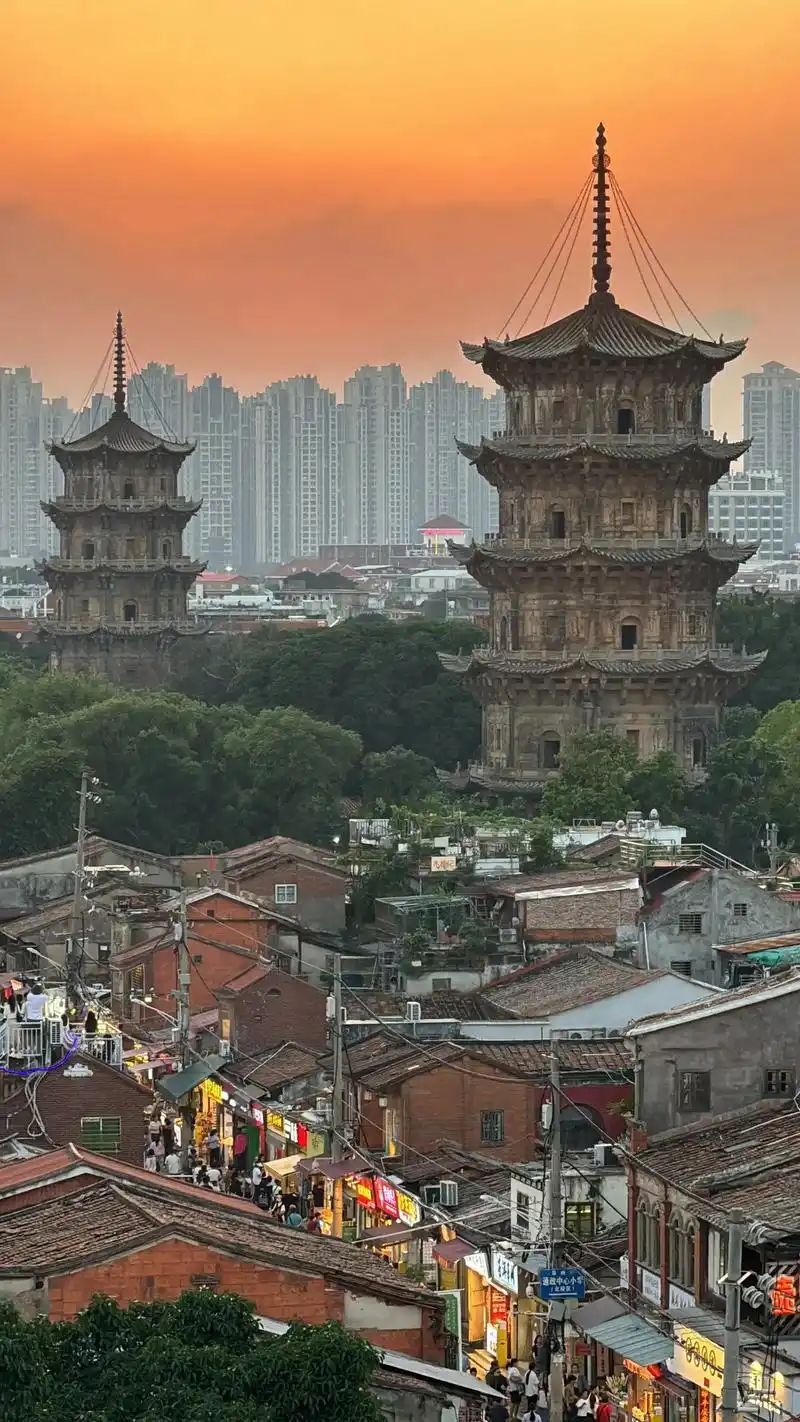
Both pagodas rise in five octagonal tiers, mimicking the elegant proportions of Song wooden architecture but executed entirely in interlocking granite blocks. No iron nails, no mortar—only precisely calculated mortise-and-tenon joints and gravity hold them together. Each tier features projecting eaves with upturned corners, Buddhist niches housing stone Buddha images, and carved brackets reminiscent of timber-frame construction. The result is a building that feels both monumental and lyrical, capturing the rhythm of wooden temples in permanent stone—a feat that surpasses many European medieval stone carvings in technical ambition.
**Artistic and Cultural Significance**
The pagodas bear 160 relief carvings depicting Buddhist jataka tales, bodhisattvas, heavenly kings, and arhat guardians, all rendered with fluid lines and vivid expressions. Remarkably, several panels incorporate Hindu iconography—visible hints of the gods Vishnu and Shiva—silent testimony to the cosmopolitan trading culture of medieval Quanzhou, where Arab, Persian, Indian, and Chinese merchants mingled along the Maritime Silk Road. Local wisdom still compares upright posture to these towers ("Stand like the East and West Pagodas"), making them enduring symbols of strength and dignity in Minnan culture.
**Practical Visit Information**
The pagodas are included within Kaiyuan Temple admission (approximately ¥10 / USD 1.5). The temple is open daily from 8:00 to 17:30, and visitors should allow at least one hour. Climb inside is not permitted, but the ground-level walk around the base provides excellent close-up views of the carvings. For photographers, the golden hours just after sunrise or before sunset bathe the warm granite in soft amber light, ideal for capturing the symmetrical pairing of the twin towers from the courtyard.
**Why Visit**
To stand before these towers is to encounter the vanished world of the Song-Yuan maritime empire, when Quanzhou—called Zayton by Marco Polo—was reportedly larger and richer than any European city. Few sites in Asia so powerfully convey the globalized character of the 13th century, when Chinese stone-carvers, Indian traders, and Persian merchants shaped a shared cultural vocabulary that is still carved into the cityscape. Pair your visit with an evening stroll down nearby West Street (Xijie), where centuries-old shops serve local specialties like rice vermicelli soup (mianxianhu) and jellyfish salad (tirunudong).
**Visitor Tips**
Enter through the main gate of Kaiyuan Temple and begin at the East-West Pagodas Plaza for the classic panoramic view before exploring the Mahavira Hall and the Sweet Dew Ordination Platform. Dress modestly and speak softly out of respect for active worshippers. Photography is prohibited inside the halls but freely permitted in the courtyards and around the pagodas.
**Historical Context**
The East and West Pagodas were originally wooden structures dating back to the Tang and Five Dynasties periods, but repeated fires prompted wealthy patrons to fund their conversion into stone between 1228 and 1250. This was no small feat: their construction spanned over two decades, contemporary with the building of Notre-Dame de Paris and the great Gothic cathedrals of Europe. For 700 years they have withstood typhoons and earthquakes—a remarkable engineering record that places them alongside Pisa's Leaning Tower (their Italian contemporary at 56 m) as among the most ambitious medieval stone towers ever built. They are the principal monuments of Quanzhou's UNESCO inscription as the "Emporium of the World in Song-Yuan China," recognized in 2021.
**Architecture and Craftsmanship**
Both pagodas rise in five octagonal tiers, mimicking the elegant proportions of Song wooden architecture but executed entirely in interlocking granite blocks. No iron nails, no mortar—only precisely calculated mortise-and-tenon joints and gravity hold them together. Each tier features projecting eaves with upturned corners, Buddhist niches housing stone Buddha images, and carved brackets reminiscent of timber-frame construction. The result is a building that feels both monumental and lyrical, capturing the rhythm of wooden temples in permanent stone—a feat that surpasses many European medieval stone carvings in technical ambition.
**Artistic and Cultural Significance**
The pagodas bear 160 relief carvings depicting Buddhist jataka tales, bodhisattvas, heavenly kings, and arhat guardians, all rendered with fluid lines and vivid expressions. Remarkably, several panels incorporate Hindu iconography—visible hints of the gods Vishnu and Shiva—silent testimony to the cosmopolitan trading culture of medieval Quanzhou, where Arab, Persian, Indian, and Chinese merchants mingled along the Maritime Silk Road. Local wisdom still compares upright posture to these towers ("Stand like the East and West Pagodas"), making them enduring symbols of strength and dignity in Minnan culture.
**Practical Visit Information**
The pagodas are included within Kaiyuan Temple admission (approximately ¥10 / USD 1.5). The temple is open daily from 8:00 to 17:30, and visitors should allow at least one hour. Climb inside is not permitted, but the ground-level walk around the base provides excellent close-up views of the carvings. For photographers, the golden hours just after sunrise or before sunset bathe the warm granite in soft amber light, ideal for capturing the symmetrical pairing of the twin towers from the courtyard.
**Why Visit**
To stand before these towers is to encounter the vanished world of the Song-Yuan maritime empire, when Quanzhou—called Zayton by Marco Polo—was reportedly larger and richer than any European city. Few sites in Asia so powerfully convey the globalized character of the 13th century, when Chinese stone-carvers, Indian traders, and Persian merchants shaped a shared cultural vocabulary that is still carved into the cityscape. Pair your visit with an evening stroll down nearby West Street (Xijie), where centuries-old shops serve local specialties like rice vermicelli soup (mianxianhu) and jellyfish salad (tirunudong).
**Visitor Tips**
Enter through the main gate of Kaiyuan Temple and begin at the East-West Pagodas Plaza for the classic panoramic view before exploring the Mahavira Hall and the Sweet Dew Ordination Platform. Dress modestly and speak softly out of respect for active worshippers. Photography is prohibited inside the halls but freely permitted in the courtyards and around the pagodas.