Qingjing Mosque
⭐ 3.80
Tumen Street, Licheng District, Quanzhou City, Fujian Province, China
 **A Crossroads of Civilizations**
Originally called the "Mosque of Holy Companions," Qingjing was funded by Arab merchants and modeled after the Great Mosque of Damascus—a connection that places it within the same architectural lineage as the Umayyad masterpieces of the Syrian capital. When it was built, Quanzhou teemed with tens of thousands of Muslim traders, and the mosque served as both a spiritual anchor and a diplomatic bridge between China and the Islamic world. By the 13th century, the Venetian traveler Marco Polo ranked the city among the world's most prosperous ports, a status this stone survivor still testifies to today.
**Architecture Carved in Stone**
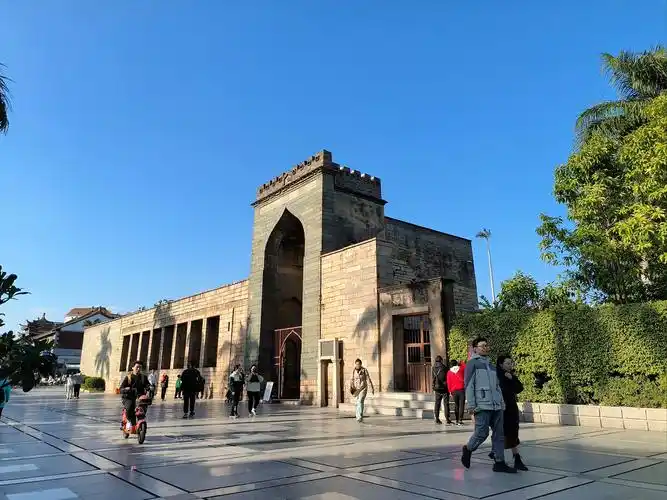
Unlike the typical brick-and-tile Chinese temples nearby, Qingjing is constructed entirely from granite and diabase, giving it the austere solidity of a Crusader-era fortress. The towering gatehouse rises with pointed arches reminiscent of Spanish Mudéjar architecture, while the crenellations symbolize the 24 solar terms of the Chinese calendar and the 99 arches represent the 99 names of Allah. Inside the roofless prayer hall, the original mihrab niche still points toward Mecca, flanked by carved Quranic inscriptions—some of the earliest Arabic epigraphy preserved on Chinese soil.
**A Living Symbol of Religious Harmony**
Standing barely 100 meters from a Confucian-Buddhist-Taoist temple dedicated to the war god Guan Yu, Qingjing forms part of what locals call Quanzhou's "religious architecture corridor." For nearly a millennium, this stretch has hosted mosques, Buddhist monasteries, Taoist shrines, and Christian churches in peaceful coexistence. The juxtaposition of Kufic inscriptions with Minnan red brick and swallowtail rooflines makes the complex a uniquely tangible artifact of the Maritime Silk Road—an East-West dialogue written in stone, stucco, and style.
**Practical Visitor Information**
The mosque sits on Tumen Street in Quanzhou's old Licheng district, directly adjacent to the Guan Yu Temple. From Quanzhou Railway Station, bus 4 or 602 will get you within walking distance; disembark at the Guan Yu Temple stop and look for the stone gatehouse. Admission is typically around 5 CNY (less than 1 USD), and opening hours run from 8:30 to 17:00, though visitors should always verify locally before traveling.
**Tips and Etiquette for Visitors**
Friday is the Islamic holy day and the mosque is closed to non-worshippers, so plan any visit for another day of the week. Dress modestly—women are advised to bring a scarf for the head—and keep voices low. Early morning or late afternoon light brings the stonework's intricate carvings into sharpest relief, making these the best times for photography. Visit it not as a glittering intact monument but as an open-air museum: the real reward lies in tracing the Arabic letters with your fingertips and imagining the Mongol-era galleons that once docked just a short walk away.
**A Crossroads of Civilizations**
Originally called the "Mosque of Holy Companions," Qingjing was funded by Arab merchants and modeled after the Great Mosque of Damascus—a connection that places it within the same architectural lineage as the Umayyad masterpieces of the Syrian capital. When it was built, Quanzhou teemed with tens of thousands of Muslim traders, and the mosque served as both a spiritual anchor and a diplomatic bridge between China and the Islamic world. By the 13th century, the Venetian traveler Marco Polo ranked the city among the world's most prosperous ports, a status this stone survivor still testifies to today.
**Architecture Carved in Stone**
Unlike the typical brick-and-tile Chinese temples nearby, Qingjing is constructed entirely from granite and diabase, giving it the austere solidity of a Crusader-era fortress. The towering gatehouse rises with pointed arches reminiscent of Spanish Mudéjar architecture, while the crenellations symbolize the 24 solar terms of the Chinese calendar and the 99 arches represent the 99 names of Allah. Inside the roofless prayer hall, the original mihrab niche still points toward Mecca, flanked by carved Quranic inscriptions—some of the earliest Arabic epigraphy preserved on Chinese soil.
**A Living Symbol of Religious Harmony**
Standing barely 100 meters from a Confucian-Buddhist-Taoist temple dedicated to the war god Guan Yu, Qingjing forms part of what locals call Quanzhou's "religious architecture corridor." For nearly a millennium, this stretch has hosted mosques, Buddhist monasteries, Taoist shrines, and Christian churches in peaceful coexistence. The juxtaposition of Kufic inscriptions with Minnan red brick and swallowtail rooflines makes the complex a uniquely tangible artifact of the Maritime Silk Road—an East-West dialogue written in stone, stucco, and style.
**Practical Visitor Information**
The mosque sits on Tumen Street in Quanzhou's old Licheng district, directly adjacent to the Guan Yu Temple. From Quanzhou Railway Station, bus 4 or 602 will get you within walking distance; disembark at the Guan Yu Temple stop and look for the stone gatehouse. Admission is typically around 5 CNY (less than 1 USD), and opening hours run from 8:30 to 17:00, though visitors should always verify locally before traveling.
**Tips and Etiquette for Visitors**
Friday is the Islamic holy day and the mosque is closed to non-worshippers, so plan any visit for another day of the week. Dress modestly—women are advised to bring a scarf for the head—and keep voices low. Early morning or late afternoon light brings the stonework's intricate carvings into sharpest relief, making these the best times for photography. Visit it not as a glittering intact monument but as an open-air museum: the real reward lies in tracing the Arabic letters with your fingertips and imagining the Mongol-era galleons that once docked just a short walk away.