**A Thousand-Year Legacy on the Maritime Silk Road**
Quanzhou's Kaiyuan Temple traces its origins to 686 AD, originally named Lotus Flower Temple before a legend of mulberry trees blossoming into lotus flowers earned it the poetic epithet "Mulberry-Lotus Dharma Realm." By the Song and Yuan dynasties, it had become the spiritual heart of Quanzhou—then dubbed "Zayton" by Arab merchants and considered one of the world's five greatest ports, alongside Alexandria and Venice. The temple embodies this cosmopolitan past: within its grounds you'll find a memorial hall to Master Hongyi, the revered Buddhist monk and artist who spent his final years here. His last brushstroke, "Sorrow and Joy Intertwined," hangs quietly as a meditation on impermanence that any visitor familiar with monastic traditions—from Assisi to Kyoto—can appreciate.
**The Twin Pagodas: Engineering Marvels of the Song Era**
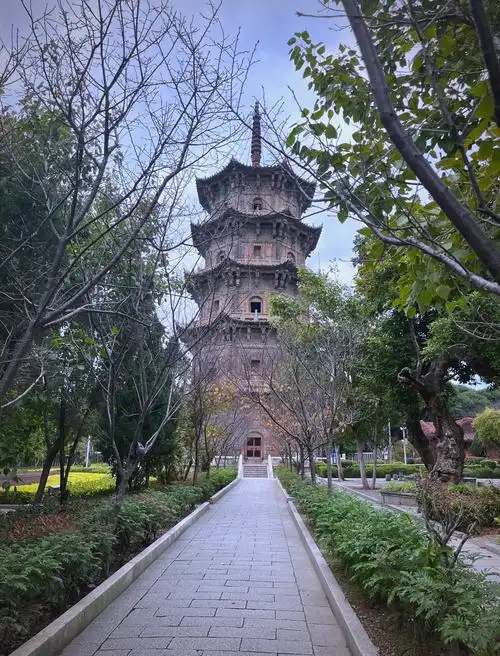
Rising like sentinels on the temple's eastern and western flanks, the Zhaoguo Pagoda (48.24 meters) and Renshou Pagoda (44.06 meters) are the tallest surviving Song Dynasty stone pagodas in all of China. Built in the traditional wooden-temple style but executed entirely in stone, they have withstood multiple devastating earthquakes that toppled lesser structures—a testament to sophisticated mortise-and-tenon joinery that rivals the seismic resilience of Roman aqueducts or Gothic cathedrals. The pagodas are adorned with 80 carved divine figures, and notably, the western pagoda's base features an early depiction of a "Monkey Pilgrim," which scholars consider a possible prototype for Sun Wukong, the Monkey King of "Journey to the West."
**The Mahavira Hall: A Symphony of Faiths**
The temple's centerpiece, known as the Hundred Pillars Hall, rests on 86 massive stone columns and rivals the scale of a European Romanesque cathedral. Its wooden beams support 24 extraordinary flying musicians with human heads and bird bodies—Apsaras figures that uniquely merge Indian Buddhist iconography with the instruments of southern Fujian's Nanyin music tradition, found nowhere else in Chinese architecture. Equally striking are the Hindu stone carvings embedded in the platform's base: lion-bodied, human-faced reliefs that survive from the Song-Yuan era, silent witnesses to the religious pluralism that once flourished in this port city, where Hindu temples, mosques, and churches stood side by side.
**The Ganlu Ordination Platform and Ancient Mulberry**
One of only three ancient ordination platforms surviving in China, the Ganlu Platform hosts a finely carved Ming Dynasty wooden Buddha seated on a lotus throne surrounded by a thousand miniature Buddha figures. Nearby stands the temple's legendary thousand-year-old mulberry tree, said to have been planted by the temple's founder and to have miraculously produced lotus blossoms—hence the temple's enduring nickname. The tree has withered and regenerated multiple times over the centuries, making it a living symbol of Buddhist resilience. Visitors often pause here to contemplate Zen koans, much as pilgrims once did at Canterbury or Santiago de Compostela.
**Practical Information for Visitors**
Located at 176 West Street in Quanzhou's historic Licheng District, Kaiyuan Temple welcomes visitors free of charge daily from 6:30 AM to 5:40 PM, with last entry at 5:00 PM. Arrive before 8:00 AM to enjoy the morning light illuminating the twin pagodas and to avoid tour bus crowds. Enter through the West Gate and follow the central axis: Heavenly Kings Hall, Mahavira Hall, Ganlu Platform, Sutra Repository, then the twin pagodas before exiting east toward West Street's food quarter. There you'll find local Minnan specialties like misian hu (fine vermicelli soup) and mochi rice cakes. Remember that flash photography is prohibited inside the halls, and modest dress is appreciated out of respect for active worshippers.