Cangzhou Museum
⭐ 4.20
Cangzhou Museum, Yunhe District, Cangzhou City, Hebei Province, China
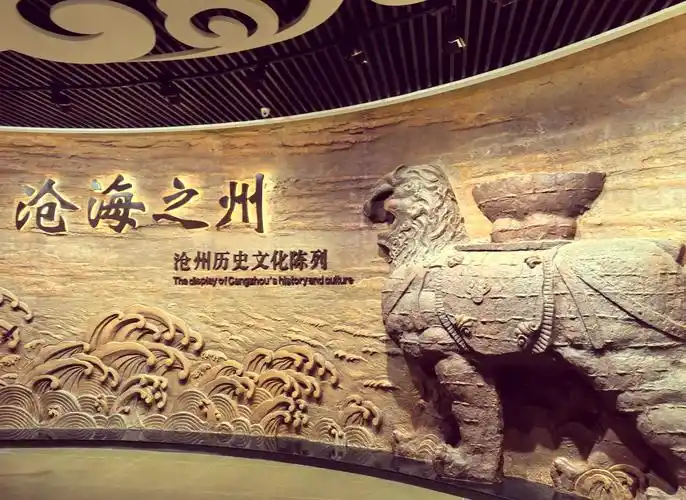 Cangzhou Museum occupies a meaningful place in China's vast cultural landscape, with a collection exceeding 17,000 artifacts tracing the region's history from the Neolithic era through the Republican period. The name "Cangzhou" poetically translates to "Sea of Blue," evoking the ancient wetlands that once defined this corner of Hebei Province. Among its treasures, a Northern Dynasties celadon ewer with dragon-shaped handle and applied floral decoration stands as the crown jewel—a piece contemporaneous with the fall of the Western Roman Empire, offering visitors a rare glimpse into sixth-century craftsmanship on par with Byzantine ceramics of the same era.
The museum's striking architecture spans 57 mu (roughly 9 acres) with a 32,000-square-meter footprint, its main structure shaped like a traditional Chinese measuring vessel known as a "dou." Opened in its current form in 2014 and elevated to national second-tier status in 2018, the building unites contemporary museum design with symbolic references to ancient ritual objects. Eleven exhibition halls distribute across a semi-basement and four above-ground floors, with climate control and generous circulation space ensuring comfort throughout every season.
Three signature exhibitions anchor the cultural narrative. The second-floor "Sea of Blue" gallery walks visitors through Cangzhou's chronological evolution, while the third floor hosts two pioneering displays unique within Hebei Province: the "Cradle of Acrobatics" gallery celebrating Wuqiao's 2,000-year acrobatic heritage—comparable to the legacy of Italian commedia dell'arte performers—and the "Hometown of Martial Arts" exhibition exploring the famous saying "镖不喊沧," meaning no镖师 (martial escort) ever dared call out their arrival when passing through Cangzhou for fear of its legendary fighters. A multimedia Grand Canal gallery recreates the waterway's golden age, when Cangzhou rivaled Venice as a bustling inland port.
Beyond traditional displays, the museum embraces cutting-edge engagement through AR and VR installations, motion-sensing projections, and hands-on weaponry demonstrations that place visitors inside martial arts training sessions. Regular programming includes sand painting workshops, stamp-collection trails, and traditional Hanfu costume experiences—activities that recall the family-oriented learning environments of London's Tate Modern or Washington's Smithsonian museums, where exploration meets play.
Practical planning is straightforward: the museum operates Tuesday through Sunday from 9:00 a.m. to 5:00 p.m., closing on Mondays and adjusting hours around Chinese holidays. Advance reservation through the official WeChat account is mandatory, with entry requiring valid identification. Smart audio guides are available for rental, and free guided tours depart daily. Allow two to three hours for a satisfying visit, and consider pairing your trip with the adjacent Science and Technology Museum and Library to create a rewarding half-day cultural circuit through Cangzhou's revitalized civic district.
[DETAILED]
Cangzhou Museum offers Western travelers something genuinely rare: an uncrowded, deeply local institution that rewards curiosity without the admission fees or queue fatigue of China's mega-museums. Few places so clearly demonstrate how regional China fuses warrior traditions with performing arts—think of it as combining the spirit of a Highland clan museum with the theatrical heritage of a Venetian carnival hall, all housed beneath one contemporary roof. Whether you arrive as a martial arts enthusiast, a canal history buff, or a parent seeking meaningful activities with children, this museum delivers a memorable, accessible encounter with northern Chinese identity that most foreign visitors to the country never get to experience.
Cangzhou Museum occupies a meaningful place in China's vast cultural landscape, with a collection exceeding 17,000 artifacts tracing the region's history from the Neolithic era through the Republican period. The name "Cangzhou" poetically translates to "Sea of Blue," evoking the ancient wetlands that once defined this corner of Hebei Province. Among its treasures, a Northern Dynasties celadon ewer with dragon-shaped handle and applied floral decoration stands as the crown jewel—a piece contemporaneous with the fall of the Western Roman Empire, offering visitors a rare glimpse into sixth-century craftsmanship on par with Byzantine ceramics of the same era.
The museum's striking architecture spans 57 mu (roughly 9 acres) with a 32,000-square-meter footprint, its main structure shaped like a traditional Chinese measuring vessel known as a "dou." Opened in its current form in 2014 and elevated to national second-tier status in 2018, the building unites contemporary museum design with symbolic references to ancient ritual objects. Eleven exhibition halls distribute across a semi-basement and four above-ground floors, with climate control and generous circulation space ensuring comfort throughout every season.
Three signature exhibitions anchor the cultural narrative. The second-floor "Sea of Blue" gallery walks visitors through Cangzhou's chronological evolution, while the third floor hosts two pioneering displays unique within Hebei Province: the "Cradle of Acrobatics" gallery celebrating Wuqiao's 2,000-year acrobatic heritage—comparable to the legacy of Italian commedia dell'arte performers—and the "Hometown of Martial Arts" exhibition exploring the famous saying "镖不喊沧," meaning no镖师 (martial escort) ever dared call out their arrival when passing through Cangzhou for fear of its legendary fighters. A multimedia Grand Canal gallery recreates the waterway's golden age, when Cangzhou rivaled Venice as a bustling inland port.
Beyond traditional displays, the museum embraces cutting-edge engagement through AR and VR installations, motion-sensing projections, and hands-on weaponry demonstrations that place visitors inside martial arts training sessions. Regular programming includes sand painting workshops, stamp-collection trails, and traditional Hanfu costume experiences—activities that recall the family-oriented learning environments of London's Tate Modern or Washington's Smithsonian museums, where exploration meets play.
Practical planning is straightforward: the museum operates Tuesday through Sunday from 9:00 a.m. to 5:00 p.m., closing on Mondays and adjusting hours around Chinese holidays. Advance reservation through the official WeChat account is mandatory, with entry requiring valid identification. Smart audio guides are available for rental, and free guided tours depart daily. Allow two to three hours for a satisfying visit, and consider pairing your trip with the adjacent Science and Technology Museum and Library to create a rewarding half-day cultural circuit through Cangzhou's revitalized civic district.
[DETAILED]
Cangzhou Museum offers Western travelers something genuinely rare: an uncrowded, deeply local institution that rewards curiosity without the admission fees or queue fatigue of China's mega-museums. Few places so clearly demonstrate how regional China fuses warrior traditions with performing arts—think of it as combining the spirit of a Highland clan museum with the theatrical heritage of a Venetian carnival hall, all housed beneath one contemporary roof. Whether you arrive as a martial arts enthusiast, a canal history buff, or a parent seeking meaningful activities with children, this museum delivers a memorable, accessible encounter with northern Chinese identity that most foreign visitors to the country never get to experience.