Cangzhou Botanical Garden
⭐ 3.80
Cangzhou Botanical Garden, Yunhe District, Cangzhou City, Hebei Province, China
 Cangzhou has long stood along the Grand Canal, the 1,700-kilometer waterway that UNESCO inscribed in 2014 and that rivals the Roman aqueduct system in engineering ambition. The city itself has served as a strategic crossroads since the Han dynasty, and its botanical garden nods to that antiquity through a ceremonial gateway flanked by twin tower pavilions, vaguely reminiscent of a Roman triumphal arch. Beyond the gate, twenty bronze sculpture groups portray 108 historical figures—scholars, generals, and modern reformers—turning the park into an open-air pantheon that feels closer to Rome's Via dei Fori Imperiali or the Hall of Heroes at Versailles than to a typical Chinese city park.
Running along the garden's central axis, the "Avenue of Celebrities" culminates in the Celebrity Hall, a quiet pavilion where biographical panels invite lingering reflection. The effect is reminiscent of a European statuary walk: visitors absorb centuries of regional history simply by strolling forward, without the hushed formality of a museum. From ancient loyal ministers to 20th-century cultural pioneers, the cast reads almost like a who's who of one province, offering Western travelers an accessible primer on the personalities who shaped this corner of the North China Plain.
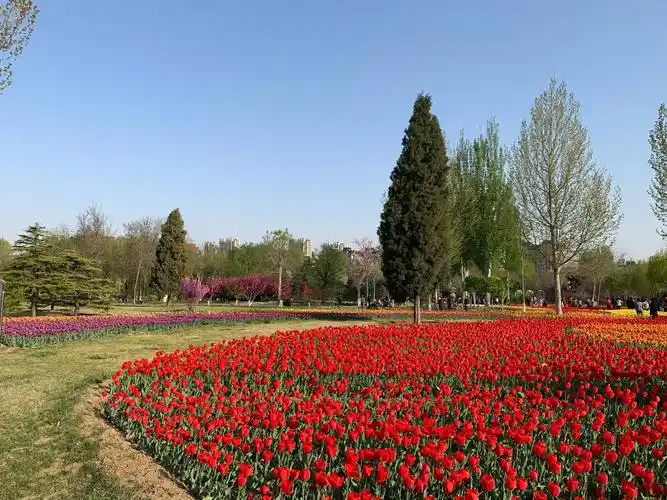
For plant enthusiasts, the park functions as a living encyclopedia. Themed zones include a Peony Garden (a Chinese echo of Kyoto's imperial peony estates), a Dutch-influenced Tulip Display, a serene Bamboo Grove, a Crabapple Garden, an Aquatic Plants zone where lotus and water lilies drift in summer, and a Medicinal Herb Garden. Particularly noteworthy is the "Multi-Sensory Fragrance Garden," the first of its kind in Hebei Province, designed for visually impaired visitors to experience plants through scent and touch—a thoughtful gesture of inclusive design that few European gardens match.
Water and stone animate the landscape much as they do in classical Suzhou gardens, though on a larger civic scale. Meandering streams tumble past rockeries, while a sunken bridge arches over lotus-filled ponds, producing the kind of mirrored reflections that have inspired Chinese painters for centuries. Wide, gently graded paths accommodate strollers and wheelchairs, with frequent benches and interpretive signage in Chinese. English translations are limited, so a translation app proves handy. The flat terrain and open sightlines make the park especially welcoming for families with children, elderly visitors, and casual photographers.
The garden is free, requires no reservation, and welcomes visitors daily from 5:00 a.m. to 8:30 p.m. Self-driving visitors should navigate to the South Gate, where ample free parking awaits. Public transit is straightforward: buses 17, 19, 226, and 665 stop at "Celebrity Botanical Garden," while routes 3 and 12 reach "Botanical Garden Station," about a five-minute walk from the entrance. Bring your own water and snacks—on-site concessions are minimal—and pack mosquito repellent if visiting between June and August. Light long sleeves are advisable during humid months.
Spring (April, for tulips and peonies) and early summer (June, for irises and early lotus) are the prime seasons, though August delivers spectacular lotus displays. Plan to arrive between 8 and 10 a.m. or after 4:30 p.m. to avoid midday heat and the harshest light for photography. Allow two to four hours for a thorough visit. Unlike the crowded Summer Palace in Beijing or the manicured Yuyuan Garden in Shanghai, Cangzhou's botanical garden offers an unhurried, locally authentic experience—a green pause between imperial grandeur and the Bohai Sea coastline, where nature and history share equal billing.
Cangzhou has long stood along the Grand Canal, the 1,700-kilometer waterway that UNESCO inscribed in 2014 and that rivals the Roman aqueduct system in engineering ambition. The city itself has served as a strategic crossroads since the Han dynasty, and its botanical garden nods to that antiquity through a ceremonial gateway flanked by twin tower pavilions, vaguely reminiscent of a Roman triumphal arch. Beyond the gate, twenty bronze sculpture groups portray 108 historical figures—scholars, generals, and modern reformers—turning the park into an open-air pantheon that feels closer to Rome's Via dei Fori Imperiali or the Hall of Heroes at Versailles than to a typical Chinese city park.
Running along the garden's central axis, the "Avenue of Celebrities" culminates in the Celebrity Hall, a quiet pavilion where biographical panels invite lingering reflection. The effect is reminiscent of a European statuary walk: visitors absorb centuries of regional history simply by strolling forward, without the hushed formality of a museum. From ancient loyal ministers to 20th-century cultural pioneers, the cast reads almost like a who's who of one province, offering Western travelers an accessible primer on the personalities who shaped this corner of the North China Plain.
For plant enthusiasts, the park functions as a living encyclopedia. Themed zones include a Peony Garden (a Chinese echo of Kyoto's imperial peony estates), a Dutch-influenced Tulip Display, a serene Bamboo Grove, a Crabapple Garden, an Aquatic Plants zone where lotus and water lilies drift in summer, and a Medicinal Herb Garden. Particularly noteworthy is the "Multi-Sensory Fragrance Garden," the first of its kind in Hebei Province, designed for visually impaired visitors to experience plants through scent and touch—a thoughtful gesture of inclusive design that few European gardens match.
Water and stone animate the landscape much as they do in classical Suzhou gardens, though on a larger civic scale. Meandering streams tumble past rockeries, while a sunken bridge arches over lotus-filled ponds, producing the kind of mirrored reflections that have inspired Chinese painters for centuries. Wide, gently graded paths accommodate strollers and wheelchairs, with frequent benches and interpretive signage in Chinese. English translations are limited, so a translation app proves handy. The flat terrain and open sightlines make the park especially welcoming for families with children, elderly visitors, and casual photographers.
The garden is free, requires no reservation, and welcomes visitors daily from 5:00 a.m. to 8:30 p.m. Self-driving visitors should navigate to the South Gate, where ample free parking awaits. Public transit is straightforward: buses 17, 19, 226, and 665 stop at "Celebrity Botanical Garden," while routes 3 and 12 reach "Botanical Garden Station," about a five-minute walk from the entrance. Bring your own water and snacks—on-site concessions are minimal—and pack mosquito repellent if visiting between June and August. Light long sleeves are advisable during humid months.
Spring (April, for tulips and peonies) and early summer (June, for irises and early lotus) are the prime seasons, though August delivers spectacular lotus displays. Plan to arrive between 8 and 10 a.m. or after 4:30 p.m. to avoid midday heat and the harshest light for photography. Allow two to four hours for a thorough visit. Unlike the crowded Summer Palace in Beijing or the manicured Yuyuan Garden in Shanghai, Cangzhou's botanical garden offers an unhurried, locally authentic experience—a green pause between imperial grandeur and the Bohai Sea coastline, where nature and history share equal billing.