Beida Mosque
⭐ 4.70
Xinhua District, Cangzhou City, Hebei Province, China
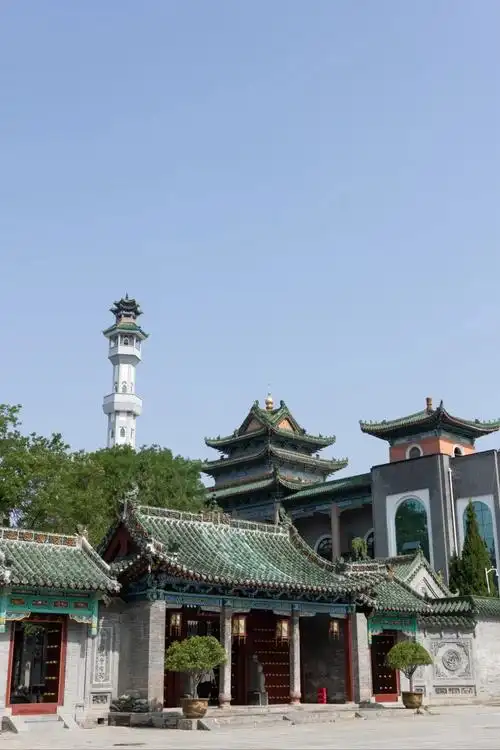 Rising from the ashes of a war-torn Ming capital, the North Mosque was commissioned in 1402 and completed in 1420, an eighteen-year construction saga comparable in ambition to Europe's great Gothic cathedral projects of the same era. The early Ming period coincides with the final flowering of Chartres and the early rise of Florentine Brunelleschi, placing this Chinese Islamic landmark firmly within the world's monumental religious architecture of the late Middle Ages. Designated a national key cultural relic in 2001, it shares the prestigious "Four Great Mosques of China" title with the famed Huaisheng Mosque in Guangzhou, Quanzhou's pioneering Islamic temple, and the historic mosque of Jining.
Step inside and you encounter a thrilling rarity: a vast prayer hall built entirely without nails or rivets, in a traditional "Wen-style" timber construction more often associated with Buddhist temples than with mosques. The structure winds its way through front, middle, and rear halls joined by curving galleries, a layout said to resemble the Chinese character "主" when viewed from above and an ink-brush stand from the side. Some ninety painted pillars, glowing in imperial vermilion, frame a soaring roof decorated with carved beasts along five golden ridges, a touch that recalls the gargoyles and grotesques of Western medieval cathedrals yet remains unmistakably East Asian in spirit.
Beyond its beauty, the mosque is a cradle of Chinese Islam itself. Generations of imams trained within its walls, and most remarkably, the very first translation of the Quran into Chinese was produced here, predating Martin Luther's vernacular German Bible by roughly seventy years. Visitors who pause in the courtyard, where ancient scholar-trees shade weathered stone steles, can sense six centuries of scholarship and devotion layered into every beam and inscription.
The mosque sits at 65 Jiefang Middle Road, in Cangzhou's Xinhua District, an easy ride on buses 3, 22, 31, or 307 to the "Qingzhensi" stop, about ten kilometers from the high-speed rail station. Admission is free, though hours typically run 8:00 to 16:00, so call ahead to confirm. Because this remains an active place of Muslim worship, no pork products or alcohol may be brought on-site, and modest dress is essential.
For the most flattering photographs, plan your visit before 10 a.m. or after 4 p.m., when soft light slants across the columned arcade. Women should bring a headscarf, men should skip shorts and tank tops, and shoes come off before entering the prayer hall. Silence and respect are greatly valued, especially in the worship zone. In a country that often feels unfamiliar to Western travelers, this welcoming sanctuary offers an unusually gentle introduction to the living, layered traditions of Chinese Islam.
Rising from the ashes of a war-torn Ming capital, the North Mosque was commissioned in 1402 and completed in 1420, an eighteen-year construction saga comparable in ambition to Europe's great Gothic cathedral projects of the same era. The early Ming period coincides with the final flowering of Chartres and the early rise of Florentine Brunelleschi, placing this Chinese Islamic landmark firmly within the world's monumental religious architecture of the late Middle Ages. Designated a national key cultural relic in 2001, it shares the prestigious "Four Great Mosques of China" title with the famed Huaisheng Mosque in Guangzhou, Quanzhou's pioneering Islamic temple, and the historic mosque of Jining.
Step inside and you encounter a thrilling rarity: a vast prayer hall built entirely without nails or rivets, in a traditional "Wen-style" timber construction more often associated with Buddhist temples than with mosques. The structure winds its way through front, middle, and rear halls joined by curving galleries, a layout said to resemble the Chinese character "主" when viewed from above and an ink-brush stand from the side. Some ninety painted pillars, glowing in imperial vermilion, frame a soaring roof decorated with carved beasts along five golden ridges, a touch that recalls the gargoyles and grotesques of Western medieval cathedrals yet remains unmistakably East Asian in spirit.
Beyond its beauty, the mosque is a cradle of Chinese Islam itself. Generations of imams trained within its walls, and most remarkably, the very first translation of the Quran into Chinese was produced here, predating Martin Luther's vernacular German Bible by roughly seventy years. Visitors who pause in the courtyard, where ancient scholar-trees shade weathered stone steles, can sense six centuries of scholarship and devotion layered into every beam and inscription.
The mosque sits at 65 Jiefang Middle Road, in Cangzhou's Xinhua District, an easy ride on buses 3, 22, 31, or 307 to the "Qingzhensi" stop, about ten kilometers from the high-speed rail station. Admission is free, though hours typically run 8:00 to 16:00, so call ahead to confirm. Because this remains an active place of Muslim worship, no pork products or alcohol may be brought on-site, and modest dress is essential.
For the most flattering photographs, plan your visit before 10 a.m. or after 4 p.m., when soft light slants across the columned arcade. Women should bring a headscarf, men should skip shorts and tank tops, and shoes come off before entering the prayer hall. Silence and respect are greatly valued, especially in the worship zone. In a country that often feels unfamiliar to Western travelers, this welcoming sanctuary offers an unusually gentle introduction to the living, layered traditions of Chinese Islam.