Cangzhou Iron Lion
⭐ 5.00
Cangzhou Iron Lion Scenic Area, Cang County, Cangzhou City, Hebei Province, China
 **Historical Context**
Cast in 953 AD under Emperor Guo Wei of the Later Zhou dynasty, the Iron Lion was commissioned to ward off coastal flooding and protect the region. To place it in world history: this colossal beast took shape just seven years before the death of European Emperor Otto the Great, around the time Viking explorers were still raiding the Mediterranean. In an era when Europe was building Romanesque churches from stone, Chinese craftsmen were mastering molten iron on a scale unmatched anywhere in the world. The lion originally guarded the grand Kaiyuan Temple before centuries of war and river-course shifts left it stranded in open farmland.
**Architecture and Craftsmanship**
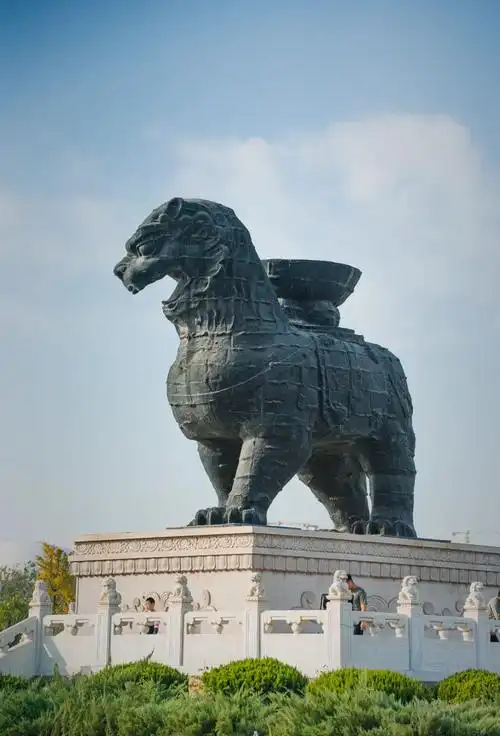
The statue was produced using an extraordinary segmented clay-mold open-pour technique, with hundreds of mold blocks assembled in successive layers—a method comparable in ambition to the lost-wax bronze traditions of medieval Europe, but executed in iron at thirty-two times the mass. Its hollow body conceals hundreds of characters from the Diamond Sutra, fusing Buddhist devotion with the practical function of a civic guardian. The sculptor captured anatomical balance and a flowing mane with startling naturalism, making the beast appear mid-roar rather than merely seated.
**Cultural Significance**
Beyond its religious role as a sea-calming talisman, the lion embodies the meeting point of metallurgy, Buddhist faith, and folk superstition during a fragmented era often overlooked by Western historians. It is one of the very few surviving material witnesses to the Five Dynasties period, a time when northern China produced innovations that would later influence casting techniques across East Asia. For travelers interested in the technical and spiritual crosscurrents of tenth-century Eurasia, the monument offers a rare, tangible touchstone.
**Conservation and Current Condition**
More than a millennium of corrosion has left the lion pitted, cracked, and missing portions of its head, tail, and lower jaw, with hollowed legs now propped up by a modern steel cradle. Earlier twentieth-century interventions—most notably an enclosed pavilion built in 1956 that trapped humidity, and a clumsy 1984 crane lift—caused dozens of new fractures. These visible scars are now studied worldwide as cautionary lessons in heritage conservation, reminding visitors that protecting ancient monuments is itself an evolving science.
**Practical Visit Information**
The Iron Lion sits inside the Cangzhou Iron Lion and Old City Ruins Park in Jiuzhou Town, Cangxian County, about a 35-minute drive from central Cangzhou in Hebei Province. Bus 901 from the city stops directly at the site. Entry is approximately 20 yuan, with discounts for seniors and students; summer hours run 8:30 a.m. to 5:30 p.m. Allow 1.5 to 2 hours to explore the ruins park, exhibition hall, and iron-coin vault. Signage is Chinese only, so arranging a guide or reading in advance is strongly recommended.
**Why Visit**
This is not a flashy tourist showpiece but a quiet, weather-stained survivor that rewards those who arrive with curiosity and patience. Photographers will love the soft light of early morning or late afternoon, while history enthusiasts can stand inches from a 32-ton object that was old when the Norman Conquest was still a century away. Plan a full day or overnight trip to pair the visit with Wuqiao's acrobatic heritage and the Grand Canal's living history along Cangzhou's waterfront.
**Historical Context**
Cast in 953 AD under Emperor Guo Wei of the Later Zhou dynasty, the Iron Lion was commissioned to ward off coastal flooding and protect the region. To place it in world history: this colossal beast took shape just seven years before the death of European Emperor Otto the Great, around the time Viking explorers were still raiding the Mediterranean. In an era when Europe was building Romanesque churches from stone, Chinese craftsmen were mastering molten iron on a scale unmatched anywhere in the world. The lion originally guarded the grand Kaiyuan Temple before centuries of war and river-course shifts left it stranded in open farmland.
**Architecture and Craftsmanship**
The statue was produced using an extraordinary segmented clay-mold open-pour technique, with hundreds of mold blocks assembled in successive layers—a method comparable in ambition to the lost-wax bronze traditions of medieval Europe, but executed in iron at thirty-two times the mass. Its hollow body conceals hundreds of characters from the Diamond Sutra, fusing Buddhist devotion with the practical function of a civic guardian. The sculptor captured anatomical balance and a flowing mane with startling naturalism, making the beast appear mid-roar rather than merely seated.
**Cultural Significance**
Beyond its religious role as a sea-calming talisman, the lion embodies the meeting point of metallurgy, Buddhist faith, and folk superstition during a fragmented era often overlooked by Western historians. It is one of the very few surviving material witnesses to the Five Dynasties period, a time when northern China produced innovations that would later influence casting techniques across East Asia. For travelers interested in the technical and spiritual crosscurrents of tenth-century Eurasia, the monument offers a rare, tangible touchstone.
**Conservation and Current Condition**
More than a millennium of corrosion has left the lion pitted, cracked, and missing portions of its head, tail, and lower jaw, with hollowed legs now propped up by a modern steel cradle. Earlier twentieth-century interventions—most notably an enclosed pavilion built in 1956 that trapped humidity, and a clumsy 1984 crane lift—caused dozens of new fractures. These visible scars are now studied worldwide as cautionary lessons in heritage conservation, reminding visitors that protecting ancient monuments is itself an evolving science.
**Practical Visit Information**
The Iron Lion sits inside the Cangzhou Iron Lion and Old City Ruins Park in Jiuzhou Town, Cangxian County, about a 35-minute drive from central Cangzhou in Hebei Province. Bus 901 from the city stops directly at the site. Entry is approximately 20 yuan, with discounts for seniors and students; summer hours run 8:30 a.m. to 5:30 p.m. Allow 1.5 to 2 hours to explore the ruins park, exhibition hall, and iron-coin vault. Signage is Chinese only, so arranging a guide or reading in advance is strongly recommended.
**Why Visit**
This is not a flashy tourist showpiece but a quiet, weather-stained survivor that rewards those who arrive with curiosity and patience. Photographers will love the soft light of early morning or late afternoon, while history enthusiasts can stand inches from a 32-ton object that was old when the Norman Conquest was still a century away. Plan a full day or overnight trip to pair the visit with Wuqiao's acrobatic heritage and the Grand Canal's living history along Cangzhou's waterfront.