Asia-Europe Exposition Exhibition Center
⭐ 4.20
Asia-Europe Exposition Exhibition Center, Shuimogou District, Urumqi City, Xinjiang Uygur Autonomous Region, China
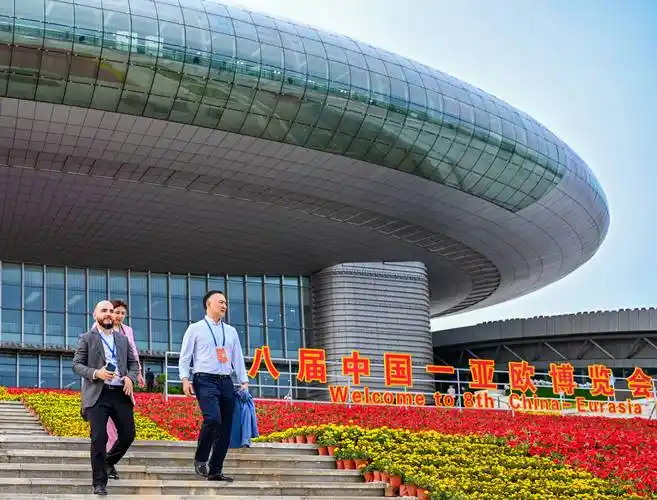 Home to the China-Eurasia Expo since 2011, this venue represents the modern revival of trade routes that first flourished under the Han Dynasty and reached their golden age during the Tang and Yuan periods. Where camel caravans once carried silk and spices between Chang'an and the Mediterranean, container trains now hum along the Eurasian Land Bridge, passing through Urumqi on their way to Rotterdam and Istanbul. The center embodies China's 21st-century "Belt and Road" vision, hosting high-level dialogues between Chinese leaders and counterparts from Kazakhstan, Uzbekistan, Russia, and beyond. It stands as a powerful symbol of how this ancient crossroads continues to connect civilizations on a continental scale.
Spanning some 320,000 square meters, the center comprises 15 column-free exhibition halls alongside conference and banquet facilities, matching major European venues like Berlin's Messe in scale. Its design draws on traditional Chinese motifs—auspicious clouds, lilies, the embroidered Chinese knot, and the snow-capped peaks of the Tianshan Mountains—reinterpreted with a contemporary minimalist sensibility. From a distance, the sweeping roofline resembles a luminous full moon nestled against Hongguang Mountain, a serene silhouette that bridges Eastern aesthetics with global modernism. The quality of construction earned it the prestigious Luban Prize, China's highest architectural honor and an equivalent to the Pritzker Prize in national stature.
During exhibition periods, the center transforms into a microcosm of the modern Silk Road. National pavilions from dozens of countries display their finest goods, from Uzbek carpets and Kyrgyz felt crafts to Russian spirits and Turkish textiles. Visitors can sample Central Asian cuisine, watch folk dance performances, and explore cutting-edge technology demonstrations from China's emerging industries. Equally important are the intangible cultural heritage displays—embroidery, carpet-weaving, and traditional music—that remind visitors of the deep artistic traditions still thriving along these ancient routes. For Western travelers, it offers a rare chance to experience the cultural breadth of Inner Eurasia without crossing a single international border.
The center sits at No. 3 Hongguangshan Road, Shuimogou District, roughly 8 kilometers southeast of central Urumqi and about 25 minutes by taxi from the main railway station. During exhibitions, admission is free with valid identification, and dedicated shuttle buses link the venue to major hotels and transit hubs. Two large parking areas (P1 and P2) accommodate drivers. The official China-Eurasia Expo website and WeChat account publish the calendar well in advance—consult these before planning. Outside exhibition dates, the halls are typically closed for setup and internal use, with only the exterior accessible to the public.
A visit is genuinely rewarding only when timed to coincide with a major expo, typically held every other year in early autumn. If your dates align, plan a half-day following the suggested route: Silk Road Cooperation Zone, New Quality Productive Forces Zone, then Investment Cooperation Zone. International pavilions and tech showcases are the standout highlights. Pair the visit with the dazzling Xinjiang International Grand Bazaar—evoking Istanbul's bazaars but unmistakably Central Asian—and the outstanding Xinjiang Uyghur Autonomous Region Museum, home to well-preserved Tarim mummies and Silk Road artifacts, for a full and unforgettable cultural day.
Home to the China-Eurasia Expo since 2011, this venue represents the modern revival of trade routes that first flourished under the Han Dynasty and reached their golden age during the Tang and Yuan periods. Where camel caravans once carried silk and spices between Chang'an and the Mediterranean, container trains now hum along the Eurasian Land Bridge, passing through Urumqi on their way to Rotterdam and Istanbul. The center embodies China's 21st-century "Belt and Road" vision, hosting high-level dialogues between Chinese leaders and counterparts from Kazakhstan, Uzbekistan, Russia, and beyond. It stands as a powerful symbol of how this ancient crossroads continues to connect civilizations on a continental scale.
Spanning some 320,000 square meters, the center comprises 15 column-free exhibition halls alongside conference and banquet facilities, matching major European venues like Berlin's Messe in scale. Its design draws on traditional Chinese motifs—auspicious clouds, lilies, the embroidered Chinese knot, and the snow-capped peaks of the Tianshan Mountains—reinterpreted with a contemporary minimalist sensibility. From a distance, the sweeping roofline resembles a luminous full moon nestled against Hongguang Mountain, a serene silhouette that bridges Eastern aesthetics with global modernism. The quality of construction earned it the prestigious Luban Prize, China's highest architectural honor and an equivalent to the Pritzker Prize in national stature.
During exhibition periods, the center transforms into a microcosm of the modern Silk Road. National pavilions from dozens of countries display their finest goods, from Uzbek carpets and Kyrgyz felt crafts to Russian spirits and Turkish textiles. Visitors can sample Central Asian cuisine, watch folk dance performances, and explore cutting-edge technology demonstrations from China's emerging industries. Equally important are the intangible cultural heritage displays—embroidery, carpet-weaving, and traditional music—that remind visitors of the deep artistic traditions still thriving along these ancient routes. For Western travelers, it offers a rare chance to experience the cultural breadth of Inner Eurasia without crossing a single international border.
The center sits at No. 3 Hongguangshan Road, Shuimogou District, roughly 8 kilometers southeast of central Urumqi and about 25 minutes by taxi from the main railway station. During exhibitions, admission is free with valid identification, and dedicated shuttle buses link the venue to major hotels and transit hubs. Two large parking areas (P1 and P2) accommodate drivers. The official China-Eurasia Expo website and WeChat account publish the calendar well in advance—consult these before planning. Outside exhibition dates, the halls are typically closed for setup and internal use, with only the exterior accessible to the public.
A visit is genuinely rewarding only when timed to coincide with a major expo, typically held every other year in early autumn. If your dates align, plan a half-day following the suggested route: Silk Road Cooperation Zone, New Quality Productive Forces Zone, then Investment Cooperation Zone. International pavilions and tech showcases are the standout highlights. Pair the visit with the dazzling Xinjiang International Grand Bazaar—evoking Istanbul's bazaars but unmistakably Central Asian—and the outstanding Xinjiang Uyghur Autonomous Region Museum, home to well-preserved Tarim mummies and Silk Road artifacts, for a full and unforgettable cultural day.