Beiling Park
⭐ 4.60
Beiling Park, Hunnan District, Shenyang City, Liaoning Province, China
 **Historical Context**
The Qing Zhaoling mausoleum was begun in 1643, just as Europe's Thirty Years' War was ending, for Emperor Hong Taiji—the ambitious khan who transformed his father Nurhaci's tribal confederation into the dynasty that would rule China for nearly three centuries. As the first imperial tomb built by the Manchus before they crossed the Great Wall, it predates Beijing's Ming and Qing tombs by decades. Comparable in scale to the Habsburg Imperial Crypt in Vienna or the royal burial complex at Versailles, Zhaoling represents the architectural ambitions of a dynasty at its formative peak, blending Mongol steppe traditions with Chinese imperial ritual.
**Architecture and Layout**
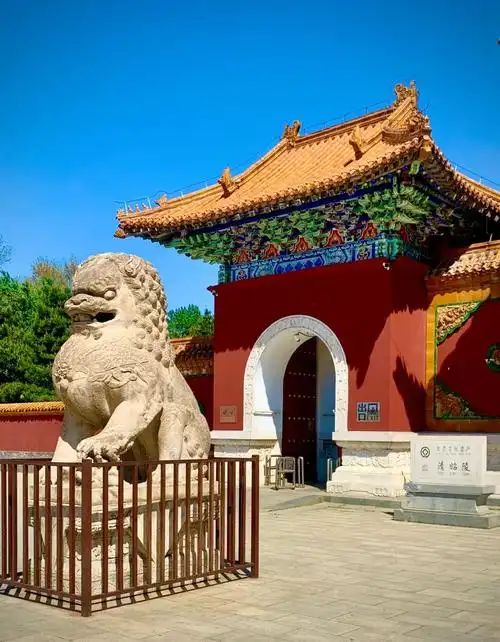
The complex follows a strict north-south axial plan stretching nearly two kilometers—remarkably similar in conception to European Baroque processional approaches at sites like the Escorial near Madrid. Visitors pass through a stone memorial archway, past stone guardian figures lining the Sacred Way, and through imposing gates into the central worship hall. The crimson walls and golden glazed-tile roofs showcase a distinctive fusion of Manchu, Han, Mongolian, and Tibetan artistic elements, with masterful stone carving that rivals the finest European Renaissance funerary sculpture.
**Cultural Significance**
As the largest and best-preserved of the three Manchu imperial tombs outside the Great Wall, Zhaoling is an irreplaceable artifact of early Qing political and religious life. The UNESCO inscription (shared with Shenyang's Imperial Palace and Fuling tomb) recognizes its role in demonstrating how the Manchu rulers synthesized multiple ethnic traditions into a unified imperial ideology—much as Charlemagne blended Frankish, Roman, and Christian cultures into the Holy Roman Empire.
**The Park Setting**
Beyond the walled mausoleum, the surrounding public park transforms the historic site into a living urban oasis. More than 2,000 century-old pines frame the red walls and golden roofs in atmospheric splendor. Seasonal highlights include spring blossoms, the August "Classical Realm Lotus Festival," autumn chrysanthemum displays, and winter snow scenes reminiscent of Chinese ink paintings.
**Practical Visit Information**
Located at 12 Taishan Road, Huanggu District, the public park is free and open daily from 5:00 AM to 9:00 PM. The mausoleum core charges 50 yuan (April 1–October 31) or 30 yuan off-season, with student and senior discounts available. Take Metro Line 2 to Beiling Park Station (Exit E) for direct access to the South Gate; buses 130, 136, and 205 also serve the area. Allow 2.5 to 3 hours for a full south-to-north exploration.
**Why Visit**
Zhaoling offers something rare: an uncrowded, atmospheric imperial tomb complex where visitors can experience authentic Qing sacred architecture without the masses found at Beijing's Forbidden City or Ming Tombs. Morning and late afternoon light beautifully illuminates the red walls, while the surrounding park provides a tranquil counterpoint to Shenyang's industrial energy—a uniquely intimate encounter with the dynasty that shaped modern China.
**Historical Context**
The Qing Zhaoling mausoleum was begun in 1643, just as Europe's Thirty Years' War was ending, for Emperor Hong Taiji—the ambitious khan who transformed his father Nurhaci's tribal confederation into the dynasty that would rule China for nearly three centuries. As the first imperial tomb built by the Manchus before they crossed the Great Wall, it predates Beijing's Ming and Qing tombs by decades. Comparable in scale to the Habsburg Imperial Crypt in Vienna or the royal burial complex at Versailles, Zhaoling represents the architectural ambitions of a dynasty at its formative peak, blending Mongol steppe traditions with Chinese imperial ritual.
**Architecture and Layout**
The complex follows a strict north-south axial plan stretching nearly two kilometers—remarkably similar in conception to European Baroque processional approaches at sites like the Escorial near Madrid. Visitors pass through a stone memorial archway, past stone guardian figures lining the Sacred Way, and through imposing gates into the central worship hall. The crimson walls and golden glazed-tile roofs showcase a distinctive fusion of Manchu, Han, Mongolian, and Tibetan artistic elements, with masterful stone carving that rivals the finest European Renaissance funerary sculpture.
**Cultural Significance**
As the largest and best-preserved of the three Manchu imperial tombs outside the Great Wall, Zhaoling is an irreplaceable artifact of early Qing political and religious life. The UNESCO inscription (shared with Shenyang's Imperial Palace and Fuling tomb) recognizes its role in demonstrating how the Manchu rulers synthesized multiple ethnic traditions into a unified imperial ideology—much as Charlemagne blended Frankish, Roman, and Christian cultures into the Holy Roman Empire.
**The Park Setting**
Beyond the walled mausoleum, the surrounding public park transforms the historic site into a living urban oasis. More than 2,000 century-old pines frame the red walls and golden roofs in atmospheric splendor. Seasonal highlights include spring blossoms, the August "Classical Realm Lotus Festival," autumn chrysanthemum displays, and winter snow scenes reminiscent of Chinese ink paintings.
**Practical Visit Information**
Located at 12 Taishan Road, Huanggu District, the public park is free and open daily from 5:00 AM to 9:00 PM. The mausoleum core charges 50 yuan (April 1–October 31) or 30 yuan off-season, with student and senior discounts available. Take Metro Line 2 to Beiling Park Station (Exit E) for direct access to the South Gate; buses 130, 136, and 205 also serve the area. Allow 2.5 to 3 hours for a full south-to-north exploration.
**Why Visit**
Zhaoling offers something rare: an uncrowded, atmospheric imperial tomb complex where visitors can experience authentic Qing sacred architecture without the masses found at Beijing's Forbidden City or Ming Tombs. Morning and late afternoon light beautifully illuminates the red walls, while the surrounding park provides a tranquil counterpoint to Shenyang's industrial energy—a uniquely intimate encounter with the dynasty that shaped modern China.