Jiangmen Binjiang Park
⭐ 3.80
Binjiang Park, Pengjiang District, Jiangmen City, Guangdong Province, China
 Jiangmen Binjiang Park was created in 1984, a decade after China's reform era began, when many riverfront cities were reclaiming their waterfronts from purely industrial use. Much like London's post-war embankment renewals or Paris's Berges de Seine transformation, the park originally doubled as flood infrastructure and public leisure space. After nearly forty years of service, the 2023 southern-section overhaul added service pavilions, smart fitness equipment, and covered exercise areas, turning a utilitarian floodway into a multifunctional civic lung. Today it anchors Jiangmen's "one river, one city" urban concept, weaving ecology, exercise, and everyday community life into a single ribbon of green.
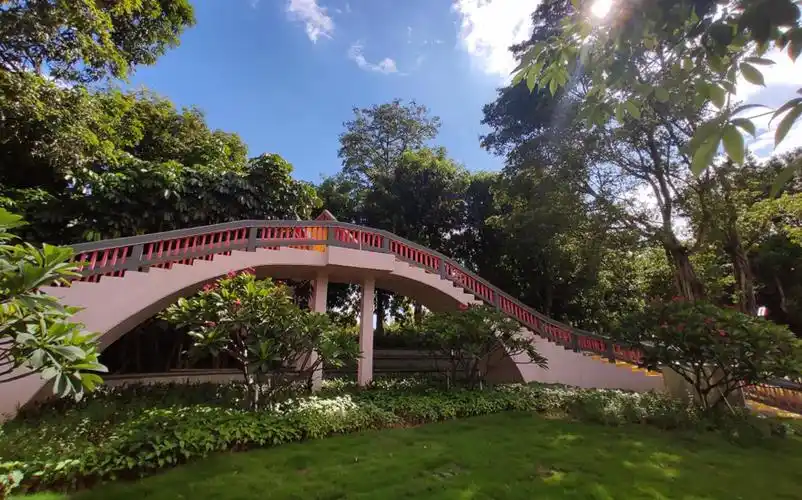
The park's defining feature is its sweeping panoramic view where the broad Xi River meets the smaller Pengjiang River, an outlook locals rank among the finest sunrise spots in the Pearl River Delta. A shaded riverside promenade links traditional pavilions such as Tengfei Pavilion, Qingtian Pavilion, and Chunguang Pavilion, while twelve charming Chinese zodiac sculptures add a playful, folk-art touch. The 2023 rainbow bridge, bold and color-saturated, now serves as the visual heart of the park, its bright span bridging the original 1984 landscape and the renovated southern zone, creating what urbanists call a "CityWalk narrative," a single stroll that reads two eras of Jiangmen's modernization.
Four functional zones structure the visitor experience: an entrance plaza for orientation, a service pavilion with restrooms and seating, a fitness zone equipped with smart, weather-protected machines, and a shaded leisure area for quiet strolls. The 1.2 km closed-loop cycling path, locally known as the Chaoren Path, along with barrier-free walking trails, weaves through all sections, creating a continuous circuit that accommodates joggers, families, cyclists, and seniors in equal measure.
Culturally, the park is more than recreation; it embodies the everyday rhythm of Jiangmen, a hometown of overseas Chinese whose diaspora shaped villages, schools, and teahouses across North America and Southeast Asia. Annual attendance exceeds 500,000, and the space functions as the city's informal living room. Visitors should note that on-site food and drink options are minimal, so bringing water is wise, though nearby old-fashioned sweet soup shops and teahouses serve Cantonese specialties like ginger milk curd and boat congee, worth a short detour.
The best times to visit are early morning, 6:00 to 8:00, for sunrise over the river, or after 5:30 pm to enjoy cooler breezes and illuminated evening views. Take any city bus to "Binjiang Station," a five-minute walk from the entrance, or drive, though only 21 parking spaces are available and weekends fill quickly. Plan two to three hours for a relaxed visit, and if time permits, extend your day with nearby Xuding Old Street and the Chen Baisha Memorial Hall to grasp the deeper cultural layers of Jiangmen's qiaoxiang, or overseas-Chinese hometown, heritage.
Jiangmen Binjiang Park was created in 1984, a decade after China's reform era began, when many riverfront cities were reclaiming their waterfronts from purely industrial use. Much like London's post-war embankment renewals or Paris's Berges de Seine transformation, the park originally doubled as flood infrastructure and public leisure space. After nearly forty years of service, the 2023 southern-section overhaul added service pavilions, smart fitness equipment, and covered exercise areas, turning a utilitarian floodway into a multifunctional civic lung. Today it anchors Jiangmen's "one river, one city" urban concept, weaving ecology, exercise, and everyday community life into a single ribbon of green.
The park's defining feature is its sweeping panoramic view where the broad Xi River meets the smaller Pengjiang River, an outlook locals rank among the finest sunrise spots in the Pearl River Delta. A shaded riverside promenade links traditional pavilions such as Tengfei Pavilion, Qingtian Pavilion, and Chunguang Pavilion, while twelve charming Chinese zodiac sculptures add a playful, folk-art touch. The 2023 rainbow bridge, bold and color-saturated, now serves as the visual heart of the park, its bright span bridging the original 1984 landscape and the renovated southern zone, creating what urbanists call a "CityWalk narrative," a single stroll that reads two eras of Jiangmen's modernization.
Four functional zones structure the visitor experience: an entrance plaza for orientation, a service pavilion with restrooms and seating, a fitness zone equipped with smart, weather-protected machines, and a shaded leisure area for quiet strolls. The 1.2 km closed-loop cycling path, locally known as the Chaoren Path, along with barrier-free walking trails, weaves through all sections, creating a continuous circuit that accommodates joggers, families, cyclists, and seniors in equal measure.
Culturally, the park is more than recreation; it embodies the everyday rhythm of Jiangmen, a hometown of overseas Chinese whose diaspora shaped villages, schools, and teahouses across North America and Southeast Asia. Annual attendance exceeds 500,000, and the space functions as the city's informal living room. Visitors should note that on-site food and drink options are minimal, so bringing water is wise, though nearby old-fashioned sweet soup shops and teahouses serve Cantonese specialties like ginger milk curd and boat congee, worth a short detour.
The best times to visit are early morning, 6:00 to 8:00, for sunrise over the river, or after 5:30 pm to enjoy cooler breezes and illuminated evening views. Take any city bus to "Binjiang Station," a five-minute walk from the entrance, or drive, though only 21 parking spaces are available and weekends fill quickly. Plan two to three hours for a relaxed visit, and if time permits, extend your day with nearby Xuding Old Street and the Chen Baisha Memorial Hall to grasp the deeper cultural layers of Jiangmen's qiaoxiang, or overseas-Chinese hometown, heritage.