Jiangmen Museum
⭐ 4.20
Jiangmen, Guangdong, China
 The Wuyi region surrounding Jiangmen has been called China's Ellis Island in reverse—a place from which millions departed rather than arrived. Comparable in scale to the Irish or Italian diasporas, the overseas Chinese from these five counties built transcontinental railways across North America, worked Borneo's tin mines and California's goldfields, and founded Chinatowns from Vancouver to Havana. Designated a national first-class museum in 2024, the Jiangmen Museum now serves as the institutional memory of this vast human movement.
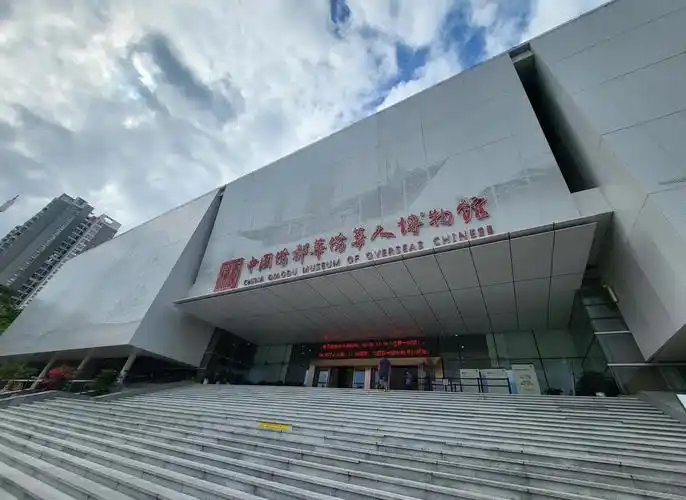
The main pavilion rises in Pengjiang District's Wuyi Overseas Chinese Plaza, its contemporary silhouette evoking a ship in full sail. The flagship "Roots in the Hometown" exhibition—winner of a national top-ten display award—unfolds through dramatic immersive tableaux: a 24-meter "voyage abroad" panorama, towering tin-mine scaffolding, and a recreated 19th-century San Francisco Chinatown storefront. Authentic artifacts, photographs, and interactive stations illuminate the migrants' contributions to railway construction, anti-Japanese resistance, and hometown philanthropy.
Beyond traditional displays, the museum embraces the digital age with VR and mixed-reality experiences, including a Victorian lantern art installation where visitors encounter mythological figures. Life-sized board-game recreations, escape-room mini-programs, and craft workshops engage families and younger visitors. Summer events like "Museum Night" and "Decoding the Qiaopi Letters" transform history into tangible adventure. The museum also administers two branches: the Ming-dynasty Chen Baisha Memorial Hall honoring the Neo-Confucian philosopher, and the Changti branch showcasing qilou arcade architecture along Jiangmen's historic waterfront.
Admission is entirely free, with no advance reservation required for individual visitors—simply present valid identification. The museum operates Tuesday through Sunday from 9:00 a.m. to 5:00 p.m., with last entry at 4:30 p.m.; it closes Mondays except during national holidays. Summer weekends often extend hours to 6:00 p.m. or later. Multilingual guided tours in Mandarin, Cantonese, English, and German are offered at no charge. Call 0750-3936219 to confirm English-language schedules—these tours are highly recommended for understanding the exhibits' full significance.
Plan at least two and a half to three hours for the main pavilion's complete route. The Changti branch, a short stroll away, offers atmospheric qilou streetscapes reminiscent of historic Penang or Singapore, while the Thirty-Three Market Street nearby serves excellent local snacks. Conclude your day at the tranquil Chen Baisha Memorial Hall for a reflective pause. Gallery air-conditioning runs cool, so bring a light jacket. Photography without flash is permitted, though touching artifacts is strictly prohibited. This museum offers an unparalleled window into one of history's greatest migrations.
The Wuyi region surrounding Jiangmen has been called China's Ellis Island in reverse—a place from which millions departed rather than arrived. Comparable in scale to the Irish or Italian diasporas, the overseas Chinese from these five counties built transcontinental railways across North America, worked Borneo's tin mines and California's goldfields, and founded Chinatowns from Vancouver to Havana. Designated a national first-class museum in 2024, the Jiangmen Museum now serves as the institutional memory of this vast human movement.
The main pavilion rises in Pengjiang District's Wuyi Overseas Chinese Plaza, its contemporary silhouette evoking a ship in full sail. The flagship "Roots in the Hometown" exhibition—winner of a national top-ten display award—unfolds through dramatic immersive tableaux: a 24-meter "voyage abroad" panorama, towering tin-mine scaffolding, and a recreated 19th-century San Francisco Chinatown storefront. Authentic artifacts, photographs, and interactive stations illuminate the migrants' contributions to railway construction, anti-Japanese resistance, and hometown philanthropy.
Beyond traditional displays, the museum embraces the digital age with VR and mixed-reality experiences, including a Victorian lantern art installation where visitors encounter mythological figures. Life-sized board-game recreations, escape-room mini-programs, and craft workshops engage families and younger visitors. Summer events like "Museum Night" and "Decoding the Qiaopi Letters" transform history into tangible adventure. The museum also administers two branches: the Ming-dynasty Chen Baisha Memorial Hall honoring the Neo-Confucian philosopher, and the Changti branch showcasing qilou arcade architecture along Jiangmen's historic waterfront.
Admission is entirely free, with no advance reservation required for individual visitors—simply present valid identification. The museum operates Tuesday through Sunday from 9:00 a.m. to 5:00 p.m., with last entry at 4:30 p.m.; it closes Mondays except during national holidays. Summer weekends often extend hours to 6:00 p.m. or later. Multilingual guided tours in Mandarin, Cantonese, English, and German are offered at no charge. Call 0750-3936219 to confirm English-language schedules—these tours are highly recommended for understanding the exhibits' full significance.
Plan at least two and a half to three hours for the main pavilion's complete route. The Changti branch, a short stroll away, offers atmospheric qilou streetscapes reminiscent of historic Penang or Singapore, while the Thirty-Three Market Street nearby serves excellent local snacks. Conclude your day at the tranquil Chen Baisha Memorial Hall for a reflective pause. Gallery air-conditioning runs cool, so bring a light jacket. Photography without flash is permitted, though touching artifacts is strictly prohibited. This museum offers an unparalleled window into one of history's greatest migrations.