Tiancheng Temple
⭐ 3.60
Tiancheng Temple, Xinhui District, Jiangmen City, Guangdong Province, China
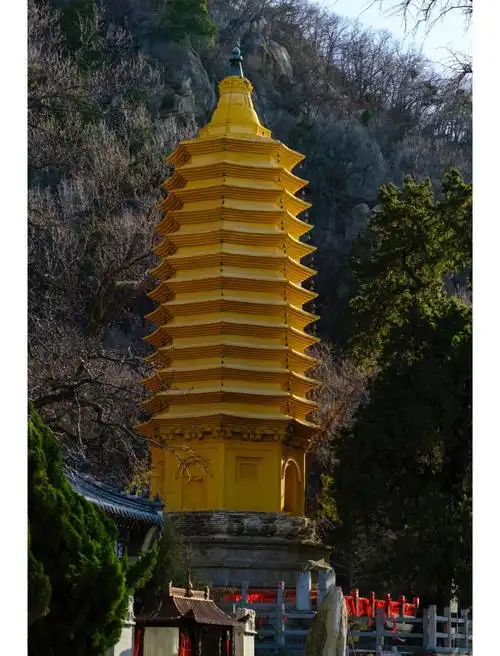 Tiancheng Temple was established during the turbulent transition between China's Southern Song and early Ming dynasties—around the same era that saw the completion of Cologne Cathedral and the late Gothic chapels of Western Europe. Its name, meaning "heaven-formed and earth-perfected," honors a legendary mountain healer who practiced medicine in seclusion. Over the centuries it has been rebuilt several times yet retains the austere elegance of Song design, making it a tangible link to a vanished religious world. Stone inscriptions from the Ming and Qing periods scattered across the surrounding cliffs further attest to the temple's role as a meeting point of Buddhist devotion and Lingnan folk belief.
The complex rises in tiered terraces up the hillside, its grey brick walls and upturned eaves echoing the restrained lyricism of Chinese monastic architecture—imagine the spatial harmony of a Benedictine abbey, translated into southern Chinese timber and tile. At the heart stands the Mahavira Hall, flanked by halls dedicated to Guanyin (the Bodhisattva of Compassion) and Dizang (the Bodhisattva of Hell-beings). The most photographed feature at the gate is a quartet of stone dragons from whose mouths springs bubble continuously, supplying fresh mountain water that visitors may collect to brew tea—a small ritual that feels centuries removed from modern China.
What truly sets Tiancheng apart is its botanical marvel: roughly forty acres of wild Hojia vines cloak the rear mountainside, forming what is considered one of the original habitats of this species in Guangdong. From late March to mid-April, the wisteria-like racemes hang in dense clusters, each curling blossom uncannily shaped like a tiny sparrow in flight. The bloom lasts only two or three weeks, drawing photographers and nature families from across the province. Even outside the flowering season, the temple grounds reward visitors with dappled shade, the constant murmur of mountain streams, and temperatures roughly five degrees cooler than the city below—comparable to retreating into a wooded Alpine valley in midsummer.
Surrounding the temple lies a network of lesser-known scenic spots: the Dragon Mouth Spring, whose clear cold waters never run dry; the jade-green Fairy Pool, wrapped in local legend; the winding Marriage Path shaded by ancient trees; and the River-view Pavilion, which gazes out across the placid waters of the Gongkeng Reservoir. Together these create a contemplative circuit that pairs naturally with a temple visit, allowing travelers to absorb the mountain atmosphere at a leisurely pace before returning to the city.
The temple welcomes visitors free of charge, typically open from 8:30 to 17:00. Driving is strongly recommended—simply navigate to "Gongkeng Temple" or "Tiancheng Temple," with parking available just outside the gate—since public buses are infrequent. Wear sturdy non-slip shoes for the sloped paths, and in summer carry mosquito repellent and plenty of water. Visitors are asked to dress modestly inside the halls, speak softly, and use only the incense provided by the temple, while refraining from pointing at statues or climbing on architectural features.
[DETAILED]
The temple welcomes visitors free of charge, typically open from 8:30 to 17:00. Driving is strongly recommended—simply navigate to "Gongkeng Temple" or "Tiancheng Temple," with parking available just outside the gate—since public buses are infrequent. Wear sturdy non-slip shoes for the sloped paths, and in summer carry mosquito repellent and plenty of water. Visitors are asked to dress modestly inside the halls, speak softly, and use only the incense provided by the temple, while refraining from pointing at statues or climbing on architectural features.
For Western travelers, Tiancheng is best approached as a half-day excursion rather than a standalone destination: pair it with a drive through the historic diaspora villages of the surrounding Kaiping countryside, whose UNESCO-listed watchtowers (diaolou) share the same late-nineteenth and early-twentieth-century context as the European colonial architecture familiar from films set in Indochina. Together they form a satisfying day of cultural contrast—ancient Buddhist retreat, rustic Lingnan scenery, and the architectural memories of Chinese emigrants who once sailed from these very hills to seek their fortunes abroad.
Tiancheng Temple was established during the turbulent transition between China's Southern Song and early Ming dynasties—around the same era that saw the completion of Cologne Cathedral and the late Gothic chapels of Western Europe. Its name, meaning "heaven-formed and earth-perfected," honors a legendary mountain healer who practiced medicine in seclusion. Over the centuries it has been rebuilt several times yet retains the austere elegance of Song design, making it a tangible link to a vanished religious world. Stone inscriptions from the Ming and Qing periods scattered across the surrounding cliffs further attest to the temple's role as a meeting point of Buddhist devotion and Lingnan folk belief.
The complex rises in tiered terraces up the hillside, its grey brick walls and upturned eaves echoing the restrained lyricism of Chinese monastic architecture—imagine the spatial harmony of a Benedictine abbey, translated into southern Chinese timber and tile. At the heart stands the Mahavira Hall, flanked by halls dedicated to Guanyin (the Bodhisattva of Compassion) and Dizang (the Bodhisattva of Hell-beings). The most photographed feature at the gate is a quartet of stone dragons from whose mouths springs bubble continuously, supplying fresh mountain water that visitors may collect to brew tea—a small ritual that feels centuries removed from modern China.
What truly sets Tiancheng apart is its botanical marvel: roughly forty acres of wild Hojia vines cloak the rear mountainside, forming what is considered one of the original habitats of this species in Guangdong. From late March to mid-April, the wisteria-like racemes hang in dense clusters, each curling blossom uncannily shaped like a tiny sparrow in flight. The bloom lasts only two or three weeks, drawing photographers and nature families from across the province. Even outside the flowering season, the temple grounds reward visitors with dappled shade, the constant murmur of mountain streams, and temperatures roughly five degrees cooler than the city below—comparable to retreating into a wooded Alpine valley in midsummer.
Surrounding the temple lies a network of lesser-known scenic spots: the Dragon Mouth Spring, whose clear cold waters never run dry; the jade-green Fairy Pool, wrapped in local legend; the winding Marriage Path shaded by ancient trees; and the River-view Pavilion, which gazes out across the placid waters of the Gongkeng Reservoir. Together these create a contemplative circuit that pairs naturally with a temple visit, allowing travelers to absorb the mountain atmosphere at a leisurely pace before returning to the city.
The temple welcomes visitors free of charge, typically open from 8:30 to 17:00. Driving is strongly recommended—simply navigate to "Gongkeng Temple" or "Tiancheng Temple," with parking available just outside the gate—since public buses are infrequent. Wear sturdy non-slip shoes for the sloped paths, and in summer carry mosquito repellent and plenty of water. Visitors are asked to dress modestly inside the halls, speak softly, and use only the incense provided by the temple, while refraining from pointing at statues or climbing on architectural features.
[DETAILED]
The temple welcomes visitors free of charge, typically open from 8:30 to 17:00. Driving is strongly recommended—simply navigate to "Gongkeng Temple" or "Tiancheng Temple," with parking available just outside the gate—since public buses are infrequent. Wear sturdy non-slip shoes for the sloped paths, and in summer carry mosquito repellent and plenty of water. Visitors are asked to dress modestly inside the halls, speak softly, and use only the incense provided by the temple, while refraining from pointing at statues or climbing on architectural features.
For Western travelers, Tiancheng is best approached as a half-day excursion rather than a standalone destination: pair it with a drive through the historic diaspora villages of the surrounding Kaiping countryside, whose UNESCO-listed watchtowers (diaolou) share the same late-nineteenth and early-twentieth-century context as the European colonial architecture familiar from films set in Indochina. Together they form a satisfying day of cultural contrast—ancient Buddhist retreat, rustic Lingnan scenery, and the architectural memories of Chinese emigrants who once sailed from these very hills to seek their fortunes abroad.