Chikan Ancient Town
⭐ 4.30
Chikan Ancient Town, Chikan Town, Jianghai District, Jiangmen City, Guangdong Province, China
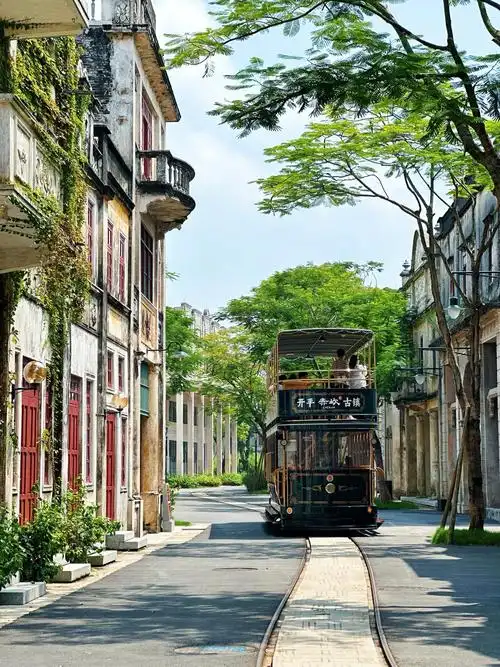 Stretching roughly three kilometres along both banks of the Tan River in Kaiping, Chikan's 600-plus qilou arcade buildings form what is arguably China's finest surviving example of overseas Chinese urban architecture. The story begins in the late Ming dynasty but truly blossomed during the 1920s and 1930s, when émigrés who had made fortunes in North America, Southeast Asia, and beyond returned home and poured capital into their ancestral villages. Their remittances—much like those that funded palazzi for Italian diaspora families or the ornate guild houses of London's Baltic merchants—created a building boom that fused European eclecticism with traditional Lingnan streetscape planning. The result is what Chinese architectural historians call a "living museum of modern Chinese architecture."
The buildings themselves are a visual feast of cross-cultural exchange. Classical Roman arcaded colonnades line the ground floors in unbroken rows, while upper storeys burst with Baroque pediments, Art Deco motifs, and Mediterranean balustrades—all married to the traditional Chinese "shop below, residence behind" layout. The scale and uniformity are reminiscent of Havana's Malecón or Marseille's Vieux-Port, yet entirely distinctive. The town has served as backdrop for celebrated films including "Let the Bullets Fly" and "The Grandmaster," cementing its cinematic allure. Two ancestral clan halls and libraries of the Situ and Guan families remain intact, bearing witness to the tightly knit clan networks that organised emigrant life—a parallel to the Scottish clan system that shaped 18th-century Highland emigration.
For Western visitors, Chikan offers rare insight into a chapter of Chinese history rarely covered in Western textbooks: the Southeast Asian and American Chinese diaspora, whose financial lifelines shaped entire regions of Guangdong. As part of the greater Wuyi (Five Counties) homeland of overseas Chinese, Chikan extends the UNESCO-listed Kaiping watchtower cultural landscape, demonstrating how emigrant wealth built not only defensive towers in the countryside but entire cosmopolitan towns at the water's edge. This is heritage rooted in mobility, money flows, and cross-cultural ambition—a story that resonates with any visitor from countries built on migration.
Today the town operates as a large-scale immersive resort, staging an ambitious programme of over a dozen daily performances. Highlights include "The Way Home," a theatrical drama about returning emigrants; "Red Wedding," a flamboyant spectacle; and the fiery "Iron Flower" show, featuring the dazzling non-heritage craft of molten metal throwing—akin to Europe's medieval fireworks traditions. Visitors ride vintage tram cars through cobbled streets, take lantern-lit sampan cruises along the river, and engage with costumed actors playing 1920s townsfolk. Hands-on workshops cover paper-cutting, Cantonese opera masks, and traditional cooking.
Practical planning is straightforward. The scenic area sits at 18 Guzhen Avenue, Chikan Town, Kaiping, Jiangmen, Guangdong, about two hours by car from Guangzhou or Shenzhen. The nearest high-speed rail stations are Kaiping South and Jiangmen. Day tickets run approximately 150 RMB, while guests at any of the 14 themed heritage hotels inside the compound enjoy complimentary entry and unlimited re-entry—a strong incentive to overnight. Most travellers should allow half a day at minimum, but a full night is highly recommended. Plan your visit from late afternoon into evening, when the arcade facades glow under floodlights and the river cruises are at their most magical. Early risers the next morning will have the three-kilometre colonnades almost entirely to themselves—a quiet, golden-hour reward few package tourists ever experience. Those with extra time should combine Chikan with a half-day excursion to the nearby Kaiping watchtowers (a separate UNESCO site) for a fuller picture of this remarkable diaspora homeland.
Stretching roughly three kilometres along both banks of the Tan River in Kaiping, Chikan's 600-plus qilou arcade buildings form what is arguably China's finest surviving example of overseas Chinese urban architecture. The story begins in the late Ming dynasty but truly blossomed during the 1920s and 1930s, when émigrés who had made fortunes in North America, Southeast Asia, and beyond returned home and poured capital into their ancestral villages. Their remittances—much like those that funded palazzi for Italian diaspora families or the ornate guild houses of London's Baltic merchants—created a building boom that fused European eclecticism with traditional Lingnan streetscape planning. The result is what Chinese architectural historians call a "living museum of modern Chinese architecture."
The buildings themselves are a visual feast of cross-cultural exchange. Classical Roman arcaded colonnades line the ground floors in unbroken rows, while upper storeys burst with Baroque pediments, Art Deco motifs, and Mediterranean balustrades—all married to the traditional Chinese "shop below, residence behind" layout. The scale and uniformity are reminiscent of Havana's Malecón or Marseille's Vieux-Port, yet entirely distinctive. The town has served as backdrop for celebrated films including "Let the Bullets Fly" and "The Grandmaster," cementing its cinematic allure. Two ancestral clan halls and libraries of the Situ and Guan families remain intact, bearing witness to the tightly knit clan networks that organised emigrant life—a parallel to the Scottish clan system that shaped 18th-century Highland emigration.
For Western visitors, Chikan offers rare insight into a chapter of Chinese history rarely covered in Western textbooks: the Southeast Asian and American Chinese diaspora, whose financial lifelines shaped entire regions of Guangdong. As part of the greater Wuyi (Five Counties) homeland of overseas Chinese, Chikan extends the UNESCO-listed Kaiping watchtower cultural landscape, demonstrating how emigrant wealth built not only defensive towers in the countryside but entire cosmopolitan towns at the water's edge. This is heritage rooted in mobility, money flows, and cross-cultural ambition—a story that resonates with any visitor from countries built on migration.
Today the town operates as a large-scale immersive resort, staging an ambitious programme of over a dozen daily performances. Highlights include "The Way Home," a theatrical drama about returning emigrants; "Red Wedding," a flamboyant spectacle; and the fiery "Iron Flower" show, featuring the dazzling non-heritage craft of molten metal throwing—akin to Europe's medieval fireworks traditions. Visitors ride vintage tram cars through cobbled streets, take lantern-lit sampan cruises along the river, and engage with costumed actors playing 1920s townsfolk. Hands-on workshops cover paper-cutting, Cantonese opera masks, and traditional cooking.
Practical planning is straightforward. The scenic area sits at 18 Guzhen Avenue, Chikan Town, Kaiping, Jiangmen, Guangdong, about two hours by car from Guangzhou or Shenzhen. The nearest high-speed rail stations are Kaiping South and Jiangmen. Day tickets run approximately 150 RMB, while guests at any of the 14 themed heritage hotels inside the compound enjoy complimentary entry and unlimited re-entry—a strong incentive to overnight. Most travellers should allow half a day at minimum, but a full night is highly recommended. Plan your visit from late afternoon into evening, when the arcade facades glow under floodlights and the river cruises are at their most magical. Early risers the next morning will have the three-kilometre colonnades almost entirely to themselves—a quiet, golden-hour reward few package tourists ever experience. Those with extra time should combine Chikan with a half-day excursion to the nearby Kaiping watchtowers (a separate UNESCO site) for a fuller picture of this remarkable diaspora homeland.