Kaiping Watchtowers and Villages
⭐ 4.20
Majianglong Watchtower Group and Zili Village Watchtower Group, Kaiping City, Jiangmen City, Guangdong Province, China
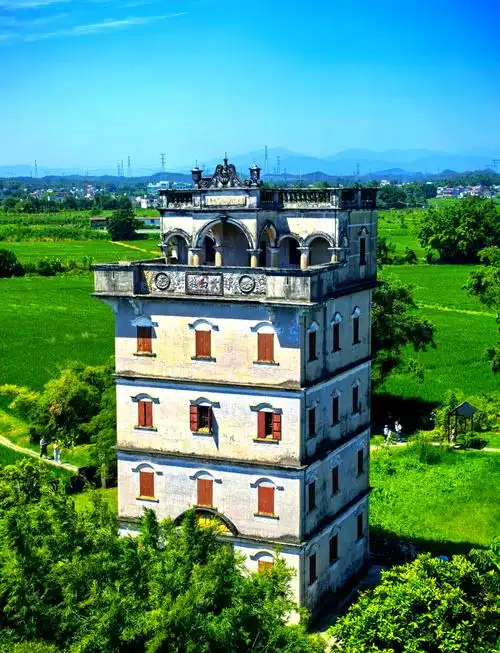 Rising during the late Qing and early Republican eras, these fortified towers were funded by overseas Chinese returning from North America and Southeast Asia. The region suffered chronic flooding from the Tan River and frequent bandit raids, prompting emigrant families to build defensive homesteads that also displayed their hard-won prosperity. Like the merchant palazzi of Renaissance Florence, the structures expressed civic pride and family ambition, yet they told a uniquely Chinese story of "fallen leaves returning to their roots"—a diaspora narrative echoing the Italian, Irish, and Jewish emigrations that reshaped the modern Atlantic world.
Functionally classified as communal defense towers (zhonglou), family residences (julou), and watchtowers (genglou), the diaolou boast reinforced walls up to a meter thick, gun slits, and comfortable living quarters. Their stylistic vocabulary is audacious: Greek temple fronts, Roman round arches, Gothic lancet windows, Baroque flourishes, and Chinese auspicious symbols coexist on a single facade. The tallest, Ruishi Lou, rises nine stories to 25 meters—comparable to a small medieval European keep. No two towers repeat, making the ensemble a one-of-a-kind architectural dialogue spanning continents.
As Guangdong Province's sole UNESCO World Heritage site, Kaiping diaolou preserve the material memory of millions of overseas Chinese who channeled remittances home. The towers embody a living dialogue between civilizations—not imitation, but creative synthesis. Zili Village's Mingshi Lou gained cinematic fame through the 2010 film "Let Bullets Fly" and still houses century-old furniture alongside early indoor plumbing. Walking through these interiors offers a tangible connection to the dreams of emigrants who crossed oceans yet yearned for their ancestral soil.
Tickets are sold per site: Zili, Li Garden, and Majianglong each cost around 50–60 RMB, with a three-site combo ticket at approximately 175 RMB, valid for three days. Opening hours typically run 08:30–17:30, sometimes extended in summer. Bring your passport—ID verification is required for entry. Sites lie 20–30 minutes apart by car, and public transit is infrequent; renting a vehicle or hiring a driver is strongly recommended. Only exterior viewing is free; ascending the towers requires a ticket.
Begin at Zili Village in morning light when the rice paddies glow and reflections frame the towers—prime photography conditions. After lunch, explore Li Garden's elegant overseas Chinese landscaping, then wander Majianglong's bamboo-shaded lanes. Early morning (8:30–10:30) and late afternoon (after 16:00) offer softer light and thinner crowds. Always step inside the towers; the interior craftsmanship—imported tiles, European chandeliers, ancestral altars—is where the East-West story truly comes alive. Wear flat, grippy shoes and pack sun protection and insect repellent.
Rising during the late Qing and early Republican eras, these fortified towers were funded by overseas Chinese returning from North America and Southeast Asia. The region suffered chronic flooding from the Tan River and frequent bandit raids, prompting emigrant families to build defensive homesteads that also displayed their hard-won prosperity. Like the merchant palazzi of Renaissance Florence, the structures expressed civic pride and family ambition, yet they told a uniquely Chinese story of "fallen leaves returning to their roots"—a diaspora narrative echoing the Italian, Irish, and Jewish emigrations that reshaped the modern Atlantic world.
Functionally classified as communal defense towers (zhonglou), family residences (julou), and watchtowers (genglou), the diaolou boast reinforced walls up to a meter thick, gun slits, and comfortable living quarters. Their stylistic vocabulary is audacious: Greek temple fronts, Roman round arches, Gothic lancet windows, Baroque flourishes, and Chinese auspicious symbols coexist on a single facade. The tallest, Ruishi Lou, rises nine stories to 25 meters—comparable to a small medieval European keep. No two towers repeat, making the ensemble a one-of-a-kind architectural dialogue spanning continents.
As Guangdong Province's sole UNESCO World Heritage site, Kaiping diaolou preserve the material memory of millions of overseas Chinese who channeled remittances home. The towers embody a living dialogue between civilizations—not imitation, but creative synthesis. Zili Village's Mingshi Lou gained cinematic fame through the 2010 film "Let Bullets Fly" and still houses century-old furniture alongside early indoor plumbing. Walking through these interiors offers a tangible connection to the dreams of emigrants who crossed oceans yet yearned for their ancestral soil.
Tickets are sold per site: Zili, Li Garden, and Majianglong each cost around 50–60 RMB, with a three-site combo ticket at approximately 175 RMB, valid for three days. Opening hours typically run 08:30–17:30, sometimes extended in summer. Bring your passport—ID verification is required for entry. Sites lie 20–30 minutes apart by car, and public transit is infrequent; renting a vehicle or hiring a driver is strongly recommended. Only exterior viewing is free; ascending the towers requires a ticket.
Begin at Zili Village in morning light when the rice paddies glow and reflections frame the towers—prime photography conditions. After lunch, explore Li Garden's elegant overseas Chinese landscaping, then wander Majianglong's bamboo-shaded lanes. Early morning (8:30–10:30) and late afternoon (after 16:00) offer softer light and thinner crowds. Always step inside the towers; the interior craftsmanship—imported tiles, European chandeliers, ancestral altars—is where the East-West story truly comes alive. Wear flat, grippy shoes and pack sun protection and insect repellent.