Shantou Museum
⭐ 4.20
No. 13, Zhongshan Road, Longhu District, Shantou, Guangdong Province, China
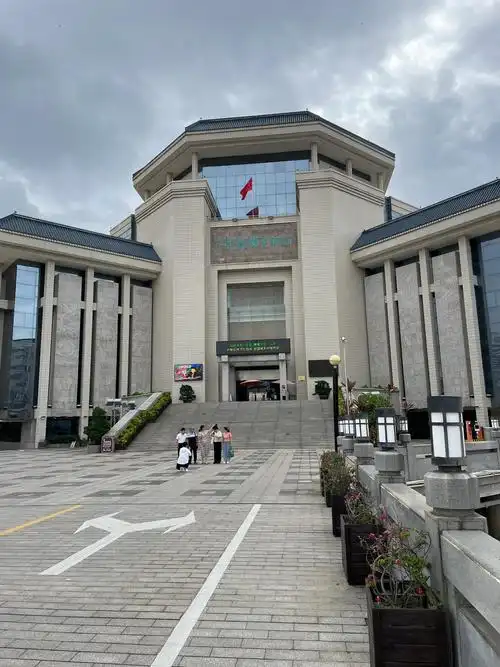 The museum sits in Jinping District at the edge of Zhongshan Park, but the building itself is a quiet marvel: it was China's first public structure built with base rubber isolation technology, the same engineering principle used in Japan's earthquake-resistant towers and California's seismic retrofits. Completed in 2020, the 8,000-square-meter facility houses over 13,000 catalogued items, of which roughly 3,000 qualify as nationally significant treasures. Think of it as a regional answer to Marseille's Musée d'Histoire or Liverpool's Maritime Museum—smaller in scale, yet intimate in scope and rich in narrative.
The third-floor "South Sea Treasures" gallery is the centerpiece, showcasing more than 27,000 artifacts raised from the Nanao No.1, a Ming-era vessel that sank while carrying export porcelain to markets as distant as the Ottoman Empire and Renaissance Europe. These blue-and-white wares predate and parallel the famous Delftware and Meissen production of the West. The fourth-floor "Treasures of Eastern Guangdong" gallery turns to land-based traditions, where intricate gilded woodcarving—often compared to the gilded altarpieces of Bavaria or the woodwork of Vienna's Baroque churches—reveals the heights of Chaoshan craftsmanship alongside ceramics, jade, and classical calligraphy.
A third permanent exhibition, "Rivers Flow to the Sea," traces Shantou's evolution from prehistoric settlement to treaty-port cosmopolitan hub, highlighting the fusion of local "Chaoshang" merchant culture with the legacy of the overseas Teochew diaspora. Particularly fascinating for Western visitors is "Qiaoyin Through Four Seas," eastern Guangdong's first dedicated banking hall, where bundles of qiaopi—overseas remittance letters—chart the informal financial networks that, like the hawala system of South Asia or early Jewish immigrant banks in London, sustained migrant communities across oceans in the 19th and 20th centuries.
The museum is air-conditioned, professionally curated, and refreshingly uncrowded—an ideal refuge during Guangdong's humid summers. Note that there are few hands-on interactive zones; this is a contemplative space suited to adult learners, families with older children, and photography enthusiasts rather than young kids seeking play areas. Free guided tours are available at scheduled times and genuinely enhance the experience, especially for those unfamiliar with Chinese material culture.
Entry is free but requires advance reservation through the museum's WeChat official account—a small hurdle for non-Chinese-speakers that a hotel concierge can easily overcome. Opening hours run Tuesday through Sunday, 9:00 to 17:00, with last admission at 16:30; the museum closes on Mondays except during national holidays. Plan two to three hours for a thorough visit. Step outside and you are immediately in leafy Zhongshan Park, while a 1.5-kilometer walk south leads to the historic "Small Park" opening district and its companion Shantou Opening Culture Hall, together forming a complete narrative loop through the city's mercantile past.
The museum sits in Jinping District at the edge of Zhongshan Park, but the building itself is a quiet marvel: it was China's first public structure built with base rubber isolation technology, the same engineering principle used in Japan's earthquake-resistant towers and California's seismic retrofits. Completed in 2020, the 8,000-square-meter facility houses over 13,000 catalogued items, of which roughly 3,000 qualify as nationally significant treasures. Think of it as a regional answer to Marseille's Musée d'Histoire or Liverpool's Maritime Museum—smaller in scale, yet intimate in scope and rich in narrative.
The third-floor "South Sea Treasures" gallery is the centerpiece, showcasing more than 27,000 artifacts raised from the Nanao No.1, a Ming-era vessel that sank while carrying export porcelain to markets as distant as the Ottoman Empire and Renaissance Europe. These blue-and-white wares predate and parallel the famous Delftware and Meissen production of the West. The fourth-floor "Treasures of Eastern Guangdong" gallery turns to land-based traditions, where intricate gilded woodcarving—often compared to the gilded altarpieces of Bavaria or the woodwork of Vienna's Baroque churches—reveals the heights of Chaoshan craftsmanship alongside ceramics, jade, and classical calligraphy.
A third permanent exhibition, "Rivers Flow to the Sea," traces Shantou's evolution from prehistoric settlement to treaty-port cosmopolitan hub, highlighting the fusion of local "Chaoshang" merchant culture with the legacy of the overseas Teochew diaspora. Particularly fascinating for Western visitors is "Qiaoyin Through Four Seas," eastern Guangdong's first dedicated banking hall, where bundles of qiaopi—overseas remittance letters—chart the informal financial networks that, like the hawala system of South Asia or early Jewish immigrant banks in London, sustained migrant communities across oceans in the 19th and 20th centuries.
The museum is air-conditioned, professionally curated, and refreshingly uncrowded—an ideal refuge during Guangdong's humid summers. Note that there are few hands-on interactive zones; this is a contemplative space suited to adult learners, families with older children, and photography enthusiasts rather than young kids seeking play areas. Free guided tours are available at scheduled times and genuinely enhance the experience, especially for those unfamiliar with Chinese material culture.
Entry is free but requires advance reservation through the museum's WeChat official account—a small hurdle for non-Chinese-speakers that a hotel concierge can easily overcome. Opening hours run Tuesday through Sunday, 9:00 to 17:00, with last admission at 16:30; the museum closes on Mondays except during national holidays. Plan two to three hours for a thorough visit. Step outside and you are immediately in leafy Zhongshan Park, while a 1.5-kilometer walk south leads to the historic "Small Park" opening district and its companion Shantou Opening Culture Hall, together forming a complete narrative loop through the city's mercantile past.