Chaoyang Miancheng Historical Sites
⭐ 3.60
Miancheng Town, Chaoyang District, Shantou City, Guangdong Province, China
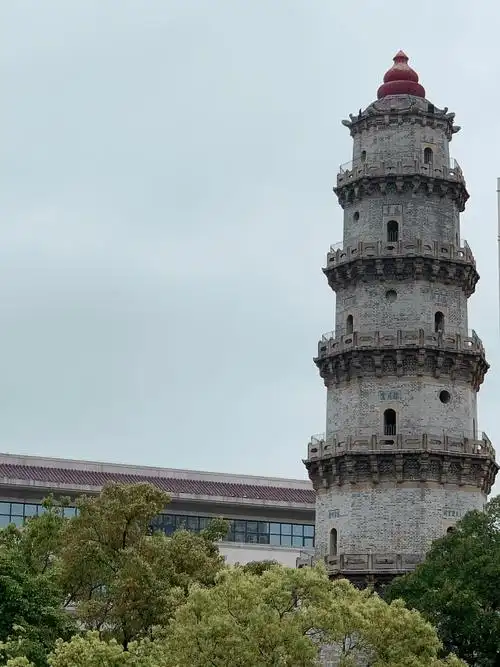 Wenguang Pagoda stands as the spiritual center of the route and one of southern China's most graceful Song-dynasty towers, begun in 1131 CE when the Southern Song court was still regrouping after losing the north. Rising 42.6 meters in an octagonal, seven-story brick-and-stone format, its silhouette recalls Italy's medieval campanile while blending Confucian, Buddhist, and Daoist symbolism under one roof—a syncretism rare even by Chinese standards. Visitors cannot climb it, but circling its base within Wenguang Park reveals carved stone lions, ancient stone wells, and weathered Buddhist reliefs hinting at the original monastery that once surrounded it.
Chaoyang Museum sits a short walk from the pagoda and serves as the ideal primer for the tour, displaying nationally registered relics alongside traditional Chaoshan crafts such as the famous Yingge folk dance costumes and intricate paper-cut art. The modern galleries offer a clear chronological grounding that makes the subsequent ancient sites far more legible to first-time visitors—much as a regional museum in Bath or Avignon helps contextualize a city's Roman remnants. Its clean, climate-controlled interior also provides welcome respite during Shantou's notoriously humid summers.
A gentle twenty-minute climb up the southern slopes of Dongshan brings you to the Dongyan cliff-inscription complex, where more than fifty stone carvings span from Tang dynasty to modern times. The spiritual heart is Zhuoxi Temple, said to have been founded in 792 CE by the great Chan (Zen) master Zhongdian during his southern preaching tours. Calligraphy enthusiasts will want extra time here, as the inscriptions blend Buddhist gathas with Confucian classical lines—an outdoor epigraphic library comparable to the famed Yungang and Longmen grottoes, though on an intimate, hikeable scale.
West of town, Xiyan represents one of the oldest Buddhist foundations in the entire Chaoshan region, traditionally dated to the Jin dynasty (roughly contemporary with early Anglo-Saxon England). Set among weathered granite outcrops on Mount Ta, the site features a natural-stone main hall, the poetically named "Questioning Tide Spring," and a thousand-year-old scholar tree whose gnarled branches frame Ming-dynasty calligraphy. It rewards unhurried exploration and pairs especially well with a quiet cup of local gongfu tea at the footpath's end.
Concluding the loop, Xi Yuan is a late-Qing private garden completed in 1898, a year that places its creation squarely alongside the dawn of European Art Nouveau. Declared a provincial heritage site, it represents the "East-meets-West" Lingnan garden style—marrying Suzhou-style rockeries with European-influenced follies such as its celebrated "Crystal Palace" pavilion. Following a major 2022 restoration, its winding shell-paved paths and lotus ponds look their best in the late-afternoon golden hour, when photographers will find their favorite compositions around every zigzag bridge.
Practical planning: allow half a day minimum, a full day for unhurried exploration, following the route Pagoda → Museum → Dongyan → Xi Yuan → Xiyan. Wear sturdy, non-slip footwear—slopes at Dongyan can be slick after rain—and visit in early morning or late afternoon to avoid the subtropical midday heat between May and September. Several interpretation panels are sparse, so downloading offline heritage resources beforehand is wise. Between monuments, slip into the old lanes west of the pagoda to sample local Chaoshan specialties: crisp lao bing tarts, dry wheat noodles, and sizzling oyster omelets (hoa jiao), washed down with cold herbal grass jelly.
Wenguang Pagoda stands as the spiritual center of the route and one of southern China's most graceful Song-dynasty towers, begun in 1131 CE when the Southern Song court was still regrouping after losing the north. Rising 42.6 meters in an octagonal, seven-story brick-and-stone format, its silhouette recalls Italy's medieval campanile while blending Confucian, Buddhist, and Daoist symbolism under one roof—a syncretism rare even by Chinese standards. Visitors cannot climb it, but circling its base within Wenguang Park reveals carved stone lions, ancient stone wells, and weathered Buddhist reliefs hinting at the original monastery that once surrounded it.
Chaoyang Museum sits a short walk from the pagoda and serves as the ideal primer for the tour, displaying nationally registered relics alongside traditional Chaoshan crafts such as the famous Yingge folk dance costumes and intricate paper-cut art. The modern galleries offer a clear chronological grounding that makes the subsequent ancient sites far more legible to first-time visitors—much as a regional museum in Bath or Avignon helps contextualize a city's Roman remnants. Its clean, climate-controlled interior also provides welcome respite during Shantou's notoriously humid summers.
A gentle twenty-minute climb up the southern slopes of Dongshan brings you to the Dongyan cliff-inscription complex, where more than fifty stone carvings span from Tang dynasty to modern times. The spiritual heart is Zhuoxi Temple, said to have been founded in 792 CE by the great Chan (Zen) master Zhongdian during his southern preaching tours. Calligraphy enthusiasts will want extra time here, as the inscriptions blend Buddhist gathas with Confucian classical lines—an outdoor epigraphic library comparable to the famed Yungang and Longmen grottoes, though on an intimate, hikeable scale.
West of town, Xiyan represents one of the oldest Buddhist foundations in the entire Chaoshan region, traditionally dated to the Jin dynasty (roughly contemporary with early Anglo-Saxon England). Set among weathered granite outcrops on Mount Ta, the site features a natural-stone main hall, the poetically named "Questioning Tide Spring," and a thousand-year-old scholar tree whose gnarled branches frame Ming-dynasty calligraphy. It rewards unhurried exploration and pairs especially well with a quiet cup of local gongfu tea at the footpath's end.
Concluding the loop, Xi Yuan is a late-Qing private garden completed in 1898, a year that places its creation squarely alongside the dawn of European Art Nouveau. Declared a provincial heritage site, it represents the "East-meets-West" Lingnan garden style—marrying Suzhou-style rockeries with European-influenced follies such as its celebrated "Crystal Palace" pavilion. Following a major 2022 restoration, its winding shell-paved paths and lotus ponds look their best in the late-afternoon golden hour, when photographers will find their favorite compositions around every zigzag bridge.
Practical planning: allow half a day minimum, a full day for unhurried exploration, following the route Pagoda → Museum → Dongyan → Xi Yuan → Xiyan. Wear sturdy, non-slip footwear—slopes at Dongyan can be slick after rain—and visit in early morning or late afternoon to avoid the subtropical midday heat between May and September. Several interpretation panels are sparse, so downloading offline heritage resources beforehand is wise. Between monuments, slip into the old lanes west of the pagoda to sample local Chaoshan specialties: crisp lao bing tarts, dry wheat noodles, and sizzling oyster omelets (hoa jiao), washed down with cold herbal grass jelly.