Shantou Bay Bridge
⭐ 3.50
Shantou Bay Bridge, Longhu District, Shantou, Guangdong, China
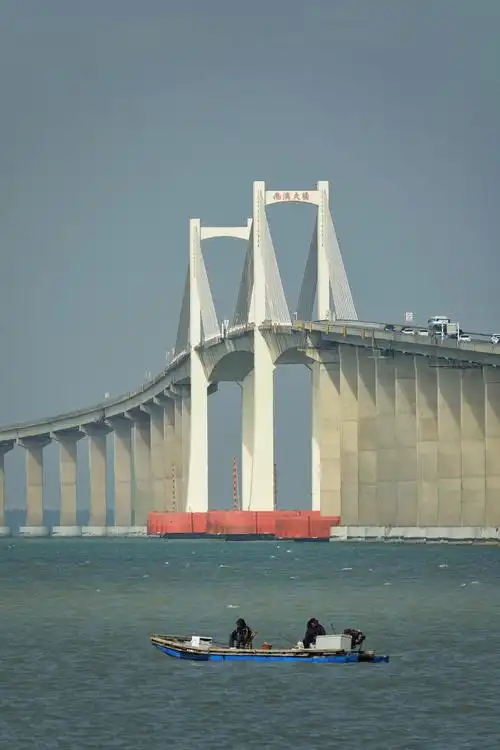 The Shantou Bay Bridge was a milestone in modern Chinese engineering when it opened in 1995. As the country's first large-span suspension bridge, it arrived just over half a century after Joseph Strauss's Golden Gate Bridge (1937) reshaped San Francisco, and roughly three decades after the Bosphorus Bridge (1973) first linked Europe and Asia across Istanbul. Its completion ended centuries of ferry dependence between Shantou's two harbour shores, welding the Longhu and Haojiang districts into a single economic unit and unlocking trade across eastern Guangdong.
Architecturally, the bridge follows the classic suspension typology refined in twentieth-century Europe and America: two slender pylons, sweeping main cables, and a streamlined deck. The 452-metre main span and 961.8-metre approach crossing rise 46 metres above the waterline, leaving ample clearance for cargo vessels bound for the port. A six-lane carriageway carries traffic at 60 km/h, and the clean geometric silhouette reads powerfully against the South China Sea horizon.
Beyond its engineering credentials, the bridge carries strong cultural weight. It embodies the reform-era spirit of "daring to be first" that defined Shantou, one of the original four Special Economic Zones opened in 1981. Locals see its graceful arc as a metaphor for the city's leap from a treaty-port trading hub into a modern coastal metropolis, and it appears almost ubiquitously in tourism imagery of the region.
Because the deck is a closed expressway, pedestrians cannot walk across, and climbing the structure is both forbidden and dangerous. Light vehicles pay a modest toll of around 10–15 yuan one way, waived on major Chinese holidays. The best vantage points lie outside the bridge: Mayu Island directly beneath the eastern pylon, Shantou Bay Park along the inner harbour, and the elevated Nanbin Road promenade, all of which are free and open daily.
A suggested half-day itinerary weaves the bridge into the "Inner Bay Circuit": drive across in the early afternoon, descend to Mayu Island for two or three hours of fishing-village lanes, street murals, and a Mazu temple visit, then return to Bay Park for sunset photography. When the cables light up at dusk, the span truly earns its "rainbow" nickname, making this one of the most rewarding modern landmarks along China's southeastern coast.
The Shantou Bay Bridge was a milestone in modern Chinese engineering when it opened in 1995. As the country's first large-span suspension bridge, it arrived just over half a century after Joseph Strauss's Golden Gate Bridge (1937) reshaped San Francisco, and roughly three decades after the Bosphorus Bridge (1973) first linked Europe and Asia across Istanbul. Its completion ended centuries of ferry dependence between Shantou's two harbour shores, welding the Longhu and Haojiang districts into a single economic unit and unlocking trade across eastern Guangdong.
Architecturally, the bridge follows the classic suspension typology refined in twentieth-century Europe and America: two slender pylons, sweeping main cables, and a streamlined deck. The 452-metre main span and 961.8-metre approach crossing rise 46 metres above the waterline, leaving ample clearance for cargo vessels bound for the port. A six-lane carriageway carries traffic at 60 km/h, and the clean geometric silhouette reads powerfully against the South China Sea horizon.
Beyond its engineering credentials, the bridge carries strong cultural weight. It embodies the reform-era spirit of "daring to be first" that defined Shantou, one of the original four Special Economic Zones opened in 1981. Locals see its graceful arc as a metaphor for the city's leap from a treaty-port trading hub into a modern coastal metropolis, and it appears almost ubiquitously in tourism imagery of the region.
Because the deck is a closed expressway, pedestrians cannot walk across, and climbing the structure is both forbidden and dangerous. Light vehicles pay a modest toll of around 10–15 yuan one way, waived on major Chinese holidays. The best vantage points lie outside the bridge: Mayu Island directly beneath the eastern pylon, Shantou Bay Park along the inner harbour, and the elevated Nanbin Road promenade, all of which are free and open daily.
A suggested half-day itinerary weaves the bridge into the "Inner Bay Circuit": drive across in the early afternoon, descend to Mayu Island for two or three hours of fishing-village lanes, street murals, and a Mazu temple visit, then return to Bay Park for sunset photography. When the cables light up at dusk, the span truly earns its "rainbow" nickname, making this one of the most rewarding modern landmarks along China's southeastern coast.