Lingshan Temple
⭐ 3.60
Lingshan Temple, Chaoyang District, Shantou City, Guangdong Province, China
 **Historical Context**
Lingshan Temple was established in 791 CE during the Tang Dynasty's Zhenyuan era—placing its founding around the same time as Charlemagne's imperial coronation in the West. Its founder, Chan master Dadian, was one of southern China's most influential monks, and in 822 CE the imperial court bestowed the title "Spirit Mountain Temple Protecting the Nation." The temple's most celebrated chapter unfolded in 819 CE, when Han Yu—often called the Dante of Chinese letters for his moral authority—arrived in Chaozhou as a demoted prefect. He spent several days in philosophical discussion with Dadian before departing, famously leaving behind a personal robe. This "Han Yu's Robe" anecdote endures as one of Chinese history's most powerful symbols of Confucian-Buddhist friendship, and in 1983 the temple was recognized as a national key Buddhist monastery.
**Architecture and Layout**
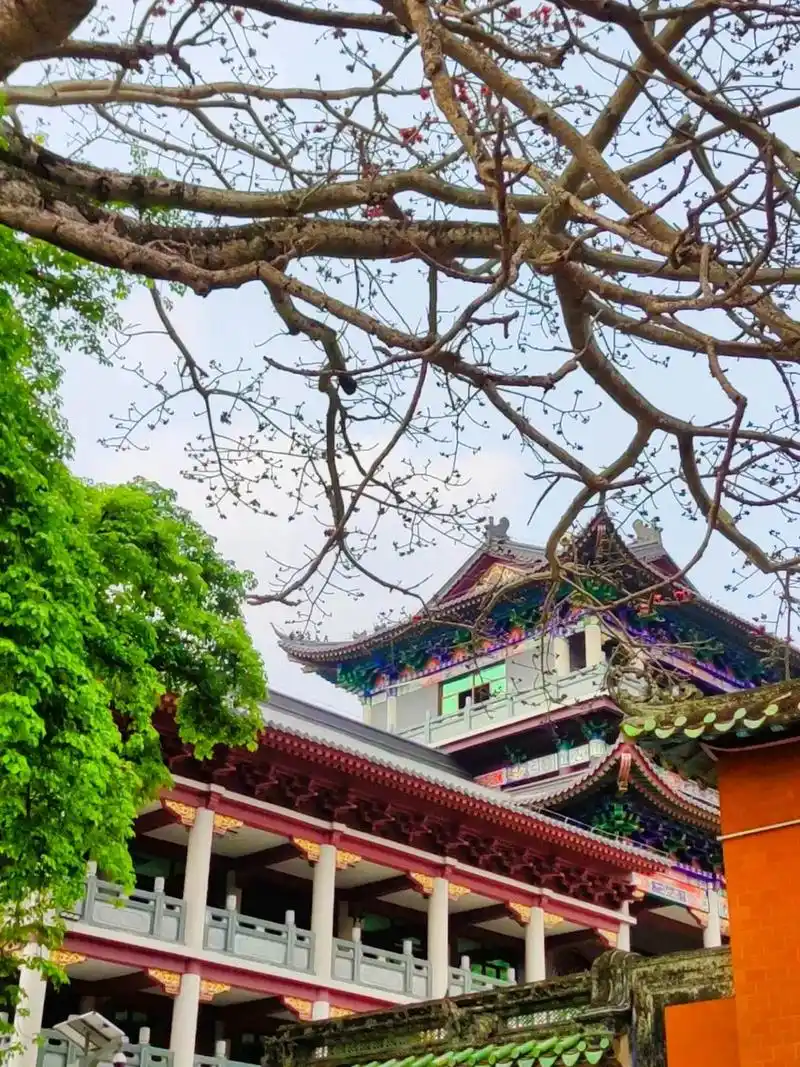
Spanning more than 30,000 square meters, Lingshan follows a classical plan of three main halls flanked by six courtyards and nine light wells—a layout that recalls how medieval European abbeys organized processional space, though scaled more like an intimate Romanesque monastery than a soaring Gothic cathedral. The central axis passes through the Mountain Gate, Guanyin Hall, and Great Hero Hall, with the Founders' Hall and Tripitaka Library extending to either side. Timber-frame construction, weathered grey tiles, 83 acres of surrounding fruit orchards, and a mountain-backed lake setting create a contemplative atmosphere that photographers find irresistible at dawn, when the soft golden light filters through the courtyards.
**Cultural and Religious Significance**
The temple's most treasured artifact is the Tongue Mirror Pagoda, erected in 824 CE the year of Dadian's death. Standing 2.8 meters tall and carved from local granite in a distinctive bell shape, it commemorates the legend that the master's tongue remained miraculously intact after cremation, "shining like a mirror." It is the oldest complete Tang Dynasty stone tower-tomb in eastern Guangdong and was inscribed on China's national protected relics list in 2019. Equally moving is the Robe-Leaving Pavilion, built to honor Han Yu's parting gift. The grounds also contain the celebrated "Eight Scenes of Lingshan," including a Sutra-Writing Platform, a Kangxi-era imperial orchid planted by the Qing emperor himself, and a working Tang Dynasty well.
**Practical Visit Information**
The temple is free to enter with no advance booking required; daily opening hours generally run from around 5:00 to 19:30, though exact times vary by season. It lies roughly 25 kilometers from Chaoyang city—a 40-minute taxi or self-drive ride to the free parking area beside the gate. Budget travelers can take bus 307 or 311 to the Lingshan Temple stop and walk the final stretch. Allow 90 minutes to two hours for a relaxed visit. English signage is essentially absent throughout the complex, so a translation app, phrasebook, or Chinese-speaking guide is strongly recommended for international visitors.
**Etiquette and Why Visit**
Modest dress is essential—shoulders and knees covered—out of respect for the resident monks. Avoid stepping on door thresholds, pointing at Buddha statues, or speaking loudly inside the halls; certain sacred areas prohibit photography, so always check for posted signs. The early morning hours between 5:00 and 9:00 AM offer the softest light and quietest ambience, ideal for contemplation. Few dining options exist nearby, so carry water. For travelers tracing Chan Buddhism's spread or the cosmopolitan Tang era, Lingshan rewards those who detour from Shantou with quiet authenticity, ancient stone, a thousand-year-old orchard, and one of the most poignant stories of inter-religious friendship in Chinese history.
**Historical Context**
Lingshan Temple was established in 791 CE during the Tang Dynasty's Zhenyuan era—placing its founding around the same time as Charlemagne's imperial coronation in the West. Its founder, Chan master Dadian, was one of southern China's most influential monks, and in 822 CE the imperial court bestowed the title "Spirit Mountain Temple Protecting the Nation." The temple's most celebrated chapter unfolded in 819 CE, when Han Yu—often called the Dante of Chinese letters for his moral authority—arrived in Chaozhou as a demoted prefect. He spent several days in philosophical discussion with Dadian before departing, famously leaving behind a personal robe. This "Han Yu's Robe" anecdote endures as one of Chinese history's most powerful symbols of Confucian-Buddhist friendship, and in 1983 the temple was recognized as a national key Buddhist monastery.
**Architecture and Layout**
Spanning more than 30,000 square meters, Lingshan follows a classical plan of three main halls flanked by six courtyards and nine light wells—a layout that recalls how medieval European abbeys organized processional space, though scaled more like an intimate Romanesque monastery than a soaring Gothic cathedral. The central axis passes through the Mountain Gate, Guanyin Hall, and Great Hero Hall, with the Founders' Hall and Tripitaka Library extending to either side. Timber-frame construction, weathered grey tiles, 83 acres of surrounding fruit orchards, and a mountain-backed lake setting create a contemplative atmosphere that photographers find irresistible at dawn, when the soft golden light filters through the courtyards.
**Cultural and Religious Significance**
The temple's most treasured artifact is the Tongue Mirror Pagoda, erected in 824 CE the year of Dadian's death. Standing 2.8 meters tall and carved from local granite in a distinctive bell shape, it commemorates the legend that the master's tongue remained miraculously intact after cremation, "shining like a mirror." It is the oldest complete Tang Dynasty stone tower-tomb in eastern Guangdong and was inscribed on China's national protected relics list in 2019. Equally moving is the Robe-Leaving Pavilion, built to honor Han Yu's parting gift. The grounds also contain the celebrated "Eight Scenes of Lingshan," including a Sutra-Writing Platform, a Kangxi-era imperial orchid planted by the Qing emperor himself, and a working Tang Dynasty well.
**Practical Visit Information**
The temple is free to enter with no advance booking required; daily opening hours generally run from around 5:00 to 19:30, though exact times vary by season. It lies roughly 25 kilometers from Chaoyang city—a 40-minute taxi or self-drive ride to the free parking area beside the gate. Budget travelers can take bus 307 or 311 to the Lingshan Temple stop and walk the final stretch. Allow 90 minutes to two hours for a relaxed visit. English signage is essentially absent throughout the complex, so a translation app, phrasebook, or Chinese-speaking guide is strongly recommended for international visitors.
**Etiquette and Why Visit**
Modest dress is essential—shoulders and knees covered—out of respect for the resident monks. Avoid stepping on door thresholds, pointing at Buddha statues, or speaking loudly inside the halls; certain sacred areas prohibit photography, so always check for posted signs. The early morning hours between 5:00 and 9:00 AM offer the softest light and quietest ambience, ideal for contemplation. Few dining options exist nearby, so carry water. For travelers tracing Chan Buddhism's spread or the cosmopolitan Tang era, Lingshan rewards those who detour from Shantou with quiet authenticity, ancient stone, a thousand-year-old orchard, and one of the most poignant stories of inter-religious friendship in Chinese history.